



Should you share that health-related Instagram post? Catherine McQueen/Moment via Getty Images
In today’s digital world, people routinely turn to the internet for health or medical information. In addition to actively searching online, they often come across health-related information on social media or receive it through emails or messages from family or friends.
It can be tempting to share such messages with loved ones – often with the best of intentions.
As a global health communication scholar studying the effects of media on health and development, I explore artistic and creative ways to make health information more engaging and accessible, empowering people to make informed decisions.
Although there is a fire hose of health-related content online, not all of it is factual. In fact, much of it is inaccurate or misleading, raising a serious health communication problem: Fake health information – whether shared unknowingly and innocently, or deliberately to mislead or cause harm – can be far more captivating than accurate information.
This makes it difficult for people to know which sources to trust and which content is worthy of sharing.
The allure of fake health information
Fake health information can take many forms. For example, it may be misleading content that distorts facts to frame an issue or individual in a certain context. Or it may be based on false connections, where headlines, visuals or captions don’t align with the content. Despite this variation, such content often shares a few common characteristics that make it seem believable and more shareable than facts.
For one thing, fake health information often appears to be true because it mixes a grain of truth with misleading claims.
For example, early in the COVID-19 pandemic, false rumors suggested that drinking ethanol or bleach could protect people from the virus. While ethanol or bleach can indeed kill viruses on surfaces such as countertops, it is extremely dangerous when it comes into contact with skin or gets inside the body.
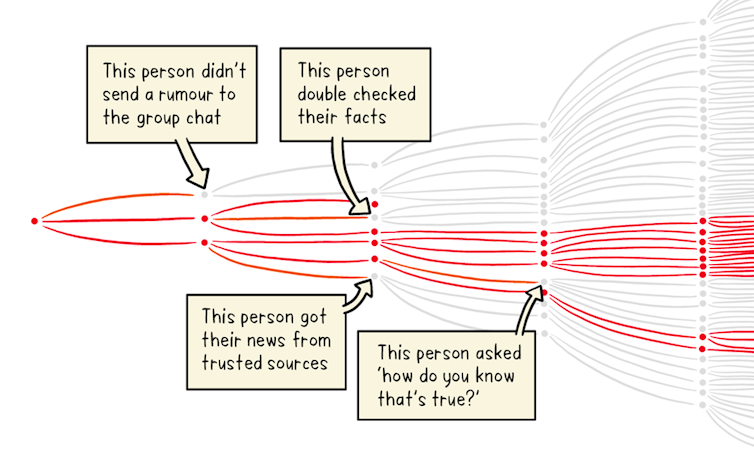
Stopping to check the facts helps stem the spread of misinformation.
World Health Organization adaptation from Siouxsie Wiles and Toby Morris in The Spinoff, CC BY-SA
Another marker of fake health information is that it presents ideas that are simply too good to be true. There is something appealingly counterintuitive in certain types of fake health information that can make people feel they have access to valuable or exclusive knowledge that others may not know. For example, a claim such as “chocolate helps you lose weight” can be especially appealing because it offers a sense of permission to indulge and taps into a simple, feel-good solution to a complex problem. Such information often spreads faster because it sounds both surprising and hopeful, validating what some people want to believe.
Sensationalism also drives the spread of fake health information. For instance, when critics falsely claimed that Anthony Fauci, the director of the National Institute of Allergy and Infectious Diseases and the chief medical adviser to the president at the time, was responsible for the COVID-19 pandemic, it generated a lot of public attention.
In a study on vaccine hesitancy published in 2020, my colleagues and I found that controversial headlines in news reports that go viral before national vaccination campaigns can discourage parents from getting their children vaccinated. These headlines seem to reveal sensational and secret information that can falsely boost the message’s credibility.
The pull to share
The internet has created fertile ground for spreading fake health information. Professional-looking websites and social media posts with misleading headlines can lure people into clicking or quickly sharing, which drives more and more readers to the falsehood. People tend to share information they believe is relevant to them or their social circles.
In 2019, an article with the false headline “Ginger is 10,000x more effective at killing cancer than chemo” was shared more than 800,000 times on Facebook. The article contained several factors that make people feel an urgency to react and share without checking the facts: compelling visuals, emotional stories, misleading graphs, quotes from experts with omitted context and outdated content that is recirculated.
Visual cues like the logos of reputable organizations or photos of people wearing white medical coats add credibility to these posts. This kind of content is highly shareable, often reaching far more people than scientifically accurate studies that may lack eye-catching headlines or visuals, easy-to-understand words or dramatic storylines.
But sharing content without verifying it first has real-world consequences. For example, studies have found that COVID-19-related fake information reduces people’s trust in the government and in health care systems, making people less likely to use or seek out health services.
Unfounded claims about vaccine side effects have led to reduced vaccination rates globally, fueling the return of dangerous diseases, including measles.
Check it out before you share.
Social media misinformation, such as false claims about cinnamon being a treatment for cancer, has caused hospitalizations and even deaths. The spread of health misinformation has reduced cooperation with important prevention and treatment recommendations, prompting a growing need for medical professionals to receive proper training and develop skills to effectively debunk fake health information.
How to combat the spread of fake health information
In today’s era of information overload in which anyone can create and share content, being able to distinguish between credible and misleading health information before sharing is more important than ever. Researchers and public health organizations have outlined several strategies to help people make better-informed decisions.
Whether health care consumers come across health information on social media, in an email or through a messaging app, here are three reliable ways to verify its accuracy and credibility before sharing:
Use a search engine to cross-check health claims. Never rely on a single source. Instead, enter the health claim into a reputable search engine like Google and see what trusted sources have to say. Prioritize information from established organizations like the World Health Organization, Centers for Disease Control and Prevention, United Nations Children’s Fund or peer-reviewed journals like The Lancet or Journal of the American Medical Association. If multiple reputable sources agree, the information is more likely to be reliable. Reliable fact-checking websites such as FactCheck.org and Snopes can also help root out fake information.
Evaluate the source’s credibility. A quick way to assess a website’s trustworthiness is to check its “About Us” page. This section usually explains who is behind the content, their mission and their credentials. Also, search the name of the author. Do they have recognized expertise or affiliations with credible institutions? Reliable websites often have domains ending in .gov or .edu, indicating government or educational institutions. Finally, check the publication date. Information on the internet keeps circulating for years and may not be the most accurate or relevant in the present context.
If you’re still unsure, don’t share. If you’re still uncertain about the accuracy of a claim, it’s better to keep it to yourself. Forwarding unverified information can unintentionally contribute to the spread of misinformation and potentially cause harm, especially when it comes to health.
Questioning dubious claims and sharing only verified information not only protects against unsafe behaviors and panic, but it also helps curb the spread of fake health information. At a time when misinformation can spread faster than a virus, taking a moment to pause and fact-check can make a big difference.

Angshuman K. Kashyap does not work for, consult, own shares in or receive funding from any company or organization that would benefit from this article, and has disclosed no relevant affiliations beyond their academic appointment.
—-
Author : Angshuman K. Kashyap, PhD candidate in Health Communication, University of Maryland
Publish date : 2025-05-16 12:27:00
Copyright for syndicated content belongs to the linked Source.