


Flowers, painted benches and handmade memorials surround a mural of George Floyd at George Floyd Square on May 18, 2025. Kerem Yucel/AFP via Getty Images
On the evening of May 25, 2020, George Floyd was murdered by police outside a grocery store in Minneapolis.
From the outset, the incident became a battle of narratives. The local police initially reported Floyd was experiencing “distress” and died from a medical incident. A day later, bystander Darnella Frazier uploaded a video that showed the graphic details, including the police’s excessive use of force leading up to Floyd’s death.
Floyd’s murder, and Frazier’s documentation of it, spawned what by some measures was the largest protest movement in American history.
And that, too, became a contest of narratives, this time in the media. A focus on the aftermath of the events in Minneapolis, and elsewhere, were quickly supplanted by stories of lawlessness and violence by protesters.
For almost a decade, I’ve researched the media’s coverage of protests, focusing extensively on the reporting of modern-day uprisings against police brutality.
Time and time again, colleagues and I have found that the bulk of news coverage of protests against police brutality tends to focus on protesters’ violence, disruption or sensational actions.
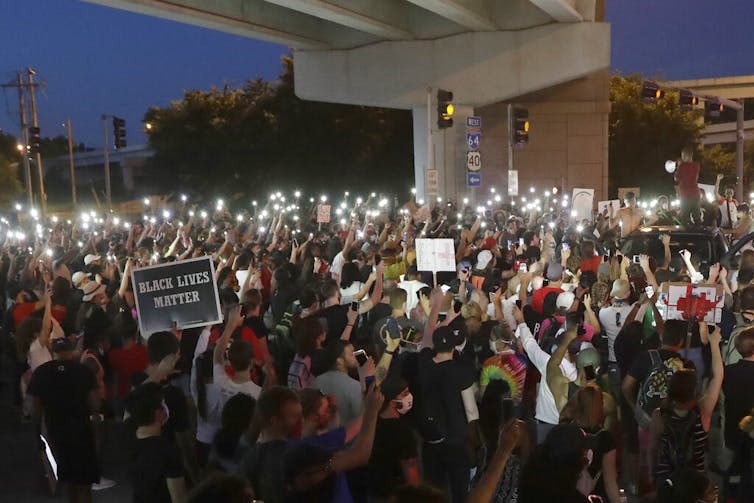
Protesters hold up their illuminated phones as they block a road beneath a highway in Missouri in June 2020.
AP Photo/Jeff Roberson
Yet in reading some of the coverage ahead of the fifth anniversary of Floyd’s death, I have observed a different media trend. With the benefit of time, what was once a news media frenzy focusing on the violence after Floyd’s killing has yielded space for reflection and coverage that legitimizes those who took to the streets.
In so doing, these narrative changes provide essential opportunities to understand the complexity of journalism and social movements seen from different moments in time.
Following flames
Quickly after Floyd’s murder in 2020, it became clear that subjects such as the role of state violence, the sophistication of demands for change and community grief were less likely to make headlines than things such as rioting and lawlessness.
This pattern is part of what scholars call a “protest paradigm” that explores the relationship between protests, media and the public.
The paradigm holds that journalism often works against protest movements hoping to change the status quo. The news media’s tendency to emphasize the frivolous, violent or annoying actions of protests rather than the depth of protesters’ demands, grievances and agendas negatively shapes public opinion and affects the public’s willingness to support the movements behind them.
After Floyd’s death, those closely following the coverage of conservative media were more likely to be exposed to stories that depicted protests as “criminal mobs.”
But it wasn’t just conservative media. On May 31, 2020, the local paper, the Star Tribune, described the governor’s “show of strength” – a term used to describe the massive deployment of the Minnesota National Guard to help quell the “days of lawless rampage.”
Most coverage at the time fit a familiar pattern of delegitimizing the protest movement.
With time and space, the pattern breaks
Five years later, some delegitimizing news coverage continues to headline. The New York Post, for example, recently published a 13-minute documentary that suggests Minneapolis is still on fire.
But a good portion of today’s news also presents a different framing. In one five-year anniversary piece, The New York Times described George Floyd Square, the murder-site-turned-place-of-reverance for many activists and local residents, as a “site of protest, art, grief and remembrance.” Another article in The Minnesota Star Tribune describes preservation efforts of street art and murals made by activists after the murder. Other coverage described the complicated process of demanding change and the path that remains ahead.
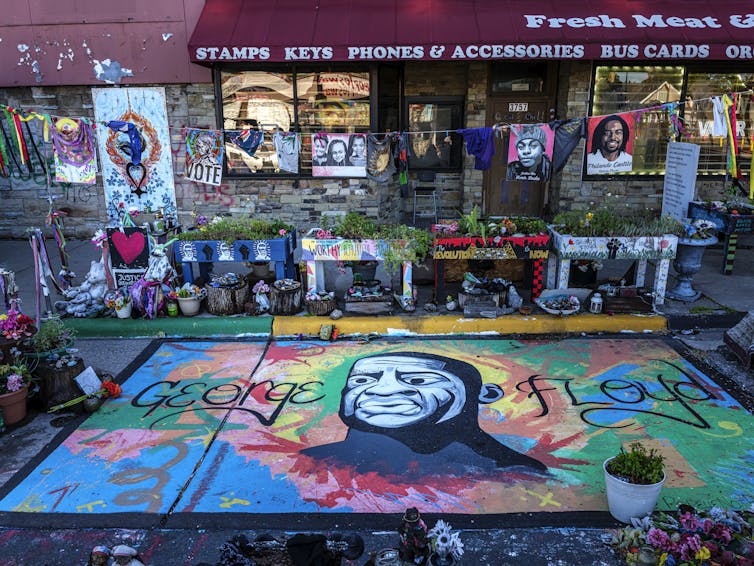
A portrait of George Floyd painted on the pavement is at the center of a memorial surrounded by flowers, artwork and tributes outside a storefront at George Floyd Square in Minneapolis, Minn., on May 22, 2025.
Photo by Kerem Yucel/AFP via Getty Images
Of course, these are selective snapshots of the coverage. And some media may shy away from covering the anniversary at all.
But from my standpoint as a media scholar, the coverage that does exist has gone from being dominated by an initial focus on the violent aspects of protest to, in the main, a more reflective look at the meaning — rather than the spectacle — of the unrest.
That legitimizing trend over time isn’t an isolated phenomenon. My colleagues Rachel Mourão and George Sylvie and I found something similar in previous research looking at the protests that followed the killings of Trayvon Martin in Florida in 2012 and Michael Brown in Ferguson, Missouri, in 2014.
In our analysis of the protests following Brown’s death, we observed that the first weeks of coverage focused more on protesters, delegitimizing frames and episodic news – that is, the disruption, destruction and arrests.
But we saw a dramatic change by the third and fourth weeks of coverage. With the passing of time, more legitimizing frames emerged, describing the protest’s substance and demands, and more thematic and in-depth reporting became apparent.
We observed a similar trend when we looked out even further from the triggering events. After the trial of George Zimmerman, the neighborhood watch leader charged and then acquitted over the deaths of Martin, and the grand jury verdict not to indict police officer Darren Wilson over the death of Brown, news coverage of protests was more contextual and thematic. The coverage provided more space and voice to “nonofficial” sources such as protesters and family members.
A question of journalism
The protest paradigm’s persistence may be a function of journalistic bias − the adage of “if it bleeds, it leads” talks to the immediate reporting imperative of prioritizing violence and spectacle over issues and meaning. But it can also be a consequence of how journalism operates to inform the public.
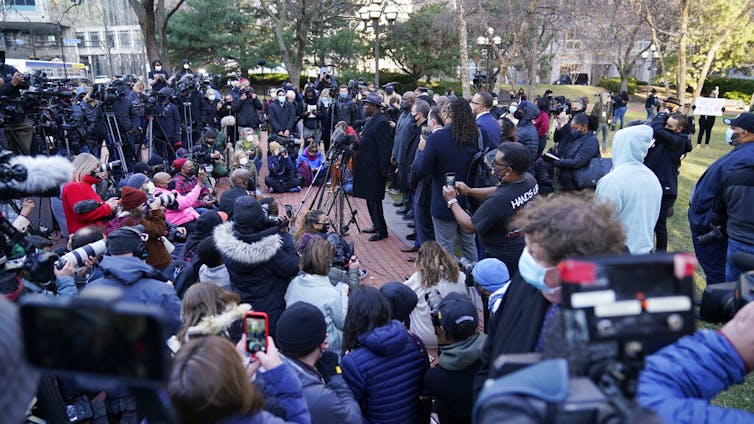
George Floyd family attorney Ben Crump addresses media along with other attorneys and members of Floyd’s family outside the Hennepin County Government Center on March 29, 2021, in Minneapolis where the trial for former Minneapolis police officer Derek Chauvin began.
AP Photo/Jim Mone
When uprisings against police brutality first begin, everything is new to the journalist and the public. The initial coverage tends to reflect this newsness and emphasizes breaking news and official narratives − which are often easier to obtain than the statements of protest groups. Police departments, for example, have well-established media relations departments with preexisting relationships with journalists.
These initial reports also tend to feature information that would have the biggest impact on wider communities − such as blocked highways and potential property destruction − than just the aggrieved community.
This translates to more coverage generally in the aftermath of a big event − and that reporting is more likely to delegitimize protests.
These are the first drafts of history, and they are typically incomplete.
But five years later in the case of George Floyd and protests of his death, coverage looks more complete and complex. That complexity brings more balance, from my perspective.
What journalists write years later are no longer the first drafts of history reported with limited perspectives. In these subsequent drafts, journalists have a little more time to think, learn and breathe. Immediacy takes a back burner, and journalists have had more time to collect information.
And it is in these collections of subsequent drafts that the protesters and social movements get a fairer shake.

Danielle K. Brown receives funding from Lumina Foundation and the John S. and James L. Knight Foundation.
—-
Author : Danielle K. Brown, Professor of Journalism, Michigan State University
Publish date : 2025-05-23 16:56:00
Copyright for syndicated content belongs to the linked Source.