



Three cicadas in North Carolina during the 2003 Brood IX emergence Chris Simon, CC BY-ND
If they’re in your area, you’ll know it from their loud droning, chirping and buzzing sounds. Cicadas from Brood XIV – one of the largest groups of cicadas that emerge from underground on a 13-year or 17-year cycle – are surfacing in May and June 2025 across 12 states. This large-scale biological event reaches from northern Georgia up into Indiana and Ohio and eastward through the mid-Atlantic, extending as far north as Long Island, N.Y. and Massachusetts.
Through mid-June, wooded areas will ring with cicadas’ loud mating calls. After mating, each female will lay hundreds of eggs inside small tree branches. Then the adult cicadas will die. When the eggs hatch six weeks later, new cicada nymphs will fall from the trees and burrow back underground, starting the cycle again.
We are evolutionary ecologists who study periodical cicadas to understand questions about the natural history, genetics and geographic distribution of life. This work starts with mapping where they appear.
We’ve been doing this for decades, updating a process begun by entomologists in the mid-1800s. Our latest maps are published online and searchable.
Periodical cicadas emerge on 13- or 17-year cycles in enormous numbers, which increases their odds of finding mates and avoiding predators long enough to reproduce.
Mapping the presence of such a noisy species might seem straightforward, but it’s actually complex. And accuracy matters because there are seven species of periodical cicadas — four with 13-year life cycles and three with 17-year cycles. Different broods can share boundaries, and some cicadas that emerge this year may be members of broods other than XIV, coming out early or late.
A lot of work goes into verifying the data in our maps so that they show the status of these unique insects as accurately as possible. Here’s a look at the process, and at how you can contribute:
Refining past records
We first started creating our maps on paper by collecting all known specimen records of 13- and 17-year periodical cicadas from past scientific studies and museums large and small across the eastern U.S., where these broods are located. For centuries, museum specimens have been the gold standard for documenting the presence of a species.
But past standards for labeling specimens were different. Many old museum labels simply noted very approximate locations where specimens were collected. Sometimes they just recorded the city, county or state.
Today we collect our records along roads. We listen for species-specific songs and then record the cicada species identity on computers, with their GPS locations. Often we’ll stop to examine a patch of forest. If the cicadas are singing, we note whether the chorus is light, moderate, loud or distant.
If stormy weather damps down the cicada songs, we look for signs of emergence, such as cast-off skins, adult cicadas on plants, or egg scars on branches.

Dozens of small brown cicadas climb grass stems during a Brood VIII emergence in Rector, Pa.
Chris Simon, CC BY-ND
Connecting the data dots
In some regions, such as the U.S. Midwest, roads are arranged on a grid that reflects land survey lines. Networks like these can be ideal for mapping species distributions. Delineating an area that’s occupied by a specific cicada brood may be as simple as connecting the dots that represent our positive sightings.
In other places, such as Appalachia, roads often follow ridges or valleys and miss many areas. Here, it’s harder to infer where cicadas are present between data points, especially when those data points are located on different roads.
Drawing a boundary that contains every data point in a survey area usually will end up overstating the area where periodical cicadas are emerging. We intentionally design our maps to be conservative, so we display our information as point data and do not attempt to draw brood boundaries or generalize our data to counties.
It’s equally important to record absence points – places where no cicadas are present. Otherwise, an area might be blank either because a species is absent or simply because no one looked for cicadas there.
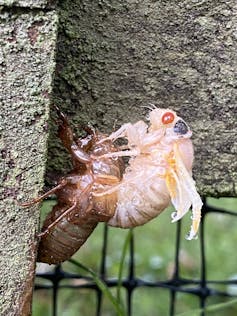
A cicada nymph from Brood X sheds its skin during an emergence in Herndon, Va.
Chris Simon, CC BY-ND
We have been verifying periodical cicada records and updating maps since the late 1980s. Our more recent maps include geographic information for data collection points.
Where our maps show the presence of cicadas, a senior member of our project has verified that cicadas were present at that place and date. The insects may have been just emerging, singing loudly, or on their way out.
Where our maps show the absence of cicadas, that means that one of us or a collaborator visited that location under appropriate conditions and verified that no cicadas were present. Where our maps show no records, we have no information on presence or absence.
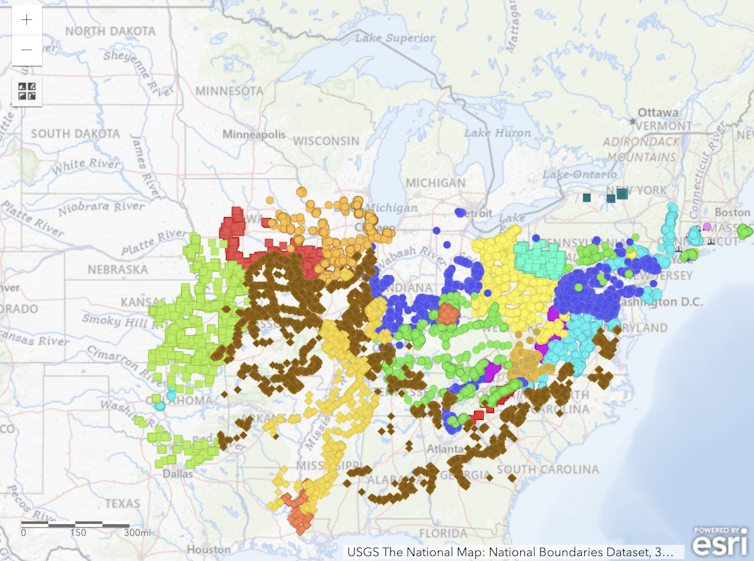
Each color on this map represents a different periodical cicada brood. Brood XIV is the darker green extending from the Midwest to eastern Massachusetts.
University of Connecticut, used with permission., CC BY-ND
Crowdsourcing the emergence
In recent years, citizen scientists – members of the public collecting data for scientific research – have revolutionized mapping efforts, using apps and the internet. Apps such as iNaturalist and Cicada Safari allow users to submit geolocated photos, sounds and videos with a few clicks.
When we receive these records, our colleague Gene Kritsky, an emeritus entomologist at Mount St. Joseph University, vets them with his team. Then they are uploaded to a map on Cicada Safari.
Citizen science maps have different biases from those that are created by our expert teams. Members of the public tend to collect their data in areas where residents are familiar with cicadas, there is good internet connectivity and media stories have piqued volunteer reporters’ interest. These maps don’t show absence records or all localities, especially in sparsely populated areas.
Even records supported by sounds or photographs may not be accurate. They may capture “stragglers” from broods that are not part of the current year’s cycle but are emerging one to four years early or late.
This phenomenon may become more commonplace in response to changing climates. Warming temperatures create longer growing seasons, which can enable at least some fraction of a periodical cicada population to develop faster and be ready to emerge earlier.
For this reason, maps based on citizen science reports are most valuable if the same observers report back from the same locations repeatedly over several weeks. The longer-term presence of periodical cicadas indicates that what’s being tallied is a non-straggler population, or a straggler population on its way to permanently shifting the timing of its emergence.
An evolving story
Maps are valuable tools for understanding how species fit into their environment, how they interact with other species and how they respond to change. However, it is important to be aware of any map’s biases and limitations when interpreting it. Research requires dedication and repetition over many years.
Our research suggests that climate warming has resulted in more four-year-early straggling events that are increasingly dense, widespread and likely to leave offspring. The result is a mosaic of broods that makes the jigsaw puzzle of periodical cicada distribution more complicated, but more interesting. Understanding how these four-year shifts are encoded in cicadas’ genes is a mystery that remains to be solved.

Chris Simon has received funding from The National Science Foundation, The National Geographic Society, The Marsden Fund of New Zealand, and the University of Connecticut.
John Cooley has received funding in the past from NSF and National Geographic Society. There are no current grants funding this work.
—-
Author : Chris Simon, Senior Research Scientist of Ecology and Evolutionary Biology, University of Connecticut
Publish date : 2025-05-22 12:44:00
Copyright for syndicated content belongs to the linked Source.