



Air traffic controllers observe a plane taking off from San Francisco International Airport in 2017. AP Photo/Jeff Chiu
Air traffic controllers have been in the news a lot lately.
A spate of airplane crashes and near misses have highlighted the ongoing shortage of air traffic workers, leading more Americans to question the safety of air travel.
The shortage, as well as aging computer systems, have also led to massive flight disruptions at airports across the country, particularly at Newark Liberty International Airport. The staffing shortage is also likely at the center of an investigation of a deadly crash between a commercial plane and an Army helicopter over Washington, D.C., in January 2025.
One reason for the air traffic controller shortage relates to the demands of the job: The training to become a controller is extremely intense, and the Federal Aviation Administration wants only highly qualified personnel to fill those seats, which has made it difficult for what has been the sole training center in the U.S., located in Oklahoma City, to churn out enough qualified graduates each year.
As scholars who study and teach tomorrow’s aviation professionals, we are working to be part of the solution. Our program at Ohio State University is applying to join over two dozen other schools in an effort to train air traffic controllers and help alleviate the shortage.
Air traffic controller school
Air traffic control training today – overseen by the Federal Aviation Administration – remains as intense as it’s ever been.
In fact, about 30% of students fail to make it from their first day of training at the FAA Academy in Oklahoma City to the status of a certified professional air traffic controller. The academy currently trains the majority of the air traffic controllers in the U.S.
Before someone is accepted into the training program, they must meet several qualifications. That includes being a U.S. citizen under the age of 31 and speaking English clearly enough to be understood over the radio. The low recruitment age is because controllers currently have a mandatory retirement age of 56 – with some exceptions – and the FAA wants them to work for at least 25 years in the job.
They must also pass a medical exam and security investigation. And they must pass the air traffic controller specialists skills assessment battery, which measures an applicant’s spatial awareness and decision-making abilities.
Candidates, additionally, must have three years of general work experience, or a combination of postsecondary education and work experience totaling at least three years.
This alone is no easy feat. Fewer than 10% of applicants meet those initial requirements and are accepted into training.
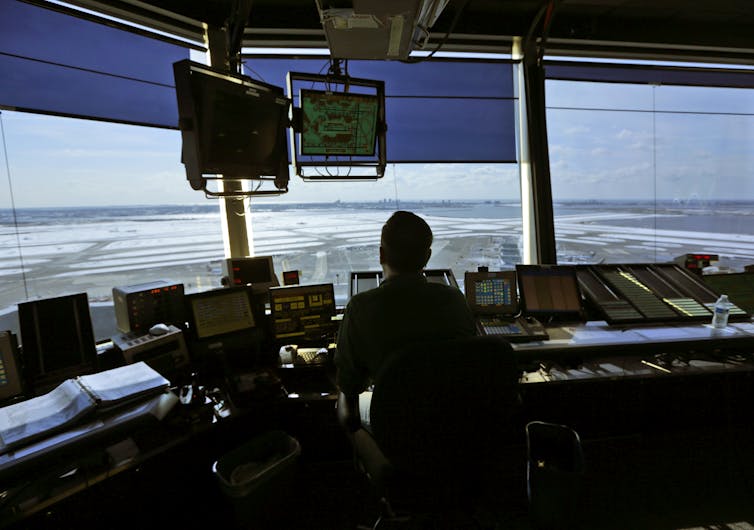
An air traffic controller monitors a runway in the tower at John F. Kennedy International Airport in New York.
AP Photo/Seth Wenig
Intense training
Once applicants meet the initial qualifications, they begin a strenuous training process.
This begins with several weeks of classroom instruction and several months of simulator training. There are several types of simulators, and a student is assigned to a simulator based on the type of facility for which they will be hired – which depends on a trainee’s preference and where controllers are needed.
There are two main types of air traffic facilities: control towers and radar. Anyone who has flown on a plane has likely seen a control tower near the runways, with 360 degrees of tall glass windows to monitor the skies nearby. Controllers there mainly look outside to direct aircraft but also use radar to monitor the airspace and assist aircraft in taking off and landing safely.
Radar facilities, on the other hand, monitor aircraft solely through the use of information depicted on a screen. This includes aircraft flying just outside the vicinity of a major airport or when they’re at higher altitudes and crisscrossing the skies above the U.S. The controllers ensure they don’t fly too close to one another as they follow their flight paths between airports.
If the candidates make it through the first stage, which takes about six months and extensive testing to meet standards, they will be sent to their respective facilities.
Once there, they again go to the classroom, learning the details of the airspace they will be working in. There are more assessments and chances to “wash out” and have to leave the program.
Finally, the candidates are paired with an experienced controller who conducts on-the-job training to control real aircraft. This process may take an additional year or more. It depends on the complexity of the airspace and the amount of aircraft traffic at the site.
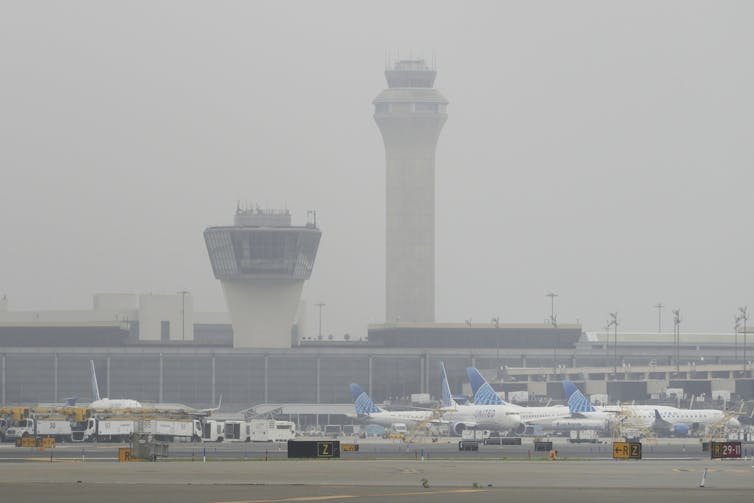
Two control towers watch over Newark Liberty International Airport, where a shortage of air traffic controllers has led to blackouts and other problems lately.
AP Photo/Seth Wenig
Increasing the employment pipeline
But no matter how good the training is, if there aren’t enough graduates, that’s a problem for managing the increasingly crowded skies.
The FAA is currently facing a deficit of about 3,000 controllers and has unveiled a plan in May 2025 to increase hiring and boost retention. In addition, Congress is mulling spending billions of dollars to update the FAA’s aging systems and hire more air traffic controllers.
Other plans include paying retention bonuses and allowing more controllers to work beyond the age of 56. That retirement age was put in place in the 1970s on the assumption that cognition for most people begins to decline around then, although research shows that age alone is not necessarily a predictor of cognitive abilities.
But we believe that aviation programs and universities can play an important role fixing the shortage by providing FAA Academy-level training.
Currently, 32 universities including the Florida Institute of Technology and Arizona State University partner with the FAA in its collegiate training initiative to provide basic air traffic control training, which gives graduates automatic entry into the FAA Academy and allows them to skip five weeks of coursework.
The institution where we work, Ohio State University, is currently working on becoming the 33rd this summer and plans to offer an undergraduate major in aviation with specialization in air traffic control.
This helps, but an enhanced version of this program, announced in October 2024, allows graduates of a select few of those universities to skip the FAA Academy altogether and go straight to a control tower or radar facility once they’ve passed all the extensive tests. These schools must match or exceed the level of rigor in their training with the FAA Academy itself.
At the end of the program, students are required to pass an evaluation by an FAA-approved evaluator to ensure that the student graduating from the program meets the same standards as all FAA Academy graduates and is prepared to go to their assigned facility for further training. So far, five schools, such as the University of North Dakota, have joined this program and are currently training air traffic controllers. We intend to join this group in the near future.
Allowing colleges and universities to start the training process while students are still in school should accelerate the pace at which new controllers enter the workforce, alleviate the shortage and make the skies over the U.S. as safe as they can be.

Melanie Dickman is a member at large of the Air Traffic Controllers Association
Brian Strzempkowski does not work for, consult, own shares in or receive funding from any company or organization that would benefit from this article, and has disclosed no relevant affiliations beyond their academic appointment.
—-
Author : Melanie Dickman, Lecturer in Aviation Studies, The Ohio State University
Publish date : 2025-05-27 12:49:00
Copyright for syndicated content belongs to the linked Source.