



White-tailed deer in North America are back to their precolonial population levels. John Woodhouse Audubon/Heritage Images/Hulton Archive via Getty Images
Given their abundance in American backyards, gardens and highway corridors these days, it may be surprising to learn that white-tailed deer were nearly extinct about a century ago. While they currently number somewhere in the range of 30 million to 35 million, at the turn of the 20th century, there were as few as 300,000 whitetails across the entire continent: just 1% of the current population.
This near-disappearance of deer was much discussed at the time. In 1854, Henry David Thoreau had written that no deer had been hunted near Concord, Massachusetts, for a generation. In his famous “Walden,” he reported that:
“One man still preserves the horns of the last deer that was killed in this vicinity, and another has told me the particulars of the hunt in which his uncle was engaged. The hunters were formerly a numerous and merry crew here.”
But what happened to white-tailed deer? What drove them nearly to extinction, and then what brought them back from the brink?
As a historical ecologist and environmental archaeologist, I have made it my job to answer these questions. Over the past decade, I’ve studied white-tailed deer bones from archaeological sites across the eastern United States, as well as historical records and ecological data, to help piece together the story of this species.
Precolonial rise of deer populations
White-tailed deer have been hunted from the earliest migrations of people into North America, over 15,000 years ago. The species was far from the most important food resource at that time, though.
Archaeological evidence suggests that white-tailed deer abundance only began to increase after the extinction of megafauna species like mammoths and mastodons opened up ecological niches for deer to fill. Deer bones become very common in archaeological sites from about 6,000 years ago onward, reflecting the economic and cultural importance of the species for Indigenous peoples.
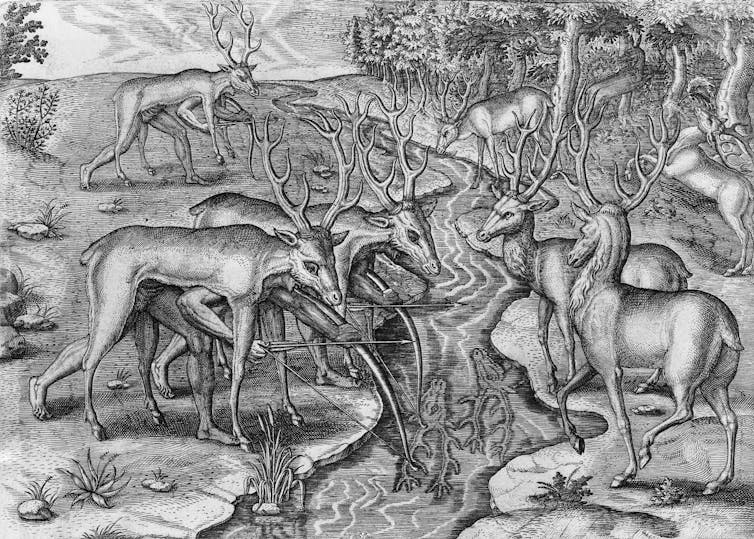
A 16th-century engraving of Indigenous Floridians hunting deer while disguised in deerskins.
Theodor de Bry/DEA Picture Library/De Agostini via Getty Images
Despite being so frequently hunted, deer populations do not seem to have appreciably declined due to Indigenous hunting prior to AD 1600. Unlike elk or sturgeon, whose numbers were reduced by Indigenous hunters and fishers, white-tailed deer seem to have been resilient to human predation. While archaeologists have found some evidence for human-caused declines in certain parts of North America, other cases are more ambiguous, and deer certainly remained abundant throughout the past several millennia.
Human use of fire could partly explain why white-tailed deer may have been resilient to hunting. Indigenous peoples across North America have long used controlled burning to promote ecosystem health, disturbing old vegetation to promote new growth. Deer love this sort of successional vegetation for food and cover, and thus thrive in previously burned habitats. Indigenous people may have therefore facilitated deer population growth, counteracting any harmful hunting pressure.
More research is needed, but even though some hunting pressure is evident, the general picture from the precolonial era is that deer seem to have been doing just fine for thousands of years. Ecologists estimate that there were roughly 30 million white-tailed deer in North America on the eve of European colonization – about the same number as today.

Elic Weitzel and volunteers excavate for deer bones at a 17th-century colonial site in Connecticut.
Scott Brady
Colonial-era fall of deer numbers
To better understand how deer populations changed in the colonial era, I recently analyzed deer bones from two archaeological sites in what is now Connecticut. My analysis suggests that hunting pressure on white-tailed deer increased almost as soon as European colonists arrived.
At one site dated to the 11th to 14th centuries – before European colonization – I found that only about 7% to 10% of the deer killed were juveniles.
Hunters generally don’t take juvenile deer if they’re frequently encountering adults, since adult deer tend to be larger, offering more meat and bigger hides. Additionally, hunting increases mortality on a deer herd but doesn’t directly affect fertility, so deer populations experiencing hunting pressure end up with juvenile-skewed age structures. For these reasons, this low percentage of juvenile deer prior to European colonization indicates minimal hunting pressure on local herds.
However, at a nearby site occupied during the 17th century – just after European colonization – between 22% and 31% of the deer hunted were juveniles, suggesting a substantial increase in hunting pressure.

Researchers can tell from the size and development of a deer’s bones its stage of life. Here is a fawn’s mandible with teeth.
Elic Weitzel
This elevated hunting pressure likely resulted from the transformation of deer into a commodity for the first time. Venison, antlers and deerskins may have long been exchanged within Indigenous trade networks, but things changed drastically in the 17th century. European colonists integrated North America into a trans-Atlantic mercantile capitalist economic system with no precedent in Indigenous society. This applied new pressures to the continent’s natural resources.
Deer – particularly their skins – were commodified and sold in markets in the colonies initially and, by the 18th century, in Europe as well. Deer were now being exploited by traders, merchants and manufacturers desiring profit, not simply hunters desiring meat or leather. It was the resulting hunting pressure that drove the species toward its extinction.
20th-century rebound of white-tailed deer
Thanks to the rise of the conservation movement in the late 19th and early 20th centuries, white-tailed deer survived their brush with extinction.
Concerned citizens and outdoorsmen feared for the fate of deer and other wildlife, and pushed for new legislative protections.
The Lacey Act of 1900, for example, banned interstate transport of poached game and – in combination with state-level protections – helped end commercial deer hunting by effectively de-commodifying the species. Aided by conservation-oriented hunting practices and reintroductions of deer from surviving populations to areas where they had been extirpated, white-tailed deer rebounded.
The story of white-tailed deer underscores an important fact: Humans are not inherently damaging to the environment. Hunting from the 17th through 19th centuries threatened the existence of white-tailed deer, but precolonial Indigenous hunting and environmental management appear to have been relatively sustainable, and modern regulatory governance in the 20th century forestalled and reversed their looming extinction.

Elic Weitzel received funding from the National Science Foundation (award #2128707) to support this research.
—-
Author : Elic Weitzel, Peter Buck Postdoctoral Research Fellow, Smithsonian Institution
Publish date : 2025-05-29 12:48:00
Copyright for syndicated content belongs to the linked Source.