



The Bonus Army demonstration at the U.S. Capitol on July 2, 1932. Underwood and Underwood, via Library of Congress
Veterans across the United States will gather on June 6, 2025, to protest the Trump administration’s cuts to the Department of Veterans Affairs, as well as the slashing of staff and programs throughout the government. Veteran-led protests will be held at the National Mall, 16 state capitol buildings and over 100 other venues across 43 states.
Veterans are disproportionately affected by federal cuts, in part because they make up only 6.1% of the U.S. population but, because of “veterans preference” in federal hiring, they compose 24% of the 3 million federal workers facing mass layoffs under the Trump administration.
Veterans also depend on comprehensive, free, federally funded health care through VA clinics throughout the country. But that care is deteriorating due to cuts, rule changes and return-to-work policies that make it impossible for many VA workers to effectively provide care.
Looming cuts to the VA may cause an irreversible blow if the VA stops providing comprehensive care to veterans and, instead, pushes veterans into seeing doctors in private practice.
This is not the first time that veterans have engaged in mass mobilization. Veterans groups in the U.S. have successfully mobilized for centuries, crossing traditional political divisions such as race, class and gender. They are powerful messengers, and their actions in the past have helped secure back pay and pensions for veterans, a Social Security and welfare system for U.S. civilians, and foreign policy changes to end wars abroad.
I’m a scholar of law, social movements and veterans benefits. Here’s a brief history of veterans’ campaigns that illustrates how veterans developed their political clout and effectively advocated to protect themselves, and many others, from harmful federal policies.
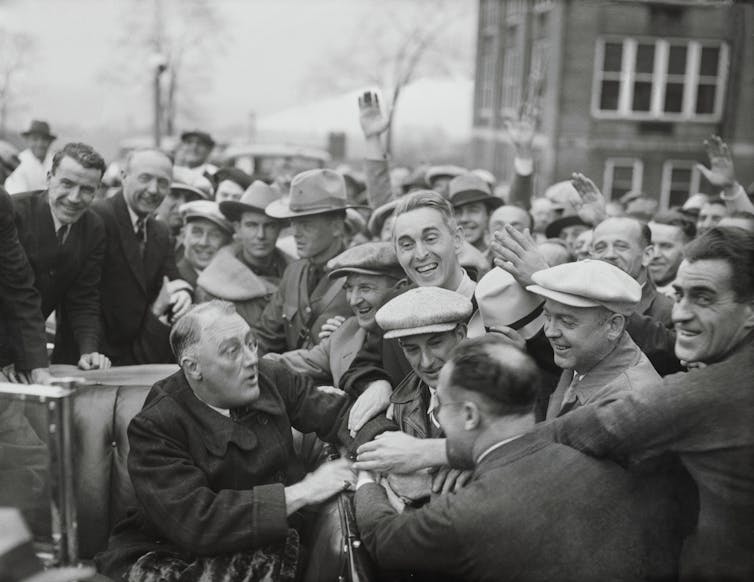
Veterans are an important political constituency. On Nov. 7, 1932 – the day before Election Day – Franklin D. Roosevelt, the New York governor running for president, visited the veterans hospital at Castle Point, near Beacon, N.Y.
Bettman/Getty Images
Fighting for pensions
Veterans were not always politically popular, nor were they treated well by the federal government.
After the Revolutionary War ended in 1783, Gen. George Washington lobbied Congress to offer lifetime half-pay to officers who served until the end of the war. Given the federal government’s financial precariousness at the end of the war, this effort failed. Veterans were unable to successfully mobilize to advocate for the pensions, given their small numbers and internal divisions between more privileged officers and less privileged soldiers.
During the Civil War, Congress passed numerous laws designed to support veterans. The 1862 pension law allocated payouts in proportion to a soldier’s permanent bodily injury or disability caused by their service. The benefits were generous in comparison with prior allocations, and more veterans began applying for them.
Yet, by 1875 only 6.5% of veterans had signed up for pensions. Veterans began to organize to increase awareness about these benefits and to lobby for more.
The Grand Army of the Republic became a leading veterans organization that demanded better pension and disability benefits. At the end of the 1800s, earning veterans’ votes became a priority for aspiring politicians. The Grand Army of the Republic directly lobbied Congress to pass bills expanding veterans pensions, one of which Democratic President Grover Cleveland vetoed in 1887.
The organization then successfully mobilized its members to vote against Cleveland in the 1888 election, securing victory for presidential candidate William Henry Harrison and for Republicans in both houses of Congress. This secured the 1890 Arrears Act, which expanded veterans’ pensions and disability payments.
By the turn of the 19th century, over 40% of federal expenditures went to veterans.
Getting back pay
As more veterans returned in 1898 from fighting in the Spanish-American War, and with a huge influx of veterans 20 years later from World War I, veterans mobilized to streamline and expand pension and disability benefits.
In the 1920s, the two most prominent veterans organizations, the American Legion and Veterans of Foreign Wars, or VFW, formed a national legislative committee dedicated to lobbying for improved benefits. Each group boasted thousands of members whom they could call on to “barrage”– a veterans term – congressmen with letters. By 1929, even as the federal budget ballooned, veterans benefits still represented 20% of the total federal budget.
The 1924 “Bonus Act,” which Congress passed after overruling Calvin Coolidge’s presidential veto, offered WWI veterans a deferred “bonus” payment available in 1945. But veterans suffered immensely in the Great Depression, along with the rest of the country.
Veterans tried a new campaign tactic in 1932, creating the “Bonus Expeditionary Forces,” or “Bonus Army,” march on Washington, D.C., to demand their promised pay be delivered sooner.
Over the course of three months, from May through July 1932, 40,000 veterans set up encampments throughout the city. During their stay, they crowded congressional galleries and plazas during debates on the bill. When President Herbert Hoover called on the military to disband the encampments, he set himself up for electoral defeat later that year.
It took another four years for Congress to pass a law offering an immediate payout, but the veterans got their bonuses in 1936, not 1945.
Campaigning to prevent cuts
Building from public support bolstered by the Bonus Army march, veterans fought publicly to protect their benefits in the Great Depression.
In 1933, President Franklin Delano Roosevelt sought to cut veterans’ benefits to help finance other relief programs during the Depression, but veterans successfully lobbied Congress to rescind the cuts.
A 1933 VFW encampment in Milwaukee attracted 10,000 veterans who openly decried Roosevelt’s economic policies. The event featured left-wing Louisiana populist Sen. Huey P. Long and former Marine turned anti-Wall Street populist Smedley Butler.
The U.S. entered World War II in December 1941. To avoid another spectacle, FDR began developing a compensation program for World War II veterans even before the war’s end. During debates about these expenditures, veterans activism helped ensure the generous educational, housing and vocational benefits from the so-called GI Bill developed by FDR, and the soldier vote helped secure FDR’s fourth-term election in 1944.
Scholars credit the GI Bill with creating a booming U.S. economy from the 1950s through the 1970s and creating the contemporary middle class, an economic and social group now shrinking and under threat.
Beyond benefits
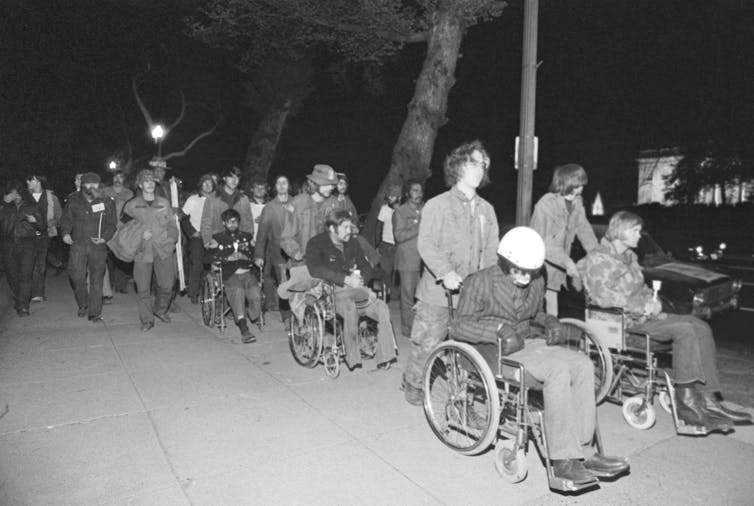
Vietnam veterans hold a silent march down Pennsylvania Avenue past the White House on April 22, 1971, to protest the Vietnam War.
Bettman/Getty Images
After World War II, veterans’ mobilization expanded from a focus on benefits to foreign policy.
Most famously, after its founding in 1967, Vietnam Veterans Against the War engaged in street theater and gathered testimonies about U.S. military abuses to condemn the U.S. government for violence against the Vietnamese.
Vietnam Veterans Against the War helped organized a four-day protest in 1971 in Washington, D.C., including camping on the National Mall. The organization continued to mobilize in more traditional ways, drafting congressional legislation for benefits and promoting investment in psychological support for Vietnam veterans.
Veterans have continued to protest wars, particularly the Iraq War, engaging in street protests and also through mainstream politics such as elections and television advertising.
Given their experiences, veterans today know what they are standing up for on June 6: their own freedom and prosperity, as well as the country’s and the world’s.

Jamie Rowen receives funding from National Science Foundation.
—-
Author : Jamie Rowen, Associate Professor of Legal Studies and Political Science, UMass Amherst
Publish date : 2025-05-30 16:34:00
Copyright for syndicated content belongs to the linked Source.