



It is spring on the Front Range of Colorado, which means before long the region will receive an influx of many, many moths.
Colorado is home to thousands of species of moths, many of which are hatching out from a winter of hibernation, known as diapause.
Moths are known to swarm porch, stadium and street lights at night. Each summer, Denver is visited by miller moths as they make their trek to the mountains.
Fairfax Media/GettyImages
At night, porch lights, stadium lights and street lamps are regularly visited by moths, a collective term for most of the nocturnal members of the insect order called Lepidoptera. Butterflies are also part of this order, but they are mostly diurnal, or active during the day. Butterflies are actually just a subset of moths, so all butterflies are moths, but not all moths are butterflies.
The Front Range lies on the path of a springtime migration of a particularly familiar species of moth, usually referred to in this part of the country, including Colorado and neighboring states, as “miller moths.” Miller moth caterpillars are often called the “army cutworm,” a whimsical name referring to the caterpillars’ tendency to reach large numbers that march across fields and roads to find food. Both the moths and their caterpillars are rather drab and brown in color, though the moths are variable in patterning.
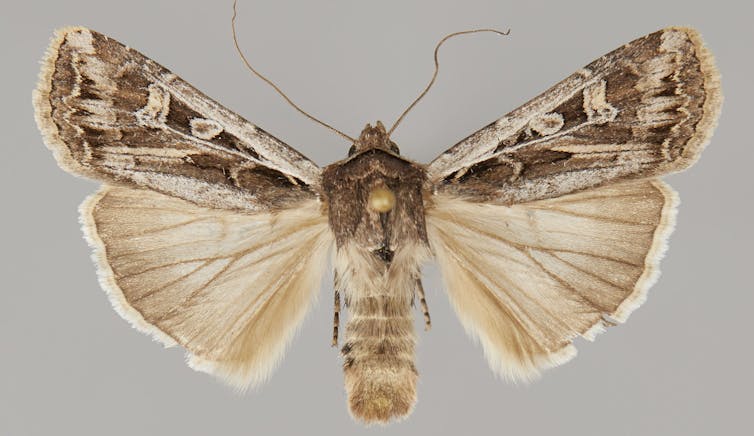
‘Miller moth’ is the common name for a moth species that migrates from southeastern Colorado to the Front Range to forage for food.
Chuck Harp, Colorado State University
Many people find miller moths to be a nuisance, and the caterpillars can be a pest. But miller moths are a native species to Colorado and play important roles across the plains and up into the high country.
I am an assistant professor of ecology and evolutionary biology as well as the curator of the entomology collection at the University of Colorado’s Natural History Museum in Boulder. I study moths from around the world. I have a particular fascination for the large moth group known as Noctuoidea, the superfamily to which miller moths and their relatives belong.
As an entomologist, I crisscross the state looking for moths for my ongoing evolutionary, classification and life history studies. During miller moth migrations, they may swarm my moth traps, which are made up of a bright light in front of a white sheet. The crush of miller moths makes finding the less common species that I am looking for all the more challenging in a sea of dusty brown.
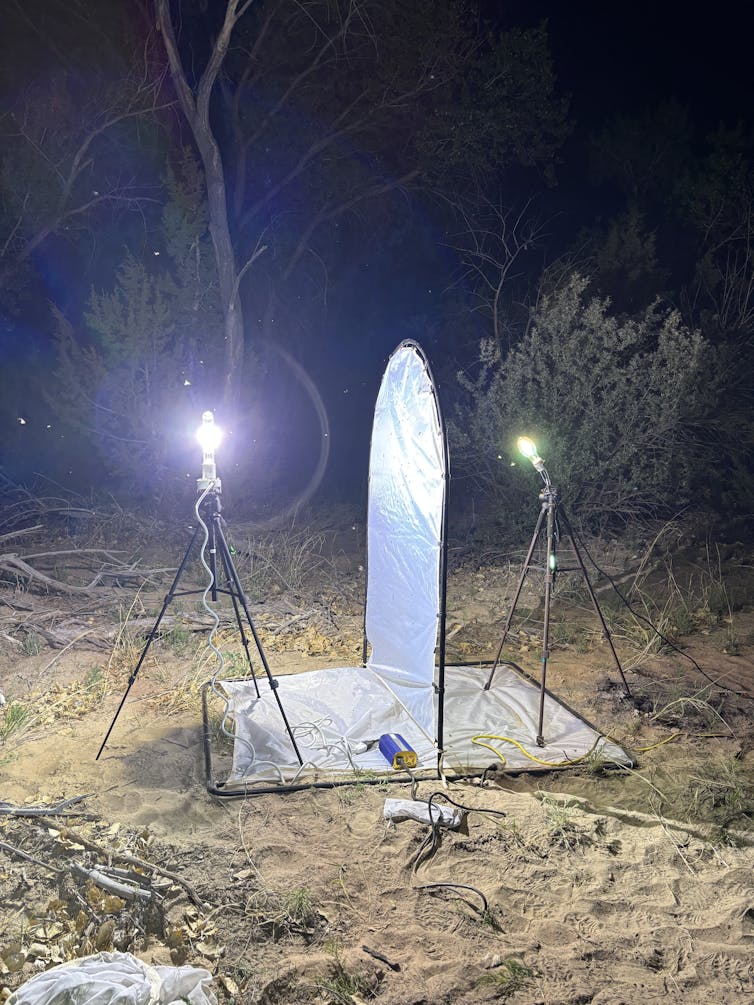
To spot and trap moths, entomologists set up bright lights in front of a white background.
Ryan St. Laurent
What makes miller moths so unique?
In temperate regions like most of North America, most moth species hibernate in the cold winter months. During this time, they are in a dormant pupal stage. Some species spin cocoons. They then hatch into adult moths, mate, lay eggs, and those caterpillars grow during the spring and summer. Come fall, the cycle starts over.
While miller moths also have a hibernation period, it is not like that of most moths. Miller moths instead spend their winters on the plains of eastern Colorado, Wyoming, Kansas, Nebraska and nearby states as partially grown caterpillars, rather than a pupa, having gotten a head start on feeding in the late summer. This puts the caterpillars at an advantage. As soon as the weather warms and low-lying crops like wheat and alfalfa produce new, nutrient-rich foliage during the early spring, the caterpillars are right there ready to feast and may cause serious damage to the crops in outbreak years.
Pupation then occurs later in the spring, and unlike in most Lepidoptera, the adult moths hatch without an extended pupal diapause, and instead begin to migrate west. They travel more than 100 miles (roughly 160 kilometers) toward higher elevations to seek out flowering plants, feeding on nectar and pollinating as they go.
Miller moths migrate to the Rocky Mountains to forage for food. In this video, courtesy of Ecologist Adrian Carper, thousands of moths flutter around trees in the mountains.
This migration is where folks on the Front Range become all too familiar with these weary travelers, who seek out narrow spaces to rest, often crawling into gaps in cars and homes. Inside a home, miller moths don’t feed, reproduce or lay eggs. Sudden agitation of the resting moths may cause them to fly about to seek out a new spot to hide – that is, if your house cat doesn’t see them first. If they do make their way inside, they can be easily swept into a cup or jar and let outside.
People on the Front Range experience a second run-in with these moths after they finish their summer of feeding in the mountains and head back to the plains to lay their eggs in the fields from August to September.
The call of the night
The importance of pollinators is familiar to many Coloradans. The state offers many resources and groups to help create spaces to attract butterflies and bees, including an initiative that designated Interstate Highway 76 as the “Colorado Pollinator Highway.”
But pollination does not stop when the sun goes down. In fact, moths make up the largest percentage of pollinators in terms of number of species globally – more than bees and butterflies combined. But scientists have yet to figure out which plants miller moths pollinate.
Despite the importance of moths as pollinators to agriculture and ecology, by comparison to bees, for example, we know exceedingly little about nocturnal pollinators. Of the thousands of moth species in Colorado, many hundreds remain unknown to science. One of the reasons scientists study moths is to literally shed a light on these insects in the environment to see what they are doing.
My work aims to understand what certain moths eat in their caterpillar stage, but other researchers, and my colleague Dr. Julian Resasco, at the University of Colorado Boulder, study what plants the adults are feeding on as they pollinate.
Colorado moths
Moths are among the primary airborne insects at night, playing a significant, and perhaps leading, role in insect-feeding bat diets. During their migration to the mountains, there are so many miller moths that they are a substantial protein- and fat-rich meal for animals as large as bears.
Considering that we still know so little about moths, it’s important to realize that light pollution, habitat loss and agricultural chemicals are all impacting moth numbers, resulting in annual declines in these insects globally.
So, the next time you see a miller moth in Colorado, or any moth at a light anywhere on Earth, remember that it’s working the night shift. Turn out that light so it can go about its way.

Ryan St Laurent receives funding from the National Science Foundation (no active grants). Some scientific publications referenced in this article were coauthored by Ryan or by his other collaborators.
—-
Author : Ryan St Laurent, Assistant Professor of Biology, University of Colorado Boulder
Publish date : 2025-06-03 12:44:00
Copyright for syndicated content belongs to the linked Source.