



The system of scientific naming began in the 1700s. Westend61 via Getty Images
Most people would call it a “field mouse,” but a scientist would ask, “Was it Peromyscus maniculatus? Or Peromyscus leucopus?”
Scientists use a system of complicated-sounding names to refer to everyday creatures, a practice heavily lampooned in the Warner Bros. cartoons featuring the Road Runner and Wile E. Coyote – or, respectively, Accelleratii incredibus and Carnivorous vulgaris.
As a biologist, I use these seemingly odd names myself and help my students learn them. For most people it’s a huge effort, like learning a second language. That’s because it is.
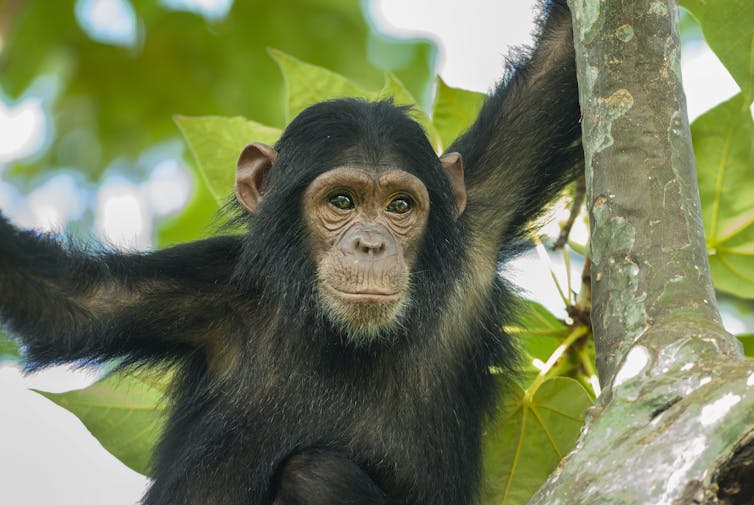
A chimpanzee, otherwise known as Pan troglodytes.
guenter guni/E+ via Getty Images
Humans, skunks and maple trees
The science of naming and classifying organisms is called taxonomy. Scientists do this so they can be as precise as possible when discussing living things.
The first word in an organism’s name is its genus, which is a group of related species, such as Panthera for lions, tigers and leopards.
The second word is the specific name identifying the species, usually defined as a population that can reproduce only with each other, such as Panthera leo for lion.
Every two-word combination must be unique. Called binomial nomenclature, this naming system was popularized by Swedish naturalist Carl Linnaeus in the 1700s. So, humans are Homo sapiens, the red maple Acer rubrum, garlic Allium sativum, and the eastern spotted skunk Spilogale putorius.
Today, biologists maintain huge databases containing the taxonomic names of plants, animals, fungi and other organisms. For instance, one of these databases – the Open Tree of Life project – includes over 2.3 million species.
The scientist who discovers a species usually names it by publishing a formal description in a peer-reviewed journal. From there, the name makes its way into the databases. From then on, scientists always use that name for the organism, even if it turns out to be misleading. For example, many fossils were originally given names containing the Greek root “saur,” which means lizard – even though paleontologists later realized dinosaurs were not lizards.

The archosaur group includes dinosaurs and also today’s birds and crocodiles.
Orla/iStock via Getty Images Plus
Snobbery isn’t the issue
To most people, these names sound inscrutable. Particularly nowadays, as science becomes more open and accessible to everyone, such arcane vocabulary can come across as old-fashioned and elitist.
Given the current backlash against “elites” and “experts” in every field, that’s a serious charge. But in a roundabout way, this seemingly exclusive practice is really a story of inclusiveness.
As modern science began taking shape in Europe during the 1600s, scientists had a problem. They wanted to read and be read by others, but language got in the way. French scientists couldn’t read Swedish, Swedes couldn’t read Italian, and Italians couldn’t read German.
Also, writing about plants and animals posed a particular challenge: Many species had common names that could vary from place to place, and some common names might apply to multiple species. Scientists needed a way to be precise and consistent when referring to species, so that everyone could understand each other.
To sidestep the language issue, scientists of the era mostly published their work in classical Latin. Back then, everyone learned it – at least every European man wealthy enough to attend school and become a scientist. Others published in classical Greek, also widely taught. By sticking with these more universally known languages, early scientists made sure that science was accessible to as many of their peers as possible.
By the late 1700s and 1800s, translation services were broadly available, so naturalists such as Georges Cuvier could write in his native French, and Charles Darwin in his native English. Today, English has become the de facto language for science, so most scientists publish in English regardless of their native tongue.
So why continue to use Latin and Greek names today? Taxonomists do it partly out of tradition, but partly because the terminology is still useful. Even without seeing a photo of the animal, a biologist might work out that Geomys bursarius – “earth-mouse with a pouch” – was a pocket gopher. Or that Reithrodontomys fulvescens – “groove-toothed mouse that is yellow” – is a yellow mouse with grooves on its incisors.
A two-minute, how-to-do-it lesson.
What’s in a name?
Although taxonomists still largely adhere to the naming principles of Linnaeus, new scientific names are more and more frequently derived from non-European languages. For example, a chicken-size dinosaur discovered and named in China is called Yi qi, meaning “strange wing” in Mandarin.
Some of the more recent names are touched by whimsy, with a few honoring politicians and celebrities. Etheostoma obama is a spangled darter named after the 44th U.S. president; the Swift twisted-claw millipede – Nannaria swiftae – is named after pop star Taylor Swift.
With so much of Earth’s biodiversity yet to be discovered and named, remember that names are just names. What we call these species often reflects our own values and perspectives.
In the future, another language – or no language at all – might rise to dominance. Artificial intelligence may act as a universal translator. This possibility would let everyone publish and read science in their own language. Predicting how technology will change our relationship with terminology is challenging, but the need for precise scientific language, including the names of species, will never go away.

Nicholas Green does not work for, consult, own shares in or receive funding from any company or organization that would benefit from this article, and has disclosed no relevant affiliations beyond their academic appointment.
—-
Author : Nicholas Green, Assistant Professor of Biology, Kennesaw State University
Publish date : 2025-06-03 12:44:00
Copyright for syndicated content belongs to the linked Source.