



Vaccination is an example of how people make decisions in an interconnected system. MichelleLWilson via iStock/Getty Images Plus
When outbreaks of vaccine-preventable diseases such as measles occur despite highly effective vaccines being available, it’s easy to conclude that parents who don’t vaccinate their children are misguided, selfish or have fallen prey to misinformation.
As professors with expertise in vaccine policy and health economics, we argue that the decision not to vaccinate isn’t simply about misinformation or hesitancy. In our view, it involves game theory, a mathematical framework that helps explain how reasonable people can make choices that collectively lead to outcomes that endanger them.
Game theory reveals that vaccine hesitancy is not a moral failure, but simply the predictable outcome of a system in which individual and collective incentives aren’t properly aligned.
Game theory meets vaccines
Game theory examines how people make decisions when their outcomes depend on what others choose. In his research on the topic, Nobel Prize-winning mathematician John Nash, portrayed in the movie “A Beautiful Mind, showed that in many situations, individually rational choices don’t automatically create the best outcome for everyone.
Vaccination decisions perfectly illustrate this principle. When a parent decides whether to vaccinate their child against measles, for instance, they weigh the small risk of vaccine side effects against the risks posed by the disease. But here’s the crucial insight: The risk of disease depends on what other parents decide. If nearly everyone vaccinates, herd immunity – essentially, vaccinating enough people – will stop the disease’s spread. But once herd immunity is achieved, individual parents may decide that not vaccinating is the less risky option for their kid.
In other words, because of a fundamental tension between individual choice and collective welfare, relying solely on individual choice may not achieve public health goals.
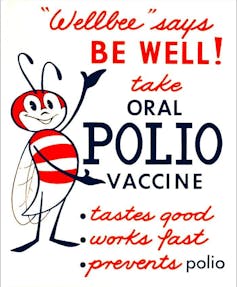
A 1963 poster featuring Wellbee, the CDC’s national symbol of public health, encouraged people to get the polio vaccine.
CDC via Wikimedia Commons
This makes vaccine decisions fundamentally different from most other health decisions. When you decide whether to take medication for high blood pressure, your outcome depends only on your choice. But with vaccines, everyone is connected.
This interconnectedness has played out dramatically in Texas, where the largest U.S. measles outbreak in a decade originated. As vaccination rates dropped in certain communities, the disease – once declared eliminated in the U.S. – returned. One county’s vaccination rate fell from 96% to 81% over just five years. Considering that about 95% of people in a community must be vaccinated to achieve herd immunity, the decline created perfect conditions for the current outbreak.
This isn’t coincidence; it’s game theory playing out in real time. When vaccination rates are high, not vaccinating seems rational for each individual family, but when enough families make this choice, collective protection collapses.
The free rider problem
This dynamic creates what economists call a free rider problem. When vaccination rates are high, an individual might benefit from herd immunity without accepting even the minimal vaccine risks. Game theory predicts something surprising: Even with a hypothetically perfect vaccine – faultless efficacy, zero side effects – voluntary vaccination programs will never achieve 100% coverage. Once coverage is high enough, some rational individuals will always choose to be free riders, benefiting from the herd immunity provided by others.
And when rates drop – as they have, dramatically, over the past five years – disease models predict exactly what we’re seeing: the return of outbreaks.
Game theory reveals another pattern: For highly contagious diseases, vaccination rates tend to decline rapidly following safety concerns, while recovery occurs much more slowly. This, too, is a mathematical property of the system because decline and recovery have different incentive structures. When safety concerns arise, many parents get worried at the same time and stop vaccinating, causing vaccination rates to drop quickly.
But recovery is slower because it requires both rebuilding trust and overcoming the free rider problem – each parent waits for others to vaccinate first. Small changes in perception can cause large shifts in behavior. Media coverage, social networks and health messaging all influence these perceptions, potentially moving communities toward or away from these critical thresholds.
Mathematics also predicts how people’s decisions about vaccination can cluster. As parents observe others’ choices, local norms develop – so the more parents skip the vaccine in a community, the more others are likely to follow suit.
Game theorists refer to the resulting pockets of low vaccine uptake as susceptibility clusters. These clusters allow diseases to persist even when overall vaccination rates appear adequate. A 95% statewide or national average could mean uniform vaccine coverage, which would prevent outbreaks. Alternatively, it could mean some areas with near-100% coverage and others with dangerously low rates that enable local outbreaks.
Not a moral failure
All this means that the dramatic fall in vaccination rates was predicted by game theory – and therefore more a reflection of system vulnerability than of a moral failure of individuals.
What’s more, blaming parents for making selfish choices can also backfire by making them more defensive and less likely to reconsider their views.
Much more helpful would be approaches that acknowledge the tensions between individual and collective interests and that work with, rather than against, the mental calculations informing how people make decisions in interconnected systems.
People make decisions by balancing individual and collective interests – a calculation that’s crucial for how infectious diseases spread.
Research shows that communities experiencing outbreaks respond differently to messaging that frames vaccination as a community problem versus messaging that implies moral failure. In a 2021 study of a community with falling vaccination rates, approaches that acknowledged parents’ genuine concerns while emphasizing the need for community protection made parents 24% more likely to consider vaccinating, while approaches that emphasized personal responsibility or implied selfishness actually decreased their willingness to consider it.
This confirms what game theory predicts: When people feel their decision-making is under moral attack, they often become more entrenched in their positions rather than more open to change.
Better communication strategies
Understanding how people weigh vaccine risks and benefits points to better approaches to communication. For example, clearly conveying risks can help: The 1-in-500 death rate from measles far outweighs the extraordinarily rare serious vaccine side effects. That may sound obvious, but it’s often missing from public discussion. Also, different communities need different approaches – high-vaccination areas need help staying on track, while low-vaccination areas need trust rebuilt.
Consistency matters tremendously. Research shows that when health experts give conflicting information or change their message, people become more suspicious and decide to hold off on vaccines. And dramatic scare tactics about disease can backfire by pushing people toward extreme positions.
Making vaccination decisions visible within communities – through community discussions and school-level reporting, where possible – can help establish positive social norms. When parents understand that vaccination protects vulnerable community members, like infants too young for vaccines or people with medical conditions, it helps bridge the gap between individual and collective interests.
Health care providers remain the most trusted source of vaccine information. When providers understand game theory dynamics, they can address parents’ concerns more effectively, recognizing that for most people, hesitancy comes from weighing risks rather than opposing vaccines outright.

The authors do not work for, consult, own shares in or receive funding from any company or organization that would benefit from this article, and have disclosed no relevant affiliations beyond their academic appointment.
—-
Author : Y. Tony Yang, Endowed Professor of Health Policy and Associate Dean, George Washington University
Publish date : 2025-06-05 12:53:00
Copyright for syndicated content belongs to the linked Source.