



George Orwell's '1984' has some lessons for 2025. NurPhoto/Corbis via Getty Images
When people use the term “Orwellian,” it’s not a good sign.
It usually characterizes an action, an individual or a society that is suppressing freedom, particularly the freedom of expression. It can also describe something perverted by tyrannical power.
It’s a term used primarily to describe the present, but whose implications inevitably connect to both the future and the past.
In his second term, President Donald Trump has revealed his ambitions to rewrite America’s official history to, in the words of the Organization of American Historians, “reflect a glorified narrative … while suppressing the voices of historically excluded groups.”
Such ambitions are deeply Orwellian. Here’s how.
Author George Orwell believed in objective, historical truth. Writing in 1946, he attributed his youthful desire to become an author in part to a “historical impulse,” or “the desire to see things as they are, to find out true facts and store them up for the use of posterity.”
But while Orwell believed in the existence of an objective truth about history, he did not necessarily believe that truth would prevail.
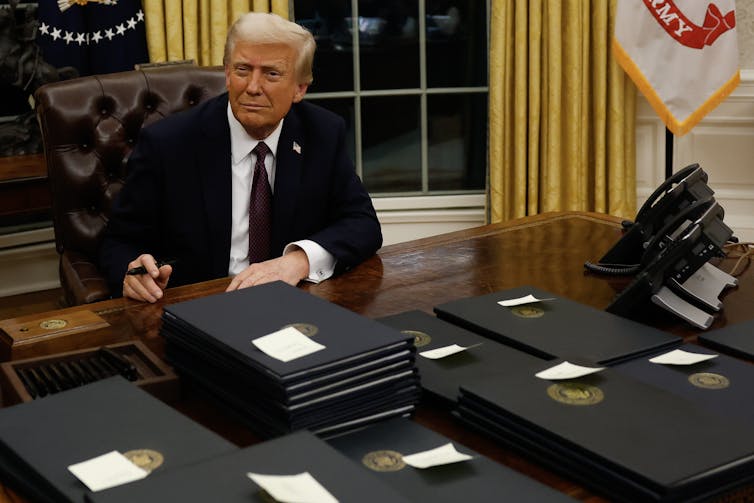
President Donald Trump signed an executive order to determine whether ‘public monuments, memorials, statues, markers, or similar properties … have been removed or changed to perpetuate a false reconstruction of American history.’
Anna Moneymaker/Getty Images
Winners write the history
During World War II, the Nazis broadcast reports on German radio describing nonexistent air raids over Britain.
Orwell knew about those reports and wrote: “Now, we are aware that those raids did not happen. But what use would our knowledge be if the Germans conquered Britain? For the purposes of a future historian, did those raids happen, or didn’t they?”
The answer, Orwell wrote, was, “If Hitler survives, they happened, and if he falls, they didn’t happen. So with innumerable other events of the past ten or twenty years. … In no case do you get one answer which is universally accepted because it is true: in each case you get a number of totally incompatible answers, one of which is finally adopted as the result of a physical struggle. History is written by the winners.”
As Orwell wrote in “1984,” his final, dystopian novel, “Who controls the past controls the future. Who controls the present controls the past.”
Power, Orwell appreciated, allowed those who possessed it to create their own historical narrative. It also allowed those in power to silence or censor opposing narratives, quashing the possibility of productive dialogue about history that could ultimately allow truth to come out.
The Ministry of Truth
The desire to eradicate counternarratives drives Winston Smith’s job at the ironically named Ministry of Truth in “1984.”
The novel is set in Oceania, a geographical entity covering North America and the British Isles and which governs much of the Global South.
Oceania is an absolute tyranny governed by Big Brother, the leader of a political party whose only goal is the perpetuation of its own power. In this society, truth is what Big Brother and the party say it is.
The regime imposes near total censorship so that not only dissident speech but subversive private reflection, or “thought crime,” is viciously prosecuted. In this way, it controls the present.
But it also controls the past. As the party’s protean policy evolves, Smith and his colleagues are tasked with systematically destroying any historical records that conflict with the current version of history. Smith literally disposes of artifacts of inexpedient history by throwing them down “memory holes,” where they are “wiped … out of existence and out of memory.”
At a key point in the novel, Smith recalls briefly holding on to a newspaper clipping that proved that an enemy of the regime had not actually committed the crime he had been accused of. Smith recognizes the power over the regime that this clipping gives him, but he simultaneously fears that power will make him a target. In the end, fear of retaliation leads him to drop the slip of newsprint down a memory hole.
The contemporary U.S. is a far cry from Orwell’s Oceania. Yet the Trump administration is doing its best to exert control over the present and the past.
Down the memory hole
The Trump administration has taken unprecedented steps to rewrite the nation’s official history, attempting to purge parts of the historical narrative down Orwellian memory holes.
Comically, those efforts included the temporary removal from government websites of information about the Enola Gay, the plane that dropped the atomic bomb over Hiroshima. The plane was unwittingly caught up in a mass purge of references to “gay” and LGBTQ+ content on government websites.

As part of efforts to purge references to gay people, U.S. Defense Secretary Pete Hegseth has ordered the removal of gay rights advocate Harvey Milk’s name from a Navy ship.
Screenshot, Military.com
Other erasures have included the deletion of content on government sites related to the life of Harriet Tubman, the Maryland woman who escaped slavery and then played a pioneering role as a conductor of the Underground Railroad, helping enslaved people escape to freedom.
The administration also directed the removal of content concerning the Tuskegee Airmen, the group of African American pilots who flew missions in World War II.
In these cases, public outcry led to the restoration of the deleted content, but other less high-profile deletions have been allowed to stand.
Over the past several months, many of Trump’s opponents have bemoaned the fecklessness of the Democratic Party in mounting an effective opposition to the president’s agenda.
Critics on the right and even some on the left denounced as little more than a stunt New Jersey Sen. Corey Booker’s marathon 25-hour speech on the U.S. Senate floor detailing the constitutional abuses of Trump’s first few months.
But while words are no substitute for action, in the face of a regime that is intent on stifling voices of dissent, from media outlets to law firms, to university campuses, through a combination of formal censorship and informal coercion and bullying, the act of speaking out matters.
Booker’s protest will be written into the Congressional Record and remain a part of the nation’s contested history.
So too will the meticulous recounting of the administration’s constitutional abuses in publications such as The Atlantic and The New York Times. The existence of such a record allows the potential for a critical historical narrative to be written in the future.
But the administration is also looking ahead.
Repressing thought
Current proponents of the “anti-woke” agenda at both the federal and state level are focused on reshaping educational curricula in a way that will make it inconceivable for future generations to question their historical claims.
Orwell’s “1984” ends with an appendix on the history of “Newspeak,” Oceania’s official language, which, while it had not yet superseded “Oldspeak” or standard English, was rapidly gaining ground as both a written and spoken dialect.
According to the appendix, “The purpose of Newspeak was not only to provide a medium of expression for the worldview and mental habits proper to the devotees of [the Party], but to make all other modes of thought impossible.”
Orwell, as so often in his writing, makes the abstract theory concrete: “The word free still existed in Newspeak, but it could only be used in such statements as ‘This dog is free from lice’ or ‘This field is free from weeds.’ … political and intellectual freedom no longer existed even as concepts.”
The goal of this language streamlining was total control over past, present and future.
If it is illegal to even speak of systemic racism, for example, let alone discuss its causes and possible remedies, it constrains the potential for, even prohibits, social change.
It has become a cliché that those who do not understand history are bound to repeat it. As George Orwell appreciated, the correlate is that social and historical progress require an awareness of, and receptivity to, both historical fact and competing historical narratives.

Laura Beers does not work for, consult, own shares in or receive funding from any company or organization that would benefit from this article, and has disclosed no relevant affiliations beyond their academic appointment.
—-
Author : Laura Beers, Professor of History, American University
Publish date : 2025-06-09 12:24:00
Copyright for syndicated content belongs to the linked Source.