



Donald Trump has picked former soccer participant Scott Turner to steer the U.S. Division of Housing and City Building. Whilst no longer a lot is understood about Turner’s positions as he awaits affirmation via the Senate, Trump’s variety attracts consideration to the incoming management’s housing insurance policies.
The ones insurance policies, obvious in each the primary Trump presidency and in feedback made all over the marketing campaign, recommend an abiding religion within the non-public sector and native executive. And they’re prone to come with deregulation and tax breaks for funding in distressed spaces.
In addition they display a disdain for federal truthful housing systems. Those systems, Trump mentioned at the marketing campaign path in 2020, are “bringing who knows into your suburbs, so your communities will be unsafe and your housing values will go down.”
‘Inharmonious neighbors’
In his September 2024 debate with Kamala Harris, Trump replied to a query on immigration via amplifying the discredited rumor that Haitian immigrants in Ohio had been “eating the pets of the people that live there.”
“This is what’s happening in our country,” he added, “and it’s a shame.”
As a historian of public coverage fascinated about city inequality, I’m struck via the similarity between Trump’s diatribe and the ideals that instituted racial segregation in housing a century in the past.
Trump’s false declare echoes the long-standing anxieties of white house owners referring to immigration normally and African American migration particularly.
Mia Perez, left, an immigration attorney, and Bernardette Dor, a pastor on the First Haitian Church, pose in combination after becoming a member of a prayer stroll in improve in their Haitian immigrant group in Springfield, Ohio, on Sept. 14, 2024.
AP Photograph/Luis Andres Henao
Each circumstances pit the pursuits of 1 set of citizens in opposition to the ones of some other.
First, there are the established, overwhelmingly white, citizens – in Trump’s lingo, “the people that live there.” Then come the undesirable new arrivals whose surprising presence in American neighborhoods is noticed as a risk to public well being, welfare and belongings values.
Traditionally, the threats posed via “inharmonious” neighbors – as actual property brokers and later federal housing businesses put it – have fascinated about immigrants and African American citizens.
The surge in immigration to the U.S. on the finish of the nineteenth century animated a notoriously nativist reaction from native governments and realty teams. It integrated early efforts at land-use zoning geared toward setting up economically and racially unique residential districts in towns. And it concerned the primary stirrings of white flight to the suburbs, particularly within the unexpectedly urbanizing Northeast and Midwest.
Patchwork apartheid
Nevertheless it was once the Nice Migration of African American citizens within the first many years of the 20 th century, coupled with the city residential increase of the Twenties, that galvanized the peculiarly American alchemy of race and belongings.
All over this era, many towns, starting with Baltimore in 1910, experimented with explicitly racial zoning that designated neighborhoods for only white or Black occupancy.
The Ultimate Court docket struck those rules down in 1917 at the grounds that it invaded “the civil right to acquire, enjoy and use property.”
With the choice of legally codified racial zoning closed, as I element in my e-book, “Patchwork Apartheid,” the white response to the Nice Migration grew to become to the non-public and piecemeal motion of builders, actual property brokers and house owners.
The center piece was once the fashionable use of personal contracts designed to stop the ones “not wholly of the Caucasian race” from proudly owning or occupying houses in “protected” neighborhoods.
This non-public resistance to built-in neighborhoods was once happening as new housing begins ballooned after the battle, from 240,000 a yr in 1920 to nearly 1 million in 1925.
Those restrictions took various paperwork.
Suburban builders frequently imposed prohibitions on African American occupancy or possession of recent development, particularly within the unexpectedly rising towns of the Midwest. Current citizens of older neighborhoods dealing with racial transition in puts equivalent to Chicago and St. Louis would additionally impose racial covenants via petition.
In these types of settings, as I element in my e-book, racial restrictions had been mechanically hooked up to particular person house gross sales via patrons, dealers or actual property brokers. They was hoping to push back what white realty pursuits mechanically known as “invasion” or “encroachment.”
The end result was once a type of patchwork apartheid. It was once crafted national however stitched in combination parcel via parcel, block via block, subdivision via subdivision.
Stark racial segregation
My paintings on St. Louis has exposed virtually 2,000 racially restrictive agreements imposed between 1900 and 1950. Via 1950, this patchwork of personal restriction encompassed just about two-thirds of the St. Louis area’s residential homes.
Their core good judgment was once that occupancy via inharmonious neighbors constituted a “nuisance” use of belongings.
Ahead of 1920, non-public belongings restrictions frequently integrated a common nuisance provision barring business makes use of, incessantly checklist trades offensive to the senses, equivalent to a slaughterhouse or a junkyard, or to at least one’s morals, equivalent to a tavern.
According to the Nice Migration, white realty corporations in St. Louis and in different places merely appended “colored” occupancy to their checklist of nuisances.
For instance, the uniform settlement utilized by the St. Louis Actual Property Alternate banned two categories of patrons or renters: “any slaughterhouse, junkshop, or rag-picking establishment” and “a Negro or Negroes.”
Within the St. Louis subdivision of Cleveland Heights, a protracted checklist of proscribed nuisances was once capped with the availability that no lot may “in any way or manner” be “occupied by any persons other than those of the Caucasian Race.”
Some restrictions elided racial classes and nuisances via proscribing gross sales to citizens regarded as merely “objectionable” or “undesirable.”
A not unusual clause present in maximum Midwestern settings barred any “race or nationality other than those for whom the premises are intended.”
Such non-public restrictions had been dominated an unenforceable violation of equivalent coverage via the Ultimate Court docket in 1948. They usually had been prohibited outright via the Truthful Housing Act twenty years later.
However the injury – stark racial segregation and a yawning racial wealth hole – was once completed. And the core assumptions about race and belongings lived on within the insurance policies of personal realty, lending and appraisal.
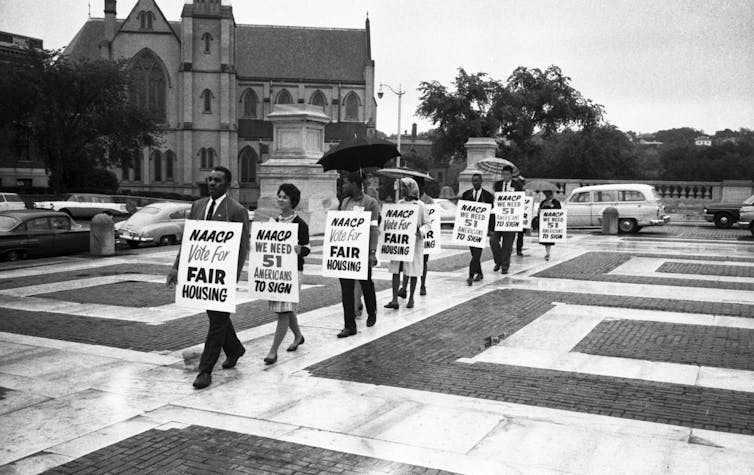
Contributors of the NAACP wooden the Rhode Island State Space in improve of truthful housing regulation in Windfall on June 10, 1963.
Photograph via Bettmann Archive/Getty Pictures
‘Your communities will be unsafe’
Trump’s debate outburst, on this appreciate, mirrored a racial politics formed as a lot via his actual property background as his political aspirations.
Trump inherited a belongings portfolio from his father that was once already deeply dedicated to racial segregation and discrimination in opposition to African American tenants. Starting within the Seventies, his circle of relatives’s New York realty observe was once infamous, and mechanically sued, for violations of the 1968 Truthful Housing Act, supposed to test non-public discrimination in non-public realty.
As president, Trump persevered to erode the perception of truthful housing for all.
In 2020, he jettisoned an Obama-era rule requiring that towns receiving federal housing budget affirmatively cope with native discrimination and segregation.
“The suburb destruction,” he promised on the time, “will end with us.”
Trump housing 2.0
Turner, as the following HUD secretary, is poised to pick out up the place the primary Trump management left off.
Imagine the housing time table of Undertaking 2025, the Heritage Basis’s sweeping blueprint for the second one Trump management. Penned via Ben Carson, Trump’s first HUD secretary, it proposes an intensive retreat from federal “overreach” that would come with gutting anti-discrimination provisions in federal systems and deferring to localities on zoning.
It could additionally bar noncitizens from public housing and opposite “all actions taken by the Biden Administration to advance progressive ideology.”
On the time of Trump’s Springfield, Ohio, feedback, the apocryphal specter of pet-eating immigrants gave the impression however yet one more oddity in a marketing campaign punctuated with them.
Nevertheless it was once greater than that. It was once the preamble to a brand new bankruptcy within the U.S.’s lengthy historical past of discriminatory group “restriction” or “protection.”