


Where did Congress go? Julia Nikhinson/Bloomberg Creative via Getty Images
Republicans in Congress have been making behind-the-scenes efforts to pass major domestic legislation via the federal budget process. They include potential cuts to Medicaid and extending the 2017 Trump tax cuts.
But even though it’s Congress’ job to pass a budget and set tax policy, most media outlets have been content to frame key elements of the legislation as being driven not by Congress but by the president.
So the news media say that the purpose of the bill is to “deliver Trump’s agenda” or to pass the “Trump tax cuts.” Many have even adopted President Donald Trump’s trademark name for the legislation: his “big, beautiful bill.”
Along with Casey Burgat and SoRelle Wyckoff Gaynor, I am co-author of a textbook titled “Congress Explained: Representation and Lawmaking in the First Branch.” In that book, it was important to us to highlight Congress’ clear role as the preeminent lawmaking body in the federal government.
But since Trump’s inauguration, Congress has ceded huge swaths of its policymaking responsibility to the president. That makes the media’s focus on Trump unsurprising. And there’s no denying that Trump has had enormous impact during his first 100 days in office.
During that time, Congress has been unwilling to assert itself as an equal branch of government. Beyond policymaking, Congress has been content to hand over many of its core constitutional powers to the executive branch. As a Congress expert who loves the institution and profoundly respects its constitutionally mandated role, this renunciation of responsibility has been difficult to watch.
And yet, Congress’ path to irrelevance as a body of government did not begin in January 2025.
It is the result of decades of erosion that created a political culture in which Congress, the first branch of government listed in the Constitution, is relegated to second-class status.
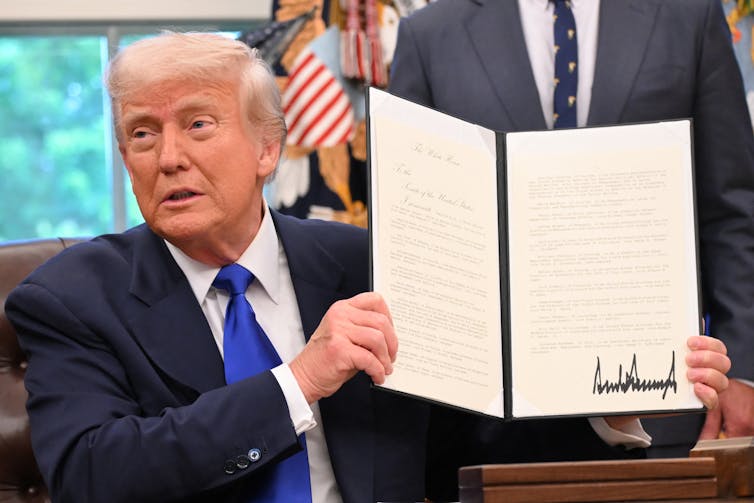
President Donald Trump holds one of the many executive orders he has signed during his second term.
Alex Wroblewski/AFP via Getty Images
The Constitution puts Congress first
The 18th-century framers of the Constitution viewed Congress as the foundation of republican governance, deliberately placing it first in Article 1 to underscore its primacy. Congress was assigned the pivotal tasks of lawmaking and budgeting because controlling government finances was seen as essential to limiting executive power and preventing abuses that the framers associated with monarchy.
Alternatively, a weak legislature and an imperial executive were precisely what many of the founders feared. With legislative authority in the hands of Congress, power would at least be decentralized among a wide variety of elected leaders from different parts of the country, each of whom would jealously guard their own local interests.
But Trump’s first 100 days turned the founders’ original vision on its head, leaving the “first branch” to play second fiddle.
Like most recent presidents, Trump came in with his party in control of the presidency, the House and the Senate. Yet despite the lawmaking power that this governing trifecta can bring, the Republican majorities in Congress have mostly been irrelevant to Trump’s agenda.
Instead, Congress has relied on Trump and the executive branch to make changes to federal policy and in many cases to reshape the federal government completely.
Trump has signed more than 140 executive orders, a pace faster than any president since Franklin D. Roosevelt. The Republican Congress has shown little interest in pushing back on any of them. Trump has also aggressively reorganized, defunded or simply deleted entire agencies, such as the U.S. Agency for International Development and the Consumer Financial Protection Bureau.
These actions have been carried out even though Congress has a clear constitutional authority over the executive branch’s budget. Again, Congress has shown little to no interest in reasserting its power, even during recent budget talks.
Many causes, no easy solutions
Even so, Congress’ weakening did not begin with Trump. There’s no one culprit but instead a collection of factors that have provided the ineffectual Congress of today.
One overriding factor is a process that has unfolded over the past 50 or more years called political nationalization. American politics have become increasingly centered on national issues, parties and figures rather than more local concerns or individuals.
This shift has elevated the importance of the president as the symbolic and practical leader of a national party agenda. Simultaneously, it weakens the role of individual members of Congress, who are now more likely to toe the party line than represent local interests.
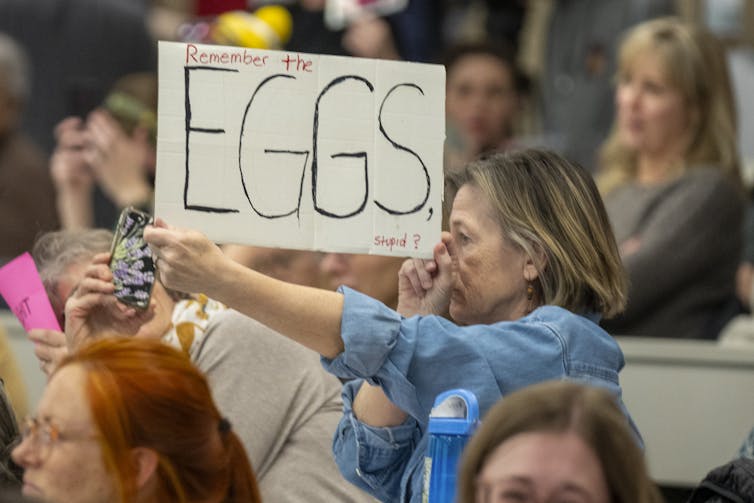
A participant holds a sign during a GOP town hall meeting with U.S. Reps. Celeste Maloy and Mike Kennedy on March 20, 2025, in Salt Lake City.
AP Photo/Rick Egan
As a result, voters focus more on presidential elections and less on congressional ones, granting the president greater influence and diminishing Congress’ independent authority.
The more Congress polarizes among its members on a party-line basis, the less the public is likely to trust the legitimacy of their opposition to a president. Instead, congressional pushback − sometimes as extreme as impeachment − can thus be written off not as principled or substantive but as partisan or politically motivated to a greater extent than ever before.
Congress has also been been complicit in giving away its own power. Especially when dealing with a polarized Congress, presidents increasingly steer the ship in budget negotiations, which can lead to more local priorities – the ones Congress is supposed to represent – being ignored.
But rather than Congress staking out positions for itself, as it often did through the turn of the 21st century, political science research has shown that presidential positions on domestic policy increasingly dictate – and polarize – Congress’ own positions on policy that hasn’t traditionally been divisive, such as funding support for NASA. Congress’ positions on procedural issues, such as raising the debt ceiling or eliminating the filibuster, also increasingly depend not on bedrock principles but on who occupies the White House.
In the realm of foreign policy, Congress has all but abandoned its constitutional power to declare war, settling instead for “authorizations” of military force that the president wants to assert. These give the commander in chief wide latitude over war powers, and both Democratic and Republican presidents have been happy to retain that power. They have used these congressional approvals to engage in extended conflicts such as the Gulf War in the early 1990s and the wars in Iraq and Afghanistan a decade later.
What’s lost with a weak Congress
Americans lose a lot when Congress hands over such drastic power to the executive branch.
When individual members of Congress from across the country take a back seat, their districts’ distinctly local problems are less likely to be addressed with the power and resources that Congress can bring to an issue. Important local perspectives on national issues fail to be represented in Congress.
Even members of the same political party represent districts with vastly different economies, demographics and geography. Members are supposed to keep this in mind when legislating on these issues, but presidential control over the process makes that difficult or even impossible.
Maybe more importantly, a weak Congress paired with what historian Arthur Schlesinger called the “Imperial Presidency” is a recipe for an unaccountable president, running wild without the constitutionally provided oversight and checks on power that the founders provided to the people through their representation by the first branch of government.

Charlie Hunt does not work for, consult, own shares in or receive funding from any company or organization that would benefit from this article, and has disclosed no relevant affiliations beyond their academic appointment.
—-
Author : Charlie Hunt, Assistant Professor of Political Science, Boise State University
Publish date : 2025-05-15 12:20:00
Copyright for syndicated content belongs to the linked Source.