



Judges appointed by Donald Trump are ruling against him during his second presidential term. Zolnierek – iStock/Getty Images Plus
During his first term in office, President Donald Trump appointed 226 federal court judges, including three U.S. Supreme Court justices. Trump successfully installed judges who promoted his political agenda, including overturning the landmark ruling from 1973 that declared the Constitution guaranteed the right to abortion, Roe v. Wade.
But something different seems to be happening in his second term.
Instead of upholding Trump administration policies, federal judges − including those appointed by Trump – are blocking the implementation of much of the president’s second-term agenda.
So, what’s going on?
I’m a scholar of judicial decision-making and presidential interactions with the courts. Although it may seem strange that judges Trump appointed are ruling against him, it’s actually not that weird.
Instead, it’s an example of what happens when a president overreaches his authority, and takes legal positions that even his own judicial appointees cannot support.
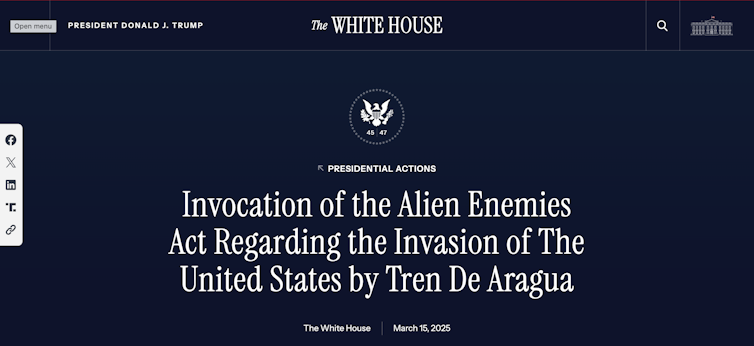
The presidential proclamation invoking the Alien Enemies Act, which a federal judge ruled violates the law.
The White House
How judicial decision-making works
In 2018, Trump and Chief Justice John Roberts got into a very public spat over the nature of judicial decision-making.
This began when Trump attacked U.S. District Judge Jon Tigar, appointed by President Barack Obama, for putting a hold on Trump’s asylum policy. In his criticism, Trump referred to Tigar as an “Obama judge.”
In an unusual retort, Roberts defended the integrity of the federal bench by writing, “We do not have Obama judges or Trump judges, Bush judges or Clinton judges. What we have is an extraordinary group of dedicated judges doing their level best to do equal right to those appearing before them.”
Trump responded, “Sorry Chief Justice John Roberts, but you do indeed have ‘Obama judges,’ and they have a much different point of view than the people who are charged with the safety of our country.”
Both Trump and Roberts had a point.
Trump is correct that judges have different points of view, and those perspectives influence their decision-making. Indeed, more than a half-century of research clearly demonstrates that judges’ ideologies heavily shape how they rule.
Put simply, judges appointed by Democratic presidents tend to rule liberally, and judges appointed by Republican presidents tend to rule conservatively. This includes a strong inclination to support the positions of the president who appointed them.
But Roberts is also correct that judges try to do their best to resolve disputes fairly. That is to say, the law also shapes the choices judges make.
The law in this context refers to the Constitution, legislation passed by Congress and precedents created by the federal courts. These various forms of law operate as a constraint on judges, limiting their ability to reach decisions solely on the basis of their political preferences. Judges must choose from a limited range of choices that are within the bounds of the Constitution, existing law and judicial precedent.
In a nutshell, judges have discretion, but they don’t have totally free choice.
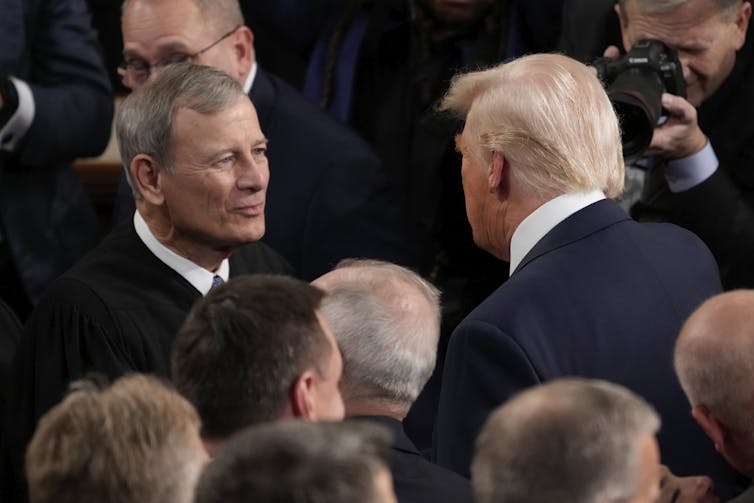
President Donald Trump greets Chief Justice John Roberts before he addresses a joint session of Congress at the U.S. Capitol on March 4, 2025.
AP Photo/Julia Demaree Nikhinson
Even ‘Trump judges’ believe the president is overreaching
This understanding of judicial decision-making is central for grasping why Trump’s judicial appointees – and other judges – are a significant obstacle to Trump’s ability to enact his second-term agenda.
To illustrate, let’s assume that judges appointed by Trump share his political agenda and want to support it. For them to do this, the actions of the Trump administration have to fall within a limited range of activities that judges can plausibly uphold under the Constitution, existing laws and federal court precedent.
The problem is that the Trump administration is taking actions that exceed its legal authority. As a result, even judges appointed by Trump cannot support such actions, because there is no reasonable interpretation of the law that would allow them to do so.
This is precisely what happened on May 1, 2025, when a Trump-appointed judge blocked the administration’s efforts to use the Alien Enemies Act to deport people it suspected of being members of the Tren de Aragua transnational criminal organization. This act allows the president to deport natives of an enemy nation during a “declared war” or “invasion” or “predatory incursion” by a foreign government.
Trump argues that he can use this act because the Tren de Aragua gang is engaged in “irregular warfare” against the United States that amounts to an “invasion or predatory incursion against the territory of the United States.”
But Trump-appointed Judge Fernando Rodriguez didn’t accept this argument.
Instead, Rodriguez wrote that “the President’s invocation of the AEA through the Proclamation exceeds the scope of the statute and, as a result, is unlawful.” Rodriguez reasoned that Tren de Aragua’s actions in the United States do not amount to an “invasion” or “predatory incursion” and therefore the act does not apply.
In short, Rodriguez said that Trump overreached and tried to claim powers beyond those granted to him by the Alien Enemies Act.
Trump’s losing now, but that may change
Although federal court judges, both those appointed by Democrats and those appointed by Republicans, continue to block much of the Trump administration’s policy agenda, this may change for two reasons.
First, the Trump administration could take a more measured approach to pursue its goals by working within the scope of existing law.
Judges have vented their frustration with what one judge called “shoddy” legal work by administration lawyers and another said were weak arguments that don’t reflect “the diligence the Court expects from any litigant … let alone the United States Department of Justice.” The administration’s lawyers can learn from these losses and develop new legal strategies.
Second, different judges may view the Trump administration’s actions differently. Indeed, Trump successfully appointed many judges who have an expansive understanding of executive authority. If Trump can get cases before those judges – something his administration is trying to do – these cases could have very different outcomes.
Like it or not, the results of highly significant cases are often determined by the perspective of a single judge.

Paul M. Collins Jr. does not work for, consult, own shares in or receive funding from any company or organization that would benefit from this article, and has disclosed no relevant affiliations beyond their academic appointment.
—-
Author : Paul M. Collins Jr., Professor of Legal Studies and Political Science, UMass Amherst
Publish date : 2025-05-06 12:38:00
Copyright for syndicated content belongs to the linked Source.