



Salt marshes protect shorelines, but they're already struggling to survive sea-level rise. John Greim/LightRocket via Getty Images
It’s no secret that warming temperatures, wildfires and flash floods are increasingly affecting lives across the United States. With the U.S. government now planning to ramp up fossil fuel use, the risks of these events are likely to become even more pronounced.
That leaves a big question: Is the nation prepared to adapt to the consequences?
For many years, federally funded scientists have been developing solutions to help reduce the harm climate change is causing in people’s lives and livelihoods. Yet, as with many other science programs, the White House is proposing to eliminate funding for climate adaptation science in the next federal budget, and reports suggest that the firing of federal climate adaptation scientists may be imminent.
As researchers and directors of regional Climate Adaptation Science Centers, funded by the U.S. Geological Survey since 2011, we have seen firsthand the work these programs do to protect the nation’s natural resources and their successes in helping states and tribes build resilience to climate risks.
Here are a few examples of the ways federally funded climate adaptation science conducted by university and federal researchers helps the nation weather the effects of climate change.
Protecting communities against wildfire risk
Wildfires have increasingly threatened communities and ecosystems across the U.S., exacerbated by worsening heat waves and drought.
In the Southwest, researchers with the Climate Adaptation Science Centers are developing forecasting models to identify locations at greatest risk of wildfire at different times of year.
Knowing where and when fire risks are highest allows communities to take steps to protect themselves, whether by carrying out controlled burns to remove dry vegetation, creating fire breaks to protect homes, managing invasive species that can leave forests more prone to devastating fires, or other measures.
The solutions are created with forest and wildland managers to ensure projects are viable, effective and tailored to each area. The research is then integrated into best practices for managing wildfires. The researchers also help city planners find the most effective methods to reduce fire risks in wildlands near homes.
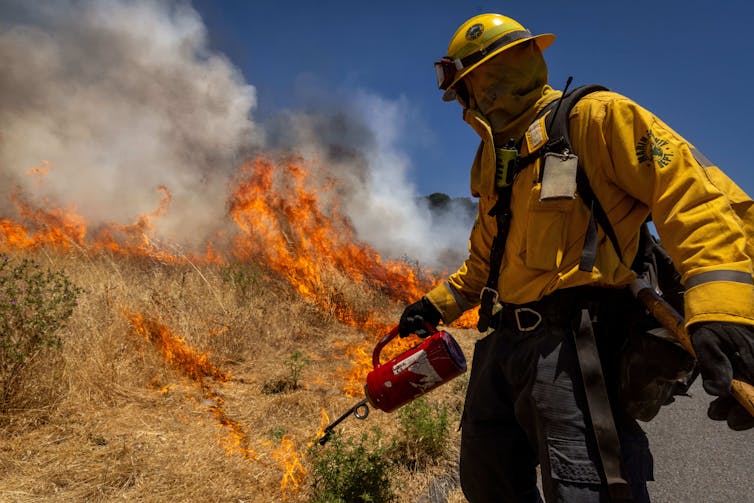
Wildland firefighters and communities have limited resources. They need to know where the greatest risks exist to take preventive measures.
Ethan Swope/Getty Images
In Hawaii and the other Pacific islands, adaptation researchers have similarly worked to identify how drought, invasive species and land-use changes contribute to fire risk there. They use these results to create maps of high-risk fire zones to help communities take steps to reduce dry and dead undergrowth that could fuel fires and also plan for recovery after fires.
Protecting shorelines and fisheries
In the Northeast, salt marshes line large parts of the coast, providing natural buffers against storms by damping powerful ocean waves that would otherwise erode the shoreline. Their shallow, grassy waters also serve as important breeding grounds for valuable fish.
However, these marshes are at risk of drowning as sea level rises faster than the sediment can build up.
As greenhouse gases from burning fossil fuels and from other human activities accumulate in the atmosphere, they trap extra heat near Earth’s surface and in the oceans, raising temperatures. The rising temperatures melt glaciers and also cause thermal expansion of the oceans. Together, those processes are raising global sea level by about 1.3 inches per decade.
Adaptation researchers with the Climate Adaptation Science Centers have been developing local flood projections for the regions’ unique oceanographic and geophysical conditions to help protect them. Those projections are essential to help natural resource managers and municipalities plan effectively for the future.
Researchers are also collaborating with local and regional organizations on salt marsh restoration, including assessing how sediment builds up each marsh and creating procedures for restoring and monitoring the marshes.
Saving salmon in Alaska and the Northwest
In the Northwest and Alaska, salmon are struggling as temperatures rise in the streams they return to for spawning each year. Warm water can make them sluggish, putting them at greater risk from predators. When temperatures get too high, they can’t survive. Even in large rivers such as the Columbia, salmon are becoming heat stressed more often.
Adaptation researchers in both regions have been evaluating the effectiveness of fish rescues – temporarily moving salmon into captivity as seasonal streams overheat or dry up due to drought.
In Alaska, adaptation scientists have built broad partnerships with tribes, nonprofit organizations and government agencies to improve temperature measurements of remote streams, creating an early warning system for fisheries so managers can take steps to help salmon survive.
Managing invasive species
Rising temperatures can also expand the range of invasive species, which cost the U.S. economy billions of dollars each year in crop and forest losses and threaten native plants and animals.
Researchers in the Northeast and Southeast Climate Adaptation Science Centers have been working to identify and prioritize the risks from invasive species that are expanding their ranges. That helps state managers eradicate these emerging threats before they become a problem. These regional invasive species networks have become the go-to source of climate-related scientific information for thousands of invasive species managers.
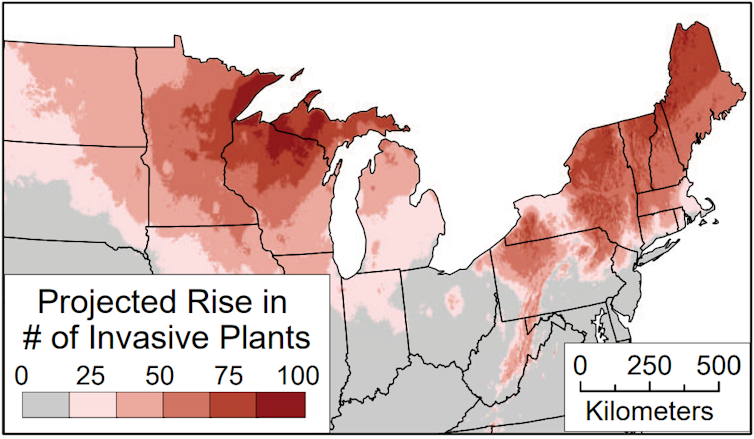
The rise in the number of invasive species projected by 2050 is substantial in the Northeast and upper Midwest. Federally funded scientists develop these risk maps and work with local communities to head off invasive species damage.
Regional Invasive Species and Climate Change Network
The Northeast is a hot spot for invasive species, particularly for plants that can outcompete native wetland and grassland species and host pathogens that can harm native species.
Without proactive assessments, invasive species management becomes more difficult. Once the damage has begun, managing invasive species becomes more expensive and less effective.
Losing the nation’s ability to adapt wisely
A key part of these projects is the strong working relationships built between scientists and the natural resource managers in state, community, tribal and government agencies who can put this knowledge into practice.
With climate extremes likely to increase in the coming years, losing adaptation science will leave the United States even more vulnerable to future climate hazards.

Bethany Bradley receives funding from the US Geological Survey as the University Director of the Northeast Climate Adaptation Science Center.
Jia Hu has receives funding from the US Geological Survey as the University Director of the Southwest Climate Adaptation Science Center.
Meade Krosby receives funding from the US Geological Survey as the University Director of the Northwest Climate Adaptation Science Center.
—-
Author : Bethany Bradley, Professor of Biogeography and Spatial Ecology, UMass Amherst
Publish date : 2025-05-12 12:25:00
Copyright for syndicated content belongs to the linked Source.