



Autocrats today tend to govern by manipulation of the public, among other tactics, rather than solely using violence. Nanzeeba Ibnat/iStock/Getty Images Plus
President Donald Trump’s critics often accuse him of harboring authoritarian ambitions. Journalists and scholars have drawn parallels between his leadership style and that of strongmen abroad. Some Democrats warn that the U.S. is sliding toward autocracy – a system in which one leader holds unchecked power.
Others counter that labeling Trump an autocrat is alarmist. After all, he hasn’t suspended the Constitution, forced school children to memorize his sayings or executed his rivals, as dictators such as Augusto Pinochet, Mao Zedong and Saddam Hussein once did.
But modern autocrats don’t always resemble their 20th-century predecessors.
Instead, they project a polished image, avoid overt violence and speak the language of democracy. They wear suits, hold elections and talk about the will of the people. Rather than terrorizing citizens, many use media control and messaging to shape public opinion and promote nationalist narratives. Many gain power not through military coups but at the ballot box.
The softer power of today’s autocrats
In the early 2000s, political scientist Andreas Schedler coined the term “electoral authoritarianism” to describe regimes that hold elections without real competition. Scholars Steven Levitsky and Lucan Way use another phrase, “competitive authoritarianism,” for systems in which opposition parties exist but leaders undermine them through censorship, electoral fraud or legal manipulation.
In my own work with economist Sergei Guriev, we explore a broader strategy that modern autocrats use to gain and maintain power. We call this “informational autocracy” or “spin dictatorship.”
These leaders don’t rely on violent repression. Instead, they craft the illusion that they are competent, democratic defenders of the nation – protecting it from foreign threats or internal enemies who seek to undermine its culture or steal its wealth.
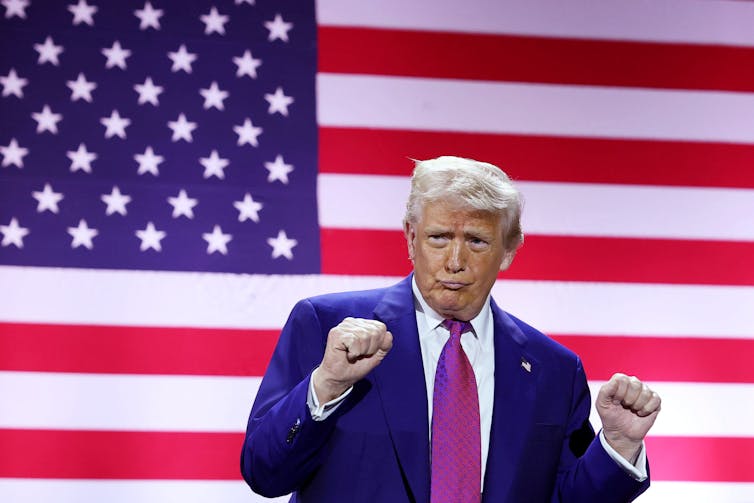
President Donald Trump appears at an Air Force base in Doha, Qatar, on May 15, 2025.
Win McNamee/Getty Images
Hungary’s democratic facade
Hungarian Prime Minister Viktor Orbán exemplifies this approach. He first served from 1998 to 2002, returned to power in 2010 and has since won three more elections – in 2014, 2018 and 2022 – after campaigns that international observers criticized as “intimidating and xenophobic.”
Orbán has preserved the formal structures of democracy – courts, a parliament and regular elections – but has systematically hollowed them out.
In his first two years he packed Hungary’s constitutional court, which reviews laws for constitutionality, with loyalists, forced judges off the bench by mandating a lower retirement age and rewrote the constitution to limit judicial review of his actions. He also tightened government control over independent media.
To boost his image, Orbán funneled state advertising funds to friendly news outlets. In 2016, an ally bought Hungary’s largest opposition newspaper – then shut it down.
Orbán has also targeted advocacy groups and universities. The Central European University, which was registered in both Budapest and the U.S., was once a symbol of the new democratic Hungary. But a law penalizing foreign-accredited institutions forced it to relocate to Vienna in 2020.
Yet Orbán has mostly avoided violence. Journalists are harassed rather than jailed or killed. Critics are discredited for their beliefs but not abducted. His appeal rests on a narrative that Hungary is under siege – by immigrants, liberal elites and foreign influences – and that only he can defend its sovereignty and Christian identity. That message resonates with older, rural, conservative voters, even as it alienates younger, urban populations.
A global shift in autocrats
In recent decades, variants of spin dictatorship have appeared in Singapore, Malaysia, Kazakhstan, Russia, Ecuador and Venezuela. Leaders such as Hugo Chávez and the early Vladimir Putin consolidated power and marginalized opposition with minimal violence.
Data confirm this trend. Drawing from human rights reports, historical records and local media, my colleague Sergei Guriev and I found that the global incidence of political killings and imprisonments by autocrats dropped significantly from the 1980s to the 2010s.
Why? In an interconnected world, overt repression has costs. Attacking journalists and dissidents can prompt foreign governments to impose economic sanctions and discourage international companies from investing. Curbing free expression risks stifling scientific and technological innovation – something even autocrats need in modern, knowledge-based economies.
Still, when crises erupt, even spin dictators often revert to more traditional tactics. Russia’s Putin has cracked down violently on
protesters and jailed opposition leaders. Meanwhile, more brutal regimes such as those in North Korea and China continue to rule by spreading fear, combining mass incarceration with advanced surveillance technologies.
But overall, spin is replacing terror.
America too?
Most experts, myself included, agree that the U.S. remains a democracy.
Yet some of Trump’s tactics resemble those of informational autocrats. He has attacked the press, defied court rulings and pressured universities to curtail academic independence and limit international admissions. His admiration for strongmen such as Putin, China’s Xi Jinping and El Salvador’s Nayib Bukele alarms observers. At the same time, Trump routinely denigrates democratic allies and international institutions such as the United Nations and NATO.
Some experts say democracy depends on politicians’ self restraint. But a system that survives only if leaders choose to respect its limits is not much of a system at all.
What matters more is whether the press, judiciary, nonprofit organizations, professional associations, churches, unions, universities and citizens have the power – and the will – to hold leaders accountable.
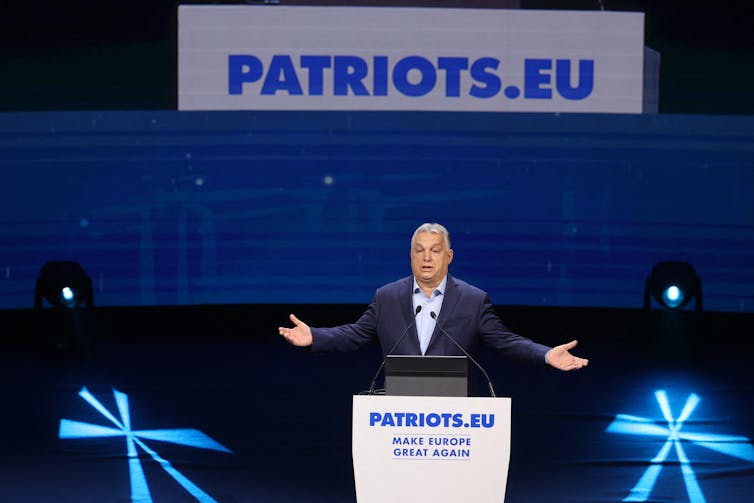
Hungarian Prime Minister Viktor Orbán delivers a speech at a hotel in Madrid on Feb. 8, 2025.
Thomas Coex/AFP via Getty Images
Preserving democracy in the US
Wealthy democracies such as the U.S., Canada and many Western European countries benefit from robust institutions such as newspapers, universities, courts and advocacy groups that act as checks on government.
Such institutions help explain why populists such as Italy’s Silvio Berlusconi or Israel’s Benjamin Netanyahu, although accused of bending electoral rules and threatening judicial independence, have not dismantled democracy outright in their countries.
In the U.S., the Constitution provides another layer of protection. Amending it requires a two-thirds majority in both houses of Congress and ratification by three-quarters of the states – a far steeper hurdle than in Hungary, where Orbán needed only a two-thirds parliamentary majority to rewrite the constitution.
Of course, even the U.S. Constitution can be undermined if a president defies the Supreme Court. But doing so risks igniting a constitutional crisis and alienating key supporters.
That doesn’t mean American democracy is safe from erosion. But its institutional foundations are older, deeper and more decentralized than those of many newer democracies. Its federal structure, with overlapping jurisdictions and multiple veto points, makes it harder for any one leader to dominate.
Still, the global rise of spin dictatorships should sharpen awareness of what is happening in the U.S. Around the world, autocrats have learned to control their citizens by faking democracy. Understanding their techniques may help Americans to preserve the real thing.

Daniel Treisman does not work for, consult, own shares in or receive funding from any company or organization that would benefit from this article, and has disclosed no relevant affiliations beyond their academic appointment.
—-
Author : Daniel Treisman, Professor of Political Science, University of California, Los Angeles
Publish date : 2025-06-03 12:43:00
Copyright for syndicated content belongs to the linked Source.