



Sick animals often move to warmer places to raise their body temperature. GK Hart/Vikki Hart/Stone via Getty Images
Why do people get fevers when we get sick?
It’s a common misconception that pathogens, such as SARS-CoV-2 or the flu, cause fevers. But as biology professors, we know it’s not that simple. Pathogens cause fevers only indirectly.
When your immune system detects harmful microbes, your body raises its internal temperature to create a hostile environment. Turning up the heat suppresses the proliferation of invaders. In short, the fever is the body’s way of fighting back.
Although many people don’t understand fever’s purpose, animals certainly utilize it. Even so-called “simple creatures,” such as lizards, fish and insects, use fever to recover from illness.
The body’s response
Suppose you catch a virus. The immune system responds by releasing molecules called pyrogens, which induce fever. They signal the brain’s hypothalamus to raise the body’s set point temperature – like adjusting a thermostat.
Normal body temperature hovers around 98.6 degrees Fahrenheit (37 degrees Celsius), but fevers commonly increase temperatures to 100.4-104 F (38-40 C).
When that happens, your muscles contract, causing shivers, and blood vessels constrict to retain heat. You’ll feel cold until your body reaches the new set point, often prompting you to add clothes or snuggle into blankets. When the infection subsides, pyrogens decrease and the hypothalamus resets the temperature. You sweat, your blood vessels dilate, and you cool off. You’re feeling better.

There’s a reason why you shiver when you have a fever.
Edwin Tan/E+ via Getty Images
Mammals, lizards, fish and insects
Humans are not special in this regard; all mammals are capable of generating fevers. Even without taking their temperature, you might recognize the signs in a familiar companion. When dogs have a fever, they often lose their appetite, become lethargic and may shiver − behaviors that closely resemble how people respond when they’re running a fever.
This adaptive response to infection is widespread in nature. Even cold-blooded animals, which rely on the environment for warmth, raise their temperature behaviorally.
Lizards move to warmer areas when sick. If they’re blocked from doing so − or given fever-reducing drugs − their survival rates drop. Zebrafish swim to warmer waters during infection; a rise of just 5.4 F (3 C) correlates with improved gene expression, stronger antiviral responses and higher survival. Naked mole rats – a social, subterranean cold-blooded mammal that looks like a hot dog with teeth – generate fevers in response to infection, despite their unusual physiology.
Insects, too, show remarkable responses. Desert locusts elevate their body temperature when infected, doing so in a dose-dependent manner: more pathogen, higher temperature. This behavior increases their chance of survival and reproduction.
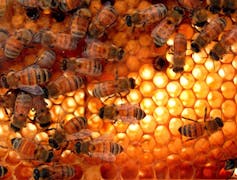
Honeybees have a unique way of fighting a fever.
Joannis S. Duran/Moment via Getty Images
Honeybees are among the most sophisticated. These social insects regulate brood temperature with extraordinary precision, keeping it between 90-95 F (32-35 C). They warm the hive by contracting flight muscles and cool it by fanning wings, sometimes spreading water on the comb to induce evaporative cooling.
If their larvae are exposed to heat-sensitive fungal spores, the colony raises the temperature − essentially giving itself a fever. The increased heat prevents spore germination and protects the next generation. Once the threat has passed, the bees restore their normal hive temperature.
If fevers don’t wind down within 24 to 36 hours, it’s time to see a doctor.
Treating a fever
These examples show that evolution has favored the fever response. Yet when humans get a fever, our instinct is often to bring it down – using aspirin, removing blankets or applying cold compresses. And sometimes that’s appropriate. Adults should seek medical attention if fever exceeds 103 F (39.4 C); children at 102 F (38.9 C); and infants younger than three months at 100.4 F (38 C).
But mild to moderate fevers often help more than they hurt. Reducing a fever too soon − via medication or environmental cooling − may interfere with the body’s natural defense, prolonging illness.
This isn’t a new idea. Nearly a century ago, Austrian physician Julius Wagner-Jauregg pioneered an extreme method called malariotherapy: infecting syphilis patients with malaria. The high fever induced by malaria killed the syphilis-causing bacteria. Once the bacteria was eliminated, doctors treated the malaria with quinine.
The approach was risky but effective enough to win Wagner-Jauregg the Nobel Prize in 1927. Although some patients died from the treatment, and many others relapsed, it remained in use for about two decades, until replaced by penicillin. Think of Wagner-Jauregg’s treatment like using a sledgehammer to drive a nail; it worked, though the wall didn’t always survive.
Much remains to be discovered about how fever affects the immune response. Still, the underlying message holds: Fever fights infection.
The fact that so many diverse creatures developed similar fever responses suggests a powerful pattern known as convergent evolution − when different species with enormously complex evolutionary histories converge on a similar solution. Despite different evolutionary paths, all these organisms faced the same challenge − infection − and arrived at the same solution: fever.

Phil Starks received past funding from the NSF for providing research experiences for undergraduates (REU).
Harry Bernheim had grants from the NIH in the 1980's.
—-
Author : Phil Starks, Associate Professor of Biology, Tufts University
Publish date : 2025-05-23 12:46:00
Copyright for syndicated content belongs to the linked Source.