



Did you consume cereal this morning? Or have you ever walked on a gravel trail? Perhaps you had a headache and needed to take a tablet? When you responded any of those questions with a sure, you interacted with a granular machine lately.
Scientists classify any selection of small, exhausting debris – equivalent to puffed rice, sand grains or drugs – as a granular machine.
Despite the fact that everybody has interacted with all these programs, describing the physics of ways the debris jointly act when they’re shut in combination is unusually exhausting.
Granular programs every so often transfer like a fluid. Bring to mind an hourglass the place sand, an excessively standard granular subject matter, flows from one part of the glass to the opposite. However in case you’ve run on a seaside, that sand too can act like a forged. You’ll be able to transfer over it with out sinking throughout the sand.
As a geologist, I’m curious about working out when a granular machine flows and when it has energy and behaves like a forged. This line of analysis is essential for lots of agricultural and commercial programs, equivalent to shifting corn kernels or drugs in a pipeline or shoot.
Figuring out when a granular machine may float may be very important for geologic danger checks. As an example, geologists want to know whether or not the quite a lot of boulders making up the slope of a mountain are strong or whether or not they’re going to transfer as a rockslide.
Shifting forces between grains
To grasp the habits of a granular machine, scientists can zoom in and take a look at the interactions between particular person grains. When two debris are in touch with each and every different, they may be able to switch forces between each and every different.
Consider this state of affairs: You’ve got 3 tennis balls – the grains on this experiment. You set the tennis balls in a row and squeeze the 3 balls between your hand and a wall, in order that your hand presses in opposition to the primary ball. The final ball is in touch with a wall, however the center ball is loose floating and touches best the opposite two balls.
Tennis balls can act as grains on this easy granular machine experiment. Whilst you push in opposition to the tennis ball at the finish, you exert a drive, which acts upon the opposite two balls and sooner or later the wall.
Jeremy Randolph-Flagg
By means of pushing in opposition to the primary ball, you have got effectively transferred the drive out of your hand throughout the row of 3 tennis balls onto the wall, despite the fact that you’ve touched best the primary ball.
Now consider you have got many grains, like in a pile of sand, and all of the sand grains are in touch with some neighboring grains. Grains that contact switch forces between each and every different. How the forces are allotted on this granular machine dictates whether or not the machine is strong and unmoving or if it’s going to transfer – equivalent to a rockslide or the sand in an hourglass.
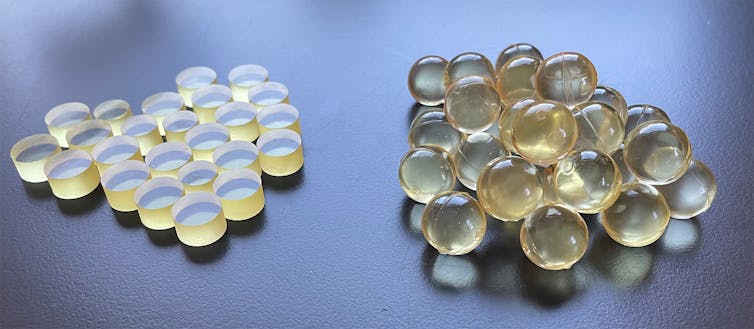
At the left are photoelastic discs used for two-dimensional experiments (9 mm diameter), and at the proper are photoelastic grains used for three-d experiments (14 mm diameter).
Nathan Coon
Monitoring forces within the lab
That is the place my analysis workforce is available in. At the side of my scholars, I find out about how grains engage with each and every different within the laboratory.
In our experiments, we will be able to visualize the forces between particular person grains in a granular machine. Whilst all granular programs have those forces provide, we can not see their distribution as a result of drive is invisible in maximum grains, equivalent to sand or drugs. We will see the forces best in some clear fabrics.
To make the forces visual, we made grains the usage of a subject matter this is clear and has a unique belongings referred to as photoelasticity. When photoelastic fabrics are illuminated and enjoy drive, they cut up mild into two rays that commute at other speeds.
This belongings bureaucracy brilliant, colourful bands within the differently clear subject matter that make the drive visual. The brightness of the grains is determined by how a lot drive a grain is experiencing, so we will be able to see how the forces are allotted within the granular machine. The debris themselves don’t emit mild, however they modify how briskly mild rays commute via them after they enjoy drive – which makes them seem brighter.
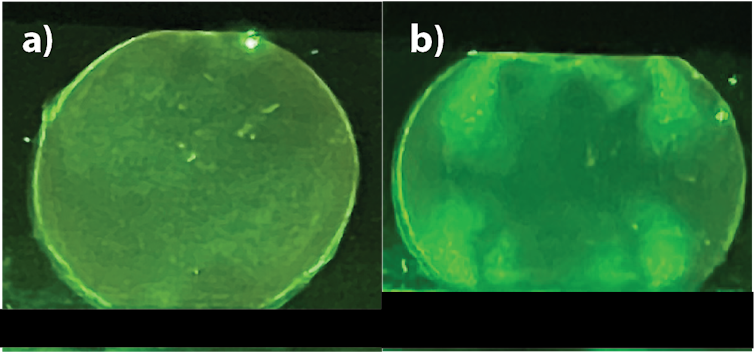
On facet A is a three-d photoelastic grain with out drive implemented, whilst on facet B is identical grain as soon as drive is implemented. On this case, we simply squish the grain from the highest and backside. The brighter inexperienced bands get started on the best and backside of the grain the place the drive is implemented and are the results of the photoelastic belongings.
Jacqueline Reber
Scientists earlier than us have used photoelasticity to visualise drive in granular fabrics. Those earlier experiments, alternatively, have tested just a unmarried layer of grains. We evolved a strategy to see the forces in now not only a unmarried layer of grains however during an entire heap.
Looking at the forces at the outdoor of the heap of grains is beautiful simple, however seeing how the forces are allotted in the course of the pile is so much more difficult. To look into the center of the granular machine and to remove darkness from grains there, we used a laser mild sheet.
To generate a laser mild sheet, we manipulated a laser beam in order that the sunshine unfold out into an excessively slim sheet.
With this mild sheet, we illuminated one slice during the granular machine. In this illuminated slice, shall we see which grains have been moving forces, in a similar way to the former two-dimensional experiments, with no need to fret concerning the 3rd size.
We then gathered knowledge from many slices throughout other portions of the grain heap. We used the tips from the person slices to reconstruct the three-d granular machine.
This system is very similar to how docs reconstruct three-d shapes of the mind and different organs from the two-dimensional pictures received through a clinical CT scanner.
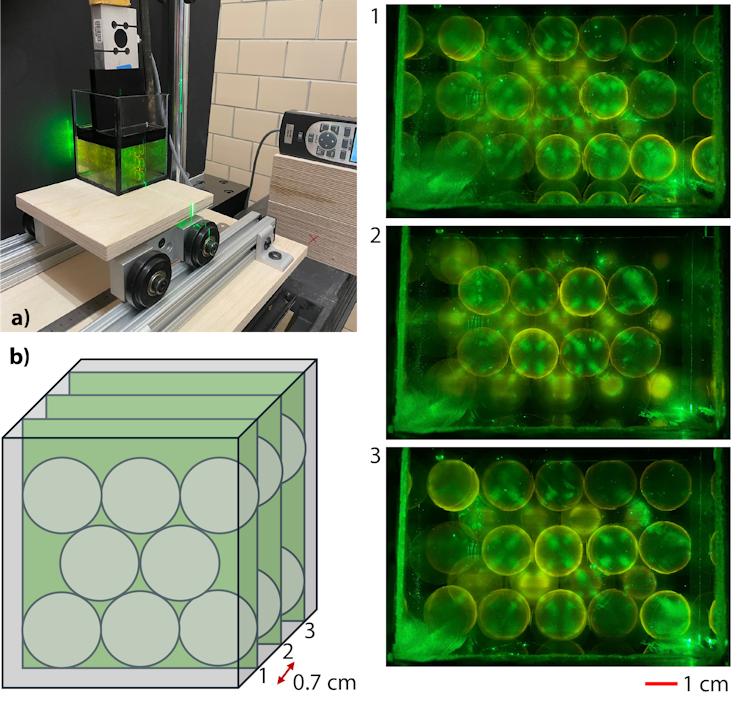
In three-D photoelastic experiments, the cart machine proven on the best left is used to procure incessantly spaced laser mild slices of the experiments, with the center being sliced. The ground left displays a schematic on how a couple of slices can recreate a three-D object. The fitting displays 3 consecutive footage which are 0.7 cm aside – more or less one grain’s radius. The brilliant inexperienced crosshatch trend displays how the forces are allotted between the person grains.
Nathan Coon
In our present experiments, we’ve been the usage of just a small selection of grains – 107. This fashion we will be able to stay observe of each and every particular person grain and check whether or not this technique works to peer the drive distribution in 3 dimensions. Those 107 grains fill a cube-shaped field this is about 4 inches (10 centimeters) extensive, tall and deep.
To this point, the experimental way is operating neatly, and we’ve been in a position to peer how the drive is sent between the 107 grains. Subsequent, we plan to enlarge the experimental setup to incorporate extra grains and discover how the drive adjustments after we agitate the granular machine – as an example, through bumping it.
This new experimental method opens the door for lots of extra experiments that may assist us to raised perceive granular programs. Those programs are throughout you, and whilst they appear so easy, researchers nonetheless don’t in reality know the way they behave.