



The wear from the Eaton Hearth wasn’t indiscriminate. The blaze that ravaged town of Altadena, California, in January 2025, killing 17 other people and eating over 9,000 structures, destroyed Black Altadenans’ properties in biggest percentage.
About 48% of Black-owned properties sustained main harm or overall destruction, when put next with 37% of the ones owned through Asian, Latino or white Altadenans, in step with a February 2025 record from the UCLA Ralph J. Bunche Middle for African American Research.
The Eaton Hearth’s asymmetric devastation finds a development of racial discrimination prior to now hid alongside neat blocks of mid-century, ranch-style properties and tree-lined streets.
‘A place for white people only’
Within the early twentieth century, Altadena used to be a qualified enclave attached to Los Angeles, 13 miles away, through the Pacific Electrical Railway, or “Red Car” machine.
It used to be additionally lily-white, and that’s how home-owner teams appreciated it, in step with analysis through Altadena historian Michele Zack.
Those organizations, which had lofty names such because the Nice Northwest Growth Affiliation and West Altadena Growth Affiliation, instructed house owners to write down language into their deeds that may bar Black, Latino or Asian tenants from purchasing or renting there.
“We want our section of Pasadena and Altadena to be a place for white people only,” learn one house owners affiliation understand despatched to belongings house owners in 1919.
A women golfing lesson in Altadena, Calif., 1958.
Maryland Studio/PGA of The united states by the use of Getty Pictures
Via the tip of International Conflict II, maximum houses in Altadena had racially restrictive deeds or covenants – a development being repeated in white suburbs around the nation.
In 1948, the U.S. Splendid Courtroom struck down such restrictions in Shelley v. Kraemer as unenforceable. Nonetheless, the 1950 census presentations that Altadena had no Black citizens.
Development the brand new LA
However the Los Angeles space used to be converting. The West Coast economic system boomed after the conflict, and Black American citizens from Louisiana, Oklahoma and Texas started heading to California. Many landed in Pasadena, at once south of Altadena.
Claiming that American citizens most popular buses and vehicles to trains, a consortium of car, oil and tire firms persuaded Los Angeles officers to tear out the electrical railway and exchange it with roads.
Los Angeles’ “Red Car” machine, which had attached the area, closed for excellent in 1961. Altadena had already misplaced its rail connection to Los Angeles lengthy prior to, in 1941.
Via mid-century, broader Los Angeles had turn out to be a chain of homeowner-controlled enclaves attached through freeways and choked with smog.
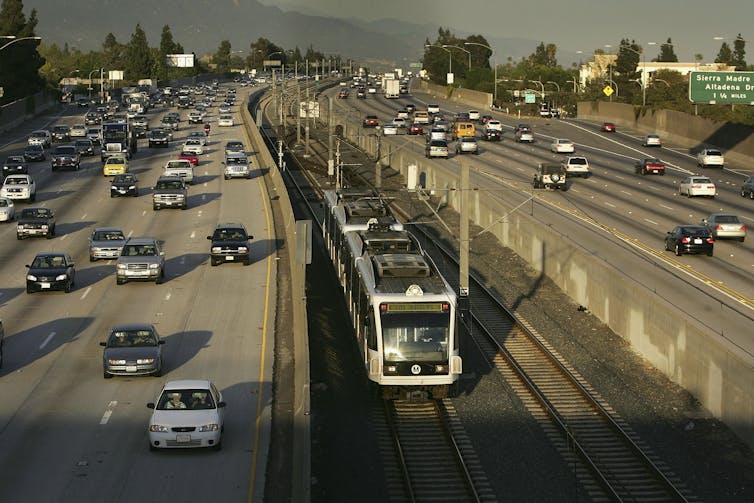
Interstate 210, between Pasadena and Los Angeles, in 2007.
David McNew/Getty Pictures
Some relocated inside Pasadena or moved to Duarte, Monrovia, Pomona or South Los Angeles. However a handful of households purchased properties in Altadena, defying the unlawful racial covenants nonetheless in position there.
When Davis moved in, the tale reviews, his new neighbors submit “a 40-inch white plaster cross that (read) ‘you are not welcome here.‘” The Davis circle of relatives “paid it no attention.”
Altadena embodied a paradox noticed national. Town built-in, however block-by-block segregation stored white and Black citizens aside.
Discrimination in new paperwork
Via 1970, kind of one-third of Altadena’s inhabitants used to be Black, and 70% of Black families in Altadena owned their properties – just about double Los Angeles County’s Black house possession fee of 38%.
Black citizens nearly completely lived in West Altadena. Quite a bit there have been smaller than the ones at the east facet of the town, so that they had been extra reasonably priced. They had been additionally older, which made them extra liable to fires as a result of they had been constructed with fabrics that had been extra flammable than the ones utilized in more moderen properties.
As my e book “The Plunder of Black America: How the Racial Wealth Gap Was Made” presentations, as soon as Black households surmounted one impediment, corresponding to racial covenants, some other rose instead.
Within the Nineteen Sixties and Nineteen Seventies, many white Altadenans resisted college integration, opposing boundary adjustments and busing that may have put Black and Latino scholars in predominantly white Altadena colleges. California handed Proposition 13 in 1978, freezing belongings taxes at 1% in their assessed price. Public colleges misplaced important investment, personal colleges won prosperous scholars, and academic segregation deepened.
Instructional discrimination feeds wealth inequality, which used to be critical national: In 1980, for each greenback a white family owned, a Black one owned 20 cents.
Emerging house values, satirically, had a in a similar way malignant impact. Within the Nineteen Eighties, the Los Angeles space changed into one of the vital dear housing markets within the country. Many Black Altadenans may now not have the funds for to reside there. The percentage of town’s inhabitants that used to be Black fell from 43% in 1980 to 38% in 1990. Via the 2000s it had dropped to underneath 25%.
Nice Recession takes its toll
Black house owners who remained in Altadena had been hit laborious through the 2008 housing disaster. That disaster used to be brought about partially through lenders guidance debtors, in particular debtors of colour, into subprime loans, even if they certified for higher offers.
Between 2007 and 2009, Black families misplaced 48% in their wealth – just about part their belongings. White wealth dropped right through the Nice Recession, too, however simplest through about one-quarter.
Analysis into this racial discrepancy later confirmed that as a result of white households had extra of a monetary cushion, they may stem their losses.
Those and different components have all dragged down the wealth of Black Californians through the years. In 2023, California’s process power on reparations calculated that the state’s discriminatory practices value the common African American in California $160,931 in homeownership wealth when put next with a white Californian.
Racism fuels the hearth
The ones inequities had been a tinderbox that the Eaton Hearth ignited.
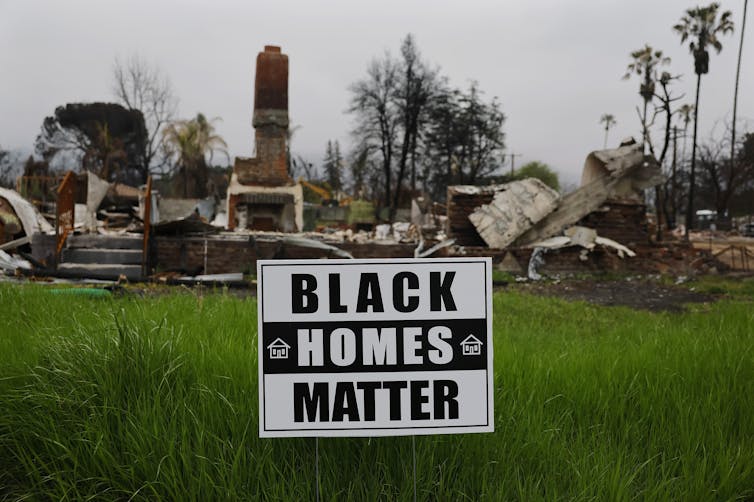
Altadena, Calif., March 26, 2025: A scene of wreck.
Mario Tama/Getty Pictures
Black Altadenans additionally have a tendency to be older than their white neighbors, as a result of maximum had purchased into the world prior to the actual property increase of the Nineteen Eighties. The bodily and fiscal traces standard of an ageing family can have brought about hardships for taking out plants – a easiest observe in protective a construction from an ember fireplace.
These kinds of components most probably contributed to the Eaton Hearth disproportionately burning Black-owned properties. All are attached to town’s legacy of discrimination and exclusion. And they’ll all make fireplace restoration tougher for Black Altadenans, too.