



The Earth formed in a ring of debris around the Sun, like the one around Vega, a bright star, in this artist's conception. NASA/JPL-Caltech
Curious Kids is a series for children of all ages. If you have a question you’d like an expert to answer, send it to CuriousKidsUS@theconversation.com.
How was the Earth built? – Noah, age 5, Florida
It isn’t easy to figure out how the Earth was built, because it happened 4½ billion years ago, and no one was there to watch. So scientists have had to look at what the Earth looks like now and at all of the other planets, moons and debris in the solar system.
They’ve concluded that the Earth was built in the same way that you would build a big snowball to make a snowman. The mass that would become our home rolled through planetary debris – rocks floating in space – for more than 100 million years, adding more and more material, until it grew into a full-size planet.
How do scientists like me know this is what happened? First, studies of the size, composition and location of asteroids and comets, many of which are as old as the Earth, indicate that 4½ billion years ago the solar system looked the way Saturn looks today, with rings of space rocks orbiting around the Sun. There’s still one such ring around the Sun – it’s called the asteroid belt and lies between Mars and Jupiter, with the Sun’s gravity holding the rocks in orbit.
The solar system that includes Earth formed from a spinning disk of dust and gases.
All of the other bodies that we know as planets today began as similar rings of space debris. An eddy, or area of rolling, developed in each of these rings and caused the debris to clump up in a snowball effect. But these pieces of debris were asteroids that smashed violently into the growing planets.
We can see those impacts on planets and moons whose surfaces haven’t weathered or reformed. If you look at the Moon or the planet Mercury, you can see that they are covered with craters from asteroid impacts.
When asteroids or comets struck these building planets, they crashed into their surfaces at speeds as high as 40,000 to 50,000 miles per hour (65,000 to 80,000 kilometers per hour). The impacts caused huge explosions that emitted massive amounts of dust and broken or melted rock.
In fact, scientists believe that the Moon was once part of the Earth, until a large asteroid crashed into the Earth so hard that the Moon broke away and shot into space. There, it began orbiting the Earth as it does now.
Still under construction
Most big asteroids and comets collided with the Earth when it was young, about 4½ billion years ago. The number of such collisions has steadily decreased ever since. However, at least 100 tons of dust-size space rock rains down on the Earth every day, increasing the size of our planet bit by bit.
The Earth also collides with space rocks, called meteors, that show up as shooting stars in the night sky. Some of these meteors come from an impact that struck Mars at some point, breaking away rock from the planet surface and shooting it into outer space. These rocks have been falling to Earth ever since.
What’s the difference between an asteroid and a comet? Asteroids are large space rocks, while comets are large, dirty ice balls. Meteors are smaller − typically the size of pebbles or even dust.
About 65 million years ago, a huge asteroid struck the Earth in the Gulf of Mexico. The enormous Chicxulub explosion drove large tsunamis throughout the ocean and raised so much dust into the air that it made the dinosaurs go extinct.
Another large asteroid impact, about 35 million years ago, made a huge crater in the area that is now the Chesapeake Bay, near Washington, D.C. More recently, in 1908, an asteroid likely exploded over Tunguska, Russia, flattening 830 square miles (2,150 square kilometers) of trees. Fortunately, no one lived in the area, so there were no known casualties.
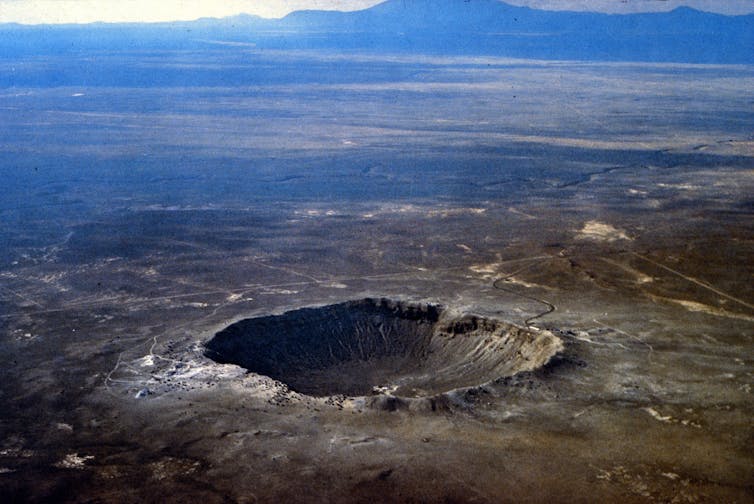
Barringer Crater in Arizona was caused by a meteor strike about 50,000 years ago. It measures about 0.75 miles (1.2 kilometers) across.
D. Roddy, USGS/Wikipedia
Once a mass of space debris was assembled into the Earth, many processes continued to shape the planet’s surface. Wind, water, heat and cold cause rocks to weather and break down and soil to erode. Mountains are created as pieces of Earth’s crust collide and crack. Rivers and glaciers wear down the planet’s surface to make it smoother.
The Earth is a dynamic planet that is constantly being built, and these processes will continue for billions of years into the future.
Hello, curious kids! Do you have a question you’d like an expert to answer? Ask an adult to send your question to CuriousKidsUS@theconversation.com. Please tell us your name, age and the city where you live.
And since curiosity has no age limit – adults, let us know what you’re wondering, too. We won’t be able to answer every question, but we will do our best.

Alexander E. Gates does not work for, consult, own shares in or receive funding from any company or organization that would benefit from this article, and has disclosed no relevant affiliations beyond their academic appointment.
—-
Author : Alexander E. Gates, Professor of Earth and Environmental Science, Rutgers University – Newark
Publish date : 2025-05-05 12:33:00
Copyright for syndicated content belongs to the linked Source.