


How do you recreate a species whose genome is largely unknown? sunxsand/iStock via Getty Images Plus
Biotech company Colossal Biosciences made headlines in April 2025 after claiming it had “successfully restored … the dire wolf to its rightful place in the ecosystem.” Three wolf pups – Romulus, Remus and Khaleesi – were born through this de-extinction project.
But behind the scenes lies a more complicated reality.
What Colossal actually did was edit a small number of gray wolf genes, aiming to create physical traits that resemble those of the extinct dire wolf. The edited embryos were implanted into surrogate domestic dogs.
Many scientists and reporters expressed skepticism about the claim that this amounts to restoring the dire wolf. Experts pointed out that tweaking a handful of genes does not replicate the full biological reality of a long-extinct species. Most of the dire wolf’s genetic makeup remains unknown and unreplicated.
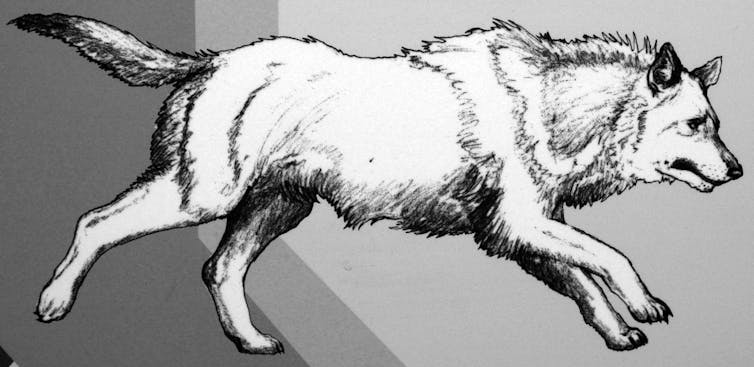
Is resembling a dire wolf enough for something to be a dire wolf?
James St. John/Wikimedia Commons, CC BY-SA
This gap between appearance and biological identity raises a deeper question: What exactly is a species, and how do you decide whether something belongs to one species rather than another?
Biologists call the answer a species concept – a theory about what a species is and how researchers sort organisms into different groups. As a philosopher of science who studies what defines a species, I can say this: Whether de-extinction projects succeed depends on which species concept you think is right – and the truth is, even scientists don’t agree.
How scientists define a species
When scientists talk about biodiversity – the variety of life-forms found in nature – species are the basic building blocks. A species is supposed to reflect a real division between distinct groups of organisms in the natural world, not just a convenient label.
In classifying living things into species, scientists are trying to “carve nature at its joints” to reflect real patterns shaped by evolution. Even so, deciding what counts as a species turns out to be surprisingly difficult and highly controversial. Scientists have proposed dozens of distinct species concepts – some scholars have counted over 32 ways to define a species – and each draws the lines a little differently. These definitions don’t always agree on whether an organism is part of one species rather than another.
Two of the most influential species concepts highlight the challenge. The biological species concept defines a species as a group of organisms that can naturally breed with each other and produce fertile offspring. Under this view, African forest elephants and African savanna elephants were once classified as the same species because they could mate and have young together, even though they lived in different habitats and looked different.
Another approach, the phylogenetic species concept, emphasizes ancestry instead of breeding. A species, in this view, is a group that shares a unique evolutionary history, forming its own distinct branch on the tree of life. By this standard, researchers found that forest and savanna elephants had been genetically evolving separately for millions of years, long enough to be considered different species even if they could still interbreed.
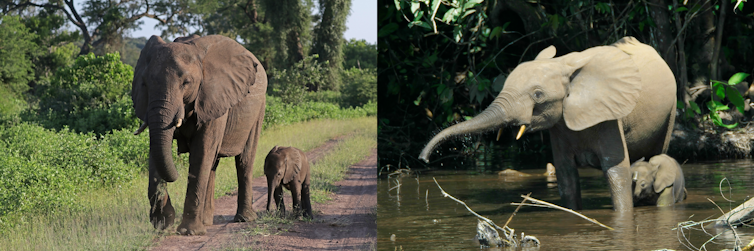
African savanna elephants, left, and African forest elephants are considered two distinct species.
Charles J. Sharp, Thomas Breuer/Wikimedia Commons, CC BY-SA
Understanding these different species concepts is crucial for evaluating claims about de-extinction. If Romulus, Remus and Khaleesi could naturally mate with historical dire wolves and produce fertile offspring, then they would be considered true dire wolves under the biological species concept.
But for definitions of species that emphasize evolutionary history, such as the phylogenetic species concept, the lab-created wolves would not qualify as real dire wolves – even if they were indistinguishable from the originals – because they did not descend from historical dire wolves.
Despite differences on how best to define species, there is a surprising degree of consensus among scientists and philosophers on one big idea: What makes something part of a species is not an internal feature, such as a specific set of genes, but a relationship to something else – to its environment, to other organisms, or to a shared evolutionary history.
By this way of thinking – what is often called relationalism – there is no special “lemon gene” that makes a lemon and no hidden genetic marker that automatically makes an animal a dire wolf. Commonly shared across all these theories is the notion that belonging to a particular species depends on connections and context, not on anything inside the organism itself.
But what if that consensus is wrong?
On warblers and mitochondria
At first glance, the standard ways of defining a species seem to work well. But every now and then, nature throws a curveball – and even the most trusted definitions don’t quite fit.
Take the case of the blue-winged and golden-winged warblers. These two songbirds look and sound different. They wear different plumage, sing different songs and prefer different habitats. Birders and organizations such as the American Ornithological Society have always classified them as separate species.
Yet under two of the most common scientific definitions of species, the biological and phylogenetic species concepts, blue-winged and golden-winged warblers are considered the same species. These birds regularly mate and produce young together. They’ve been swapping genes for thousands of years. And when scientists looked at their nuclear DNA – the genetic material tucked inside the nucleus of each cell – they found the two birds are 99.97% identical. This finding suggests that even careful, widely accepted species definitions can miss something important.
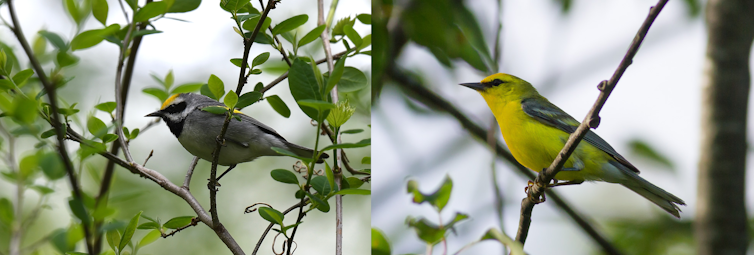
The golden-winged warbler, left, and blue-winged warbler are considered two distinct species, but according to many species concepts they would count as the same.
Wildreturn, Ken Janes/Wikimedia Commons, CC BY-SA
So what if, instead, the key to being part of a species lies deep inside the organism, in the way its basic systems of life fit together?
Recent work in biology and philosophy suggests another way of thinking about species that focuses on a hidden but vital system inside cells: the partnership between two sets of genetic material. I and my colleague Kyle B. Heine explore this idea by drawing on research in mitonuclear ecology – the study of how different parts of an organism’s genetic material adapt and work together to produce energy.
Virtually every cell contains two kinds of DNA. One set, stored in the nucleus, acts like an instruction manual that guides most of the cell’s activities. The other, found in structures called mitochondria – the cell’s energy centers – contains its own much smaller set of instructions geared toward supporting its unique role in keeping the cell running.
Producing energy depends on precise teamwork between nuclear DNA and mitochondrial DNA, like two musicians playing in perfect harmony. Over millions of years, the nuclear and mitochondrial DNA of each species have evolved together to form a unique, finely tuned system.
This insight has led to a new way of thinking about species, called the mitonuclear compatibility species concept. According to this idea, an organism belongs to a species if its two sets of genes – those in the nucleus and those in the mitochondria – are optimized to work together to generate life-sustaining energy. If the cellular partnership between these two genetic systems is mismatched, the organism may struggle to produce the energy it needs to survive, grow and reproduce.
By this standard, different species aren’t just defined by how they look or behave, but by whether their nuclear and mitochondrial genes form a uniquely coadapted team. For example, even though blue-winged and golden-winged warblers are nearly identical in their nuclear DNA, they differ by about 3% in their mitochondrial DNA – a clue that their energy systems are distinct. And that’s exactly what the mitonuclear compatibility species concept predicts: They really are two separate species.
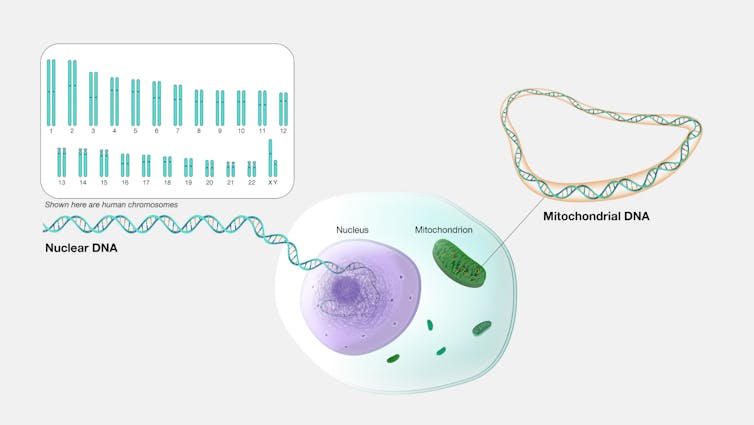
Nuclear DNA and mitochondrial DNA evolve together for cells – and species – to thrive.
National Human Genome Research Institute
Rethinking the meaning of de-extinction
Bringing back a species like the dire wolf isn’t just a matter of getting the fur right or tweaking a few visible traits. According to my preferred species concept, even if a recreated animal looks the part, it won’t truly be a dire wolf unless its inner genetic systems – the ones that power its cells – are finely tuned to work together, just as they were in the original species.
That’s a tall order. And without restoring the full inner machinery of the original species, any lab-grown look-alike would fall short.
Understanding how scientists define species – and how those definitions shape the possibilities of de-extinction – offers more than just a lesson in biological bookkeeping. It shows that classification is not just about names or lineages, but about recognizing the deep biological patterns that sustain life, offering a deeper appreciation of what it really means to bring back the past.
Reviving an extinct species isn’t like assembling a model from spare parts. It means recreating a living, breathing system – one whose parts must work in concert, not just look the part.
And that’s why philosophy and science both matter here: To understand what we’re bringing back, we must first understand what was truly lost.

Elay Shech does not work for, consult, own shares in or receive funding from any company or organization that would benefit from this article, and has disclosed no relevant affiliations beyond their academic appointment.
—-
Author : Elay Shech, Professor of Philosophy, Auburn University
Publish date : 2025-05-30 12:47:00
Copyright for syndicated content belongs to the linked Source.