



Between 1976 and 2015, 80% of Louisiana's capital sentences were later reversed. Bernd Obermann/Getty Images
Jimmie Christian Duncan learned in April 2025 that a Louisiana judge had dismissed his capital murder conviction and he would no longer face the prospect of execution. In 1998, a jury convicted Duncan of murdering his girlfriend’s 23-month-old daughter, and he had been on death row ever since.
Louisiana has a long and troubled death penalty history. From 1976 to 2015, 80% of the state’s capital sentences were reversed on appeal, and 12 people have been exonerated from its death row.
But the Bayou State is not the only death penalty state with a wrongful conviction problem. Death row exonerations – when someone is released after being sentenced – have become more common in the United States. More than 200 people have been freed in the past half-century.
DNA evidence has been involved in only a handful of those cases, but not Duncan’s. Most of the others have happened when defense lawyers discovered new evidence of faulty eyewitness identification, or when prosecutorial misconduct cast doubt on the legality of the conviction.
Duncan’s case stands out because it was the first successful use of Louisiana’s 2021 factual innocence statute. Under that law, reconsideration of convictions can be based on new facts rather than just constitutional or legal violations of a defendant’s rights.
As Louisiana District Judge Alvin Sharp explained in his April 2025 opinion in Duncan’s case, “To possibly be successful on a ‘factual innocence’ claim, a Petitioner shall present new, reliable, and non-cumulative evidence that would be legally admissible at trial and that was not known or discoverable at or prior to trial…”
In overturning Duncan’s conviction, Sharp highlighted new understandings about the unreliability of so-called bite mark analysis that played a key role in Duncan’s case. He also cited the testimony of “a very compelling witness” who testified that the child’s death was “accidental drowning,” not homicide.
It might seem odd that it took the factual innocence statute in 2021 to make what Sharp did possible. But as a death penalty scholar, I believe it’s the latest reminder that, even in capital cases, the quest for justice has not always been the United States’ highest value.
The shadow of Herrera v. Collins
States such as Louisiana have enacted factual innocence statutes because there is no nationwide, constitutional bar to executing people who are factually innocent. More than three decades ago, the U.S. Supreme Court turned back a challenge to the constitutionality of executing people who might not have committed the crime for which they were sentenced to death.
In February 1992, 10 years after his conviction, Leonel Herrera filed a writ of habeas corpus – a legal action used to challenge the legality of a person’s imprisonment. Herrera said he had new evidence showing he had not committed the murder for which he had been sentenced to death.
Herrera’s lawyers argued that executing a factually innocent person would violate the Eighth Amendment, prohibiting cruel and unusual punishment. He also said it would violate the Fourteenth Amendment’s guarantee of due process of law.
Herrera wanted the courts to consider affidavits given long after Herrera’s conviction. Those affidavits claimed that Raul Herrera, Leonel Herrera’s brother, had said before he died that he, not Leonel, was guilty of the killing for which Leonel had been convicted.
But the Supreme Court refused to consider that evidence.
A 6–3 majority concluded that evidence of actual innocence was “not relevant … absent some other constitutional violation.” This ruling means that so long as applicable legal procedures are followed, it doesn’t matter whether the outcome is correct.
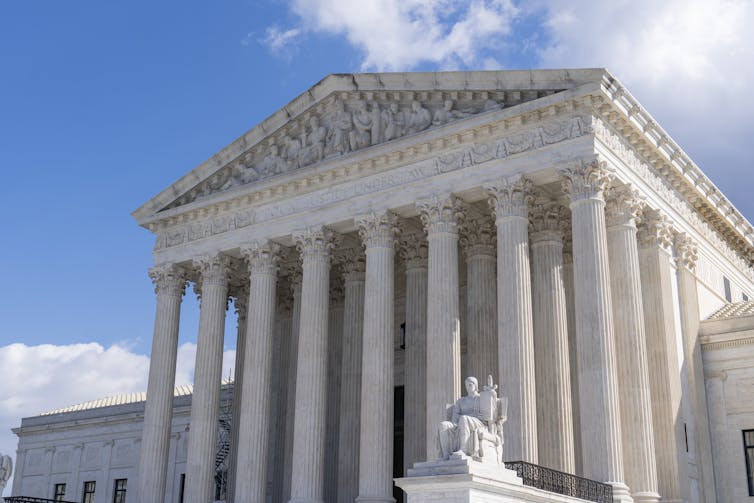
In 1992, the Supreme Court rejected a challenge to the constitutionality of executing people who might not have committed the crime for which they were sentenced to death.
AP Photo/Alex Brandon
Making a place for actual innocence
Not surprisingly, death penalty abolitionists were appalled by the outcome in Herrera’s case. They saw it as condoning the execution of the innocent.
And in 2013, the Supreme Court opened the door for litigating actual innocence claims under the Antiterrorism and Effective Death Penalty Act, which restricts prisoners’ habeas corpus rights.
The court allowed prisoners who can show proof of innocence to file a habeas petition even after the normal time limit for filing one. But it did not say that executing the innocent would violate the Constitution.
States have responded to this by enacting laws that allow people convicted of crimes to bring actual innocence claims, based on newly discovered DNA evidence.
In 2012, Massachusetts passed a law allowing prisoners to seek “forensic or scientific analysis” of evidence in support of a claim of “factual innocence of the crime for which the person has been convicted.”
Five other states – Louisiana, Maryland, Texas, Virginia and Utah – have passed laws allowing post-conviction actual innocence claims, even without DNA evidence.
Under the Louisiana statute that Duncan invoked, “A petitioner who has been convicted of an offense may seek post-conviction relief on the grounds that he is factually innocent of the offense for which he was convicted.”
In Louisiana, new evidence can be “scientific, forensic, physical, or nontestimonial documentary evidence.” Under some conditions, testimonial evidence is also admissible to prove innocence in post-conviction cases.
Someone seeking such relief must prove “by clear and convincing evidence that, had the new evidence been presented at trial, no rational juror would have found the petitioner guilty beyond a reasonable doubt.”
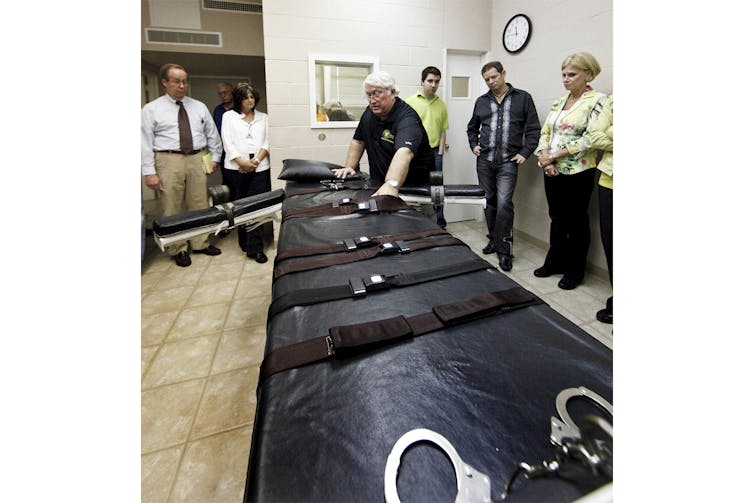
A prison warden discusses the gurney used for lethal injections at the Louisiana State Penitentiary in Angola in September 2009.
AP Photo/Judi Bottoni
Opposition to actual innocence
Many people oppose allowing convicted criminals to reopen their cases, even if they are, like Duncan, on death row.
In the Herrera case, for example, Chief Justice William Rehnquist said that doing so would have a “very disruptive effect … on the need for finality in capital cases.”
It looks like Louisiana will again be weighing the value of finality and justice in capital cases.
Louisiana Gov. Jeff Landry wants to see its actual innocence law repealed, calling it a “woke, hug-a-thug policy” and arguing that “once a verdict has been finalized, there are no more ‘get out of jail free’ cards.”
A bill in the Louisiana Legislature to change the law has been introduced in the 2025 legislative session.
The stakes could not be higher.
As former Supreme Court Justice Harry Blackmun wrote in his Herrera dissent, “Just as an execution without adequate safeguards is unacceptable, so too is an execution when the condemned prisoner can prove that he is innocent. The execution of a person who can show that he is innocent comes perilously close to simple murder.”
Louisiana will soon have to decide how close it is willing to come to producing that tragic result.

Austin Sarat does not work for, consult, own shares in or receive funding from any company or organization that would benefit from this article, and has disclosed no relevant affiliations beyond their academic appointment.
—-
Author : Austin Sarat, William Nelson Cromwell Professor of Jurisprudence and Political Science, Amherst College
Publish date : 2025-05-12 12:26:00
Copyright for syndicated content belongs to the linked Source.