



An artistic rendition of our solar system, including the Sun and eight planets. vjanez/iStock via Getty Images
Curious Kids is a series for children of all ages. If you have a question you’d like an expert to answer, send it to CuriousKidsUS@theconversation.com.
Are planets in the solar system that are closer to the Sun older than the ones further away? – Gavriel, age 10, Paducah, Kentucky
A cloud of collapsing gas created our Sun, the first thing to form in our solar system. This happened about 4½ billion years ago.
Then the planets began to emerge, as the billions of particles of gas and dust left over from the Sun’s formation became a flattened disk.
Known as a protoplanetary disk, it was enormous and surrounded the Sun for billions of miles. Within the disk, the gas and dust particles started to collide, solidify and stick together, like snowflakes clumping together to form snowballs.
As the particles clung together, the microscopic grains became pebble-size objects and then grew and grew. Some became rocks the size of baseballs, others the size of a house, and a few as big as a planet.
This process, called accretion, is how everything in the solar system – planets, moons, comets and asteroids – came into being.
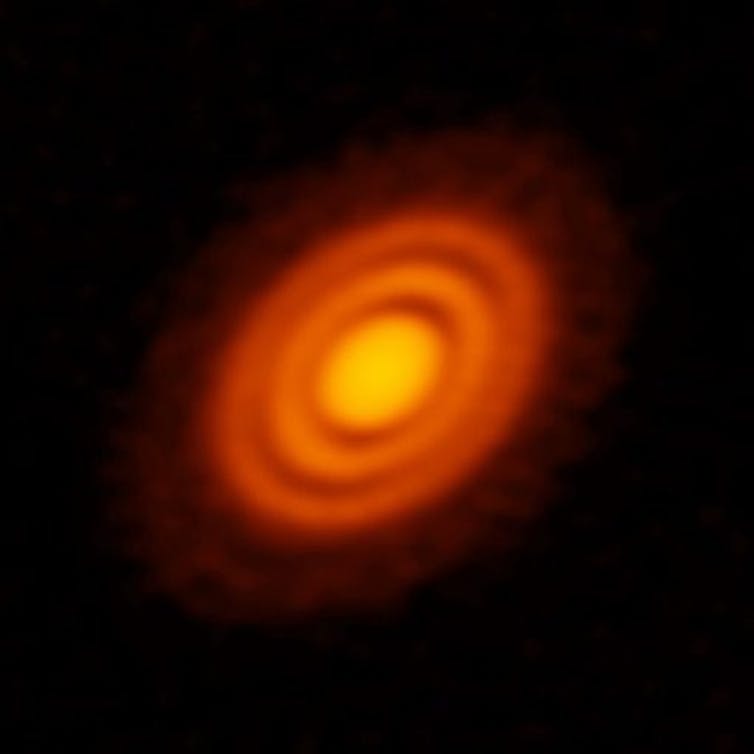
Telescopes can see young solar systems being born. This image is a protoplanetary disk from a distant star in the Milky Way galaxy.
NASA/ALMA/ESO/NAOJ/NRAO/A.Isella;/B.Saxton/NRAO/AUI/NSF
The ice line
By studying computer models and observing the creation of other star systems, astronomers like us have learned a lot about the early days of our solar system.
When the Sun was still forming and the protoplanetary disk was making planets, there was a distance from the Sun where it was cold enough for ice to gather. That place, the ice line – sometimes called the snow line – was in what’s now the asteroid belt, which is between Mars and Jupiter.
Today, of course, ice is found on almost every planet, even on Mercury. But back then, only the young protoplanets beyond the ice line were cold enough to have it. The ice, gas and dust, slamming into each other for millions of years, accumulated into enormous bodies that ultimately became giant planets – Jupiter, Saturn, Uranus and Neptune.
While all this was happening, the smaller planets inside the ice line were forming too. But with less raw material to work with, Mercury, Venus, Earth and Mars took much longer.
Today, it’s believed that Jupiter and Saturn, the largest planets, were the first to fully form, both within a few million years. Uranus and Neptune were next, within 10 million years. The inner planets, including Earth, took at least 100 million years, maybe more.
To put it another way, the four planets closest to the Sun are the youngest; the two planets farthest out, the next youngest; and the two in between, the oldest. The difference in age between the youngest and oldest planets is perhaps 90 million years.
That sounds like an enormous age difference, but in space, 90 million years isn’t really that long – less than 1% of the total time the universe has been around. One way to consider it: Think of Earth as a little sister with a big brother, Jupiter, who’s 2 or 3 years older.
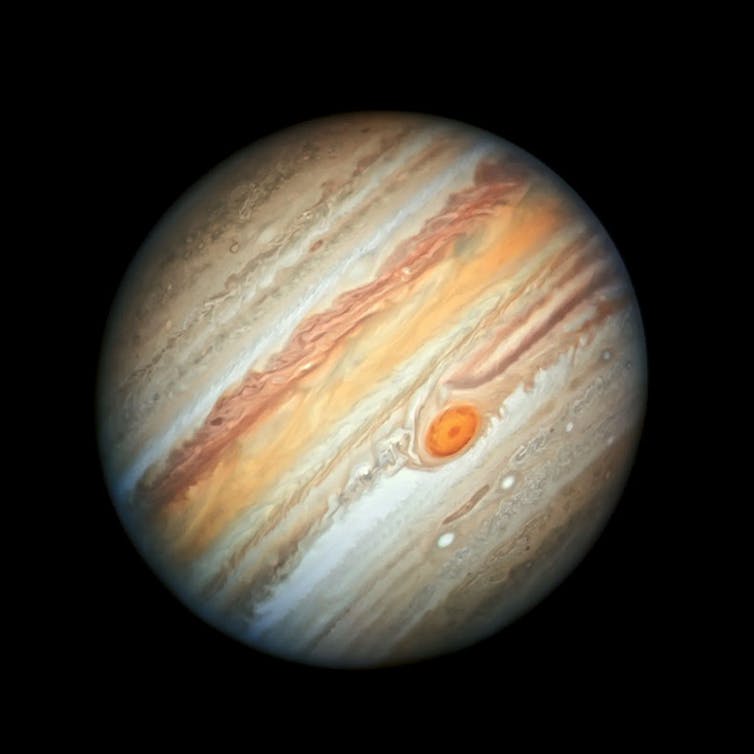
Taken by the Hubble Space Telescope in 2019, this is a photo of Jupiter, the fifth planet out from the Sun.
NASA/JPL-Caltech/SwRI/MSSS/Kevin M. Gill (CC-BY)
Location, location, location
Soon after formation the giant worlds began to migrate, moving inward toward the Sun or outward away from the Sun, before finally settling into their final orbits.
For instance, Neptune migrated outward, switching places with Uranus, and pushed a lot of the small, icy bodies into the Kuiper Belt, a place in the outer solar system that’s home to dwarf planets Pluto, Eris and Makemake and millions of comets.
Meanwhile, Jupiter moved inward, and its massive gravity forced some forming planets into the Sun, where they disintegrated. Along the way, Jupiter flung some smaller rocks out of the solar system altogether; the rest went to the asteroid belt.
But most critically, as Jupiter settled into its own orbit, it moved all of the forming objects and likely finalized the location of the remaining inner planets, including Earth.
All of Jupiter’s tugging helped put our planet in the so-called “Goldilocks zone,” a place just the right distance from the Sun, where Earth could have liquid water on its surface and the right temperature for life to evolve. If Jupiter hadn’t formed the way it did, it’s entirely possible life would not have ignited on Earth – and we would not be here today.
Hello, curious kids! Do you have a question you’d like an expert to answer? Ask an adult to send your question to CuriousKidsUS@theconversation.com. Please tell us your name, age and the city where you live.
And since curiosity has no age limit – adults, let us know what you’re wondering, too. We won’t be able to answer every question, but we will do our best.

Lucas Brefka receives funding from a NASA Exoplanet Research Program grant.
Christopher Palma does not work for, consult, own shares in or receive funding from any company or organization that would benefit from this article, and has disclosed no relevant affiliations beyond their academic appointment.
—-
Author : Christopher Palma, Teaching Professor of Astronomy & Astrophysics, Penn State
Publish date : 2025-05-19 12:41:00
Copyright for syndicated content belongs to the linked Source.