



This vibrantly colored chemical was originally created for use as a fabric dye. Kittisak Kaewchalun via iStock/Getty Images Plus
The internet is abuzz with tributes to a liquid chemical called methylene blue that is being sold as a health supplement.
Over the past five or 10 years, methylene blue has come to be touted online as a so-called nootropic agent – a substance that enhances cognitive function. Vendors claim that it amps up brain energy, improves memory, boosts focus and dispels brain fog, among other supposed benefits.
Health influencers, such as podcaster Joe Rogan, have sung its praises. In February 2025, shortly before he was confirmed as health and human services secretary, Robert F. Kennedy Jr. appeared in a video squirting a blue liquid widely presumed to be methylene blue into a glass – though he never verbally endorsed the substance.
As a researcher studying inflammation and cancer, I investigate how dyes affect human health. Claims about methylene blue are alluring, and it’s easy to buy into its promise. But so far, evidence supporting its health benefits is scant, and there are some serious risks to using the substance outside of medical practice.
What is methylene blue?
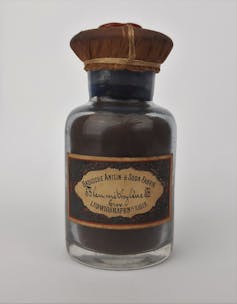
Methylene blue was first synthesized in the 19th century by scientists at the German chemical company BASF.
Museo di Chimica dell’Università di Genova via Wikimedia Commons, CC BY-SA
Methylene blue is a synthetic dye that exists as a dark green powder and takes on a deep blue color when dissolved in water. My work and that of others suggest that many synthetic dyes widely used in foods and medicines can trigger potentially harmful immune system reactions in the body. But unlike commonly used food dyes – one of which was recently banned by the U.S. Food and Drug Administration – methylene blue is not derived from petroleum, also known as crude oil. Instead, it comes from a different family of dyes, which isn’t thought to have these health concerns.
Methylene blue was first synthesized in 1876 as a dye for textiles and was valued for its intense color and ability to bind well to fabrics. Soon after, German physician Paul Ehrlich discovered its ability to stain biological tissues and to kill the parasite that causes malaria — making it one of the first synthetic drugs used in medicine.
The chemical didn’t gain widespread use as a malaria treatment because it was no more effective than quinine, the standard therapy at the time. But in the 1930s, the dye found a new use in testing the safety of raw or unpasteurized milk. If its blue color faded quickly, the milk was contaminated with bacteria, but if it remained blue, the milk was considered relatively clean.
This safety test now is largely obsolete. But it works thanks to methylene blue’s chemical superpower, which is that its molecules can swap electrons with other molecules, like a tiny battery charger.
How do doctors use it today?
That same chemical superpower enables some of methylene blue’s medical uses. Most significantly, doctors use it to treat a rare blood disorder called methemoglobinemia, in which hemoglobin, an iron-rich protein in red blood cells that carries oxygen, takes on a different form that can’t do the job. Methylene blue restores hemoglobin’s function by transferring an electron.
Doctors also sometimes use methylene blue to treat the effects of carbon monoxide poisoning, septic shock or toxicities from drugs such as chemotherapy. It is also used as a surgical dye to highlight specific tissues such as lymph nodes, or to identify where tissue is leaky and therefore may be damaged.
How does methylene blue affect the brain?
Methylene blue can enter the brain by crossing the protective tissue barrier that surrounds it. Researchers have also found that the chemical can protect and support mitochondria, cell structures that are often described as the powerhouses of the cell. Methylene blue may help mitochondria generate energy for cells to use. For these reasons, researchers are studying methylene blue’s effect on the brain.
So far, most of what’s known about the substance’s effects on the brain comes from studies in rats and in cells grown in a lab dish – not in people. For example, researchers have found that methylene blue may improve learning, boost memory and protect brain cells in rats with a condition that mimics Alzheimer’s disease.
Studies in rodents have also found that methylene blue can protect the brain from damage from brain injury. Other studies showed that methylene blue is useful in treating ischemic stroke in rats. However, no research to date has examined whether it protects peoples’ brains from traumatic brain injury or stroke.
A handful of clinical trials have investigated the effects of methylene blue in treating aspects of Alzheimer’s disease in people, but a 2023 review of these trials notes that their results have been mixed and not conclusive. A small study of 26 people found that a single low dose of the chemical boosted memory by about 7% and increased brain activity during thinking tasks. Another study by the same researchers found that methylene blue changed how different parts of the brain connected, though it didn’t improve thinking skills.
Although some studies in people have shown hints that methylene blue may be beneficial for some brain-related issues, such as pain management and neuropsychiatric disorders, such studies to date have been small. This suggests that while there may be patient circumstances where methylene blue is beneficial, researchers have not yet pinned down what those are.
Is methylene blue safe?
Methylene blue is generally safe when used under medical supervision. However, the chemical has some serious risks.
For one thing, it can interact with widely used medications. Methylene blue inhibits a molecule called monoamine oxidase, whose job is to break down an important brain chemical, serotonin. Many commonly used medications for treating anxiety and depression target serotonin. Taking the supplement along with these medicines can cause a condition called serotonin syndrome, which can lead to agitation, confusion, high fever, rapid heart rate, muscle stiffness and, in severe cases, seizures or even death.
In people with a rare genetic deficiency of an enzyme called G6PD, methylene blue can cause a dangerous condition in which red blood cells break down too quickly. At high doses, the chemical can also raise blood pressure or cause heart problems. Also, it’s considered unsafe for pregnant or breastfeeding women because it may harm the fetus or baby.
Overall, while scientists have found hints of some fascinating properties of methylene blue, much larger, longer trials are needed to know if it truly works, what the right dose is and how safe it is over time.

Lorne J. Hofseth does not work for, consult, own shares in or receive funding from any company or organization that would benefit from this article, and has disclosed no relevant affiliations beyond their academic appointment.
—-
Author : Lorne J. Hofseth, Professor and Associate Dean for Research, College of Pharmacy, University of South Carolina
Publish date : 2025-06-03 12:43:00
Copyright for syndicated content belongs to the linked Source.