



Robots can run, but they can't go the distance. AP Photo/Ng Han Guan
Earlier this year, a robot completed a half-marathon in Beijing in just under 2 hours and 40 minutes. That’s slower than the human winner, who clocked in at just over an hour – but it’s still a remarkable feat. Many recreational runners would be proud of that time. The robot kept its pace for more than 13 miles (21 kilometers).
But it didn’t do so on a single charge. Along the way, the robot had to stop and have its batteries swapped three times. That detail, while easy to overlook, speaks volumes about a deeper challenge in robotics: energy.
Modern robots can move with incredible agility, mimicking animal locomotion and executing complex tasks with mechanical precision. In many ways, they rival biology in coordination and efficiency. But when it comes to endurance, robots still fall short. They don’t tire from exertion – they simply run out of power.
As a robotics researcher focused on energy systems, I study this challenge closely. How can researchers give robots the staying power of living creatures – and why are we still so far from that goal? Though most robotics research into the energy problem has focused on better batteries, there is another possibility: Build robots that eat.
Robots move well but run out of steam
Modern robots are remarkably good at moving. Thanks to decades of research in biomechanics, motor control and actuation, machines such as Boston Dynamics’ Spot and Atlas can walk, run and climb with an agility that once seemed out of reach. In some cases, their motors are even more efficient than animal muscles.
But endurance is another matter. Spot, for example, can operate for just 90 minutes on a full charge. After that, it needs nearly an hour to recharge. These runtimes are a far cry from the eight- to 12-hour shifts expected of human workers – or the multiday endurance of sled dogs.
The issue isn’t how robots move – it’s how they store energy. Most mobile robots today use lithium-ion batteries, the same type found in smartphones and electric cars. These batteries are reliable and widely available, but their performance improves at a slow pace: Each year new lithium-ion batteries are about 7% better than the previous generation. At that rate, it would take a full decade to merely double a robot’s runtime.
Robots such as Boston Dynamic’s Atlas are remarkably capable – for relatively short amounts of time.
Animals store energy in fat, which is extraordinarily energy dense: nearly 9 kilowatt-hours per kilogram. That’s about 68 kWh total in a sled dog, similar to the energy in a fully charged Tesla Model 3. Lithium-ion batteries, by contrast, store just a fraction of that, about 0.25 kilowatt-hours per kilogram. Even with highly efficient motors, a robot like Spot would need a battery dozens of times more powerful than today’s to match the endurance of a sled dog.
And recharging isn’t always an option. In disaster zones, remote fields or on long-duration missions, a wall outlet or a spare battery might be nowhere in sight.
In some cases, robot designers can add more batteries. But more batteries mean more weight, which increases the energy required to move. In highly mobile robots, there’s a careful balance between payload, performance and endurance. For Spot, for example, the battery already makes up 16% of its weight.
Some robots have used solar panels, and in theory these could extend runtime, especially for low-power tasks or in bright, sunny environments. But in practice, solar power delivers very little power relative to what mobile robots need to walk, run or fly at practical speeds. That’s why energy harvesting like solar panels remains a niche solution today, better suited for stationary or ultra-low-power robots.
Why it matters
These aren’t just technical limitations. They define what robots can do.
A rescue robot with a 45-minute battery might not last long enough to complete a search. A farm robot that pauses to recharge every hour can’t harvest crops in time. Even in warehouses or hospitals, short runtimes add complexity and cost.
If robots are to play meaningful roles in society assisting the elderly, exploring hazardous environments and working alongside humans, they need the endurance to stay active for hours, not minutes.
New battery chemistries such as lithium-sulfur and metal-air offer a more promising path forward. These systems have much higher theoretical energy densities than today’s lithium-ion cells. Some approach levels seen in animal fat. When paired with actuators that efficiently convert electrical energy from the battery to mechanical work, they could enable robots to match or even exceed the endurance of animals with low body fat. But even these next-generation batteries have limitations. Many are difficult to recharge, degrade over time or face engineering hurdles in real-world systems.
Fast charging can help reduce downtime. Some emerging batteries can recharge in minutes rather than hours. But there are trade-offs. Fast charging strains battery life, increases heat and often requires heavy, high-power charging infrastructure. Even with improvements, a fast-charging robot still needs to stop frequently. In environments without access to grid power, this doesn’t solve the core problem of limited onboard energy. That’s why researchers are exploring alternatives such as “refueling” robots with metal or chemical fuels – much like animals eat – to bypass the limits of electrical charging altogether.
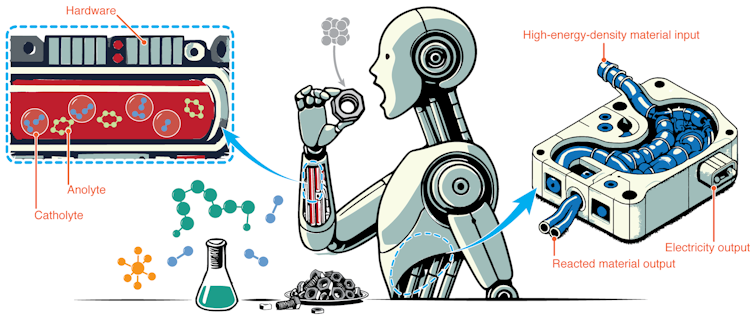
Robots could one day harvest energy from high-energy-density materials such as aluminum through synthetic digestive and vascular systems.
Yichao Shi and James Pikul
An alternative: Robotic metabolism
In nature, animals don’t recharge, they eat. Food is converted into energy through digestion, circulation and respiration. Fat stores that energy, blood moves it and muscles use it. Future robots could follow a similar blueprint with synthetic metabolisms.
Some researchers are building systems that let robots “digest” metal or chemical fuels and breathe oxygen. For example, synthetic, stomachlike chemical reactors could convert high-energy materials such as aluminum into electricity.
This builds on the many advances in robot autonomy, where robots can sense objects in a room and navigate to pick them up, but here they would be picking up energy sources.
Other researchers are developing fluid-based energy systems that circulate like blood. One early example, a robotic fish, tripled its energy density by using a multifunctional fluid instead of a standard lithium-ion battery. That single design shift delivered the equivalent of 16 years of battery improvements, not through new chemistry but through a more bioinspired approach. These systems could allow robots to operate for much longer stretches of time, drawing energy from materials that store far more energy than today’s batteries.
In animals, the energy system does more than just provide energy. Blood helps regulate temperature, deliver hormones, fight infections and repair wounds. Synthetic metabolisms could do the same. Future robots might manage heat using circulating fluids or heal themselves using stored or digested materials. Instead of a central battery pack, energy could be stored throughout the body in limbs, joints and soft, tissuelike components.
This approach could lead to machines that aren’t just longer-lasting but more adaptable, resilient and lifelike.
The bottom line
Today’s robots can leap and sprint like animals, but they can’t go the distance.
Their bodies are fast, their minds are improving, but their energy systems haven’t caught up. If robots are going to work alongside humans in meaningful ways, we’ll need to give them more than intelligence and agility. We’ll need to give them endurance.

James Pikul receives funding from the Office of Naval Research. He is affiliated with the University of Wisconsin-Madison and Metal Light Inc.
—-
Author : James Pikul, Associate Professor of Mechanical Engineering, University of Wisconsin-Madison
Publish date : 2025-06-02 12:45:00
Copyright for syndicated content belongs to the linked Source.