



The country of origin – Mexico – is noted on the label of a package of Campari tomatoes for sale in the produce section of a Safeway grocery store on March 4, 2025, in Denver. AP Photo/David Zalubowski
Although technically they’re a fruit, tomatoes are one of the most-consumed vegetables, according to the U.S. Department of Agriculture. Among the fresh produce the nation buys from foreign countries, tomatoes often rank first or second, behind avocados.
This trade is now jeopardized because the Trump administration has revived a three-decade-old effort to limit imports.
As economists who study global trade issues affecting agricultural commodities and processed food products, we have assessed the benefits of imported tomatoes and other products on consumers and businesses. Fresh tomato imports ensure year-round availability for consumers, contribute significantly to the U.S. economy by generating billions in sales and supporting thousands of jobs, and promote competitive pricing that benefits both consumers and businesses.
New import restrictions could put all that at risk because domestic production cannot satisfy national demand. For tomatoes, like steel and other products, efforts to reverse trade imbalances can decrease consumer satisfaction and potentially destroy more jobs and economic activity than they create.
Initiating a dumping investigation
This tussle over tomatoes began in the 1990s.
At that time, unprecedented growth in tomato imports from Mexico prompted U.S. producers to ask the Clinton administration to investigate whether they were being sold at unfairly low prices. If that were the case, it would violate both World Trade Organization rules and U.S. trade policy.
The U.S. responded with an antidumping investigation, conducted by the Department of Commerce and U.S. International Trade Commission. The agencies were tasked with seeing if imports are being sold in the U.S. at less than fair market value – the definition of dumping.
Dumping can harm domestic producers by depressing local prices to compete with imports, causing financial distress. An antidumping duty is essentially a tariff.
The Commerce Department ruled against Mexican producers, finding that they had engaged in dumping, but reached an agreement with them. Mexican tomato exporters agreed to set minimum prices, leading the U.S. to call off its investigation. The U.S. and Mexico have subsequently entered into a string of suspension agreements over the years.
The first was implemented in 1996, and the most recent took effect in 2019 during President Donald Trump’s prior term after his administration had threatened to impose a 17.5% tomato tariff.
Squashing the tomato suspension agreement
But in April 2025, the Commerce Department announced that it would withdraw from the latest tomato suspension agreement. The Trump administration plans to begin to impose, starting in July, antidumping duties of 21% on fresh tomatoes imported from Mexico.
It is not obvious at this stage if American importers and consumers will bear the full burden of this tariff, or if Mexican tomato exporters will absorb this cost.
This move is supposed to benefit fresh tomato producers in the U.S. – most of which are in Florida, with a significantly smaller number located in California. The tariffs could, however, hurt produce distributors, wholesalers and retailers, as well as American consumers.
People in the U.S. have become accustomed to buying fresh tomatoes to toss into their salads and stuff into their sandwiches year-round, even though in most of the country you can only harvest field-grown tomatoes in the warmest months of the year.
Focusing only on fresh tomatoes
This dispute doesn’t involve all the tomatoes and tomato products Americans eat.
U.S. tomato production is split into two main categories. Fresh tomatoes are usually purchased in a supermarket’s fresh produce section, to be consumed whole, chopped or sliced. This dispute is about those tomatoes.
The other kind is processing tomatoes, which companies use for making tomato paste, canned or stewed tomatoes and tomato sauce. California leads the nation in processing tomato production. Unlike fresh tomatoes, where the U.S. imports far more than it produces or exports, the U.S. is actually running a trade surplus in processed tomato products.
When the North American Free Trade Agreement was implemented in January 1994, U.S. fresh tomato production was more than four times the quantity of imported fresh tomatoes: 3.7 billion pounds (1.7 million metric tons) produced versus only 870 million pounds (400,000 metric tons) imported.
Domestic production has steadily declined since then, while imports have increased. Imported fresh tomatoes are now twice as plentiful: 2.2 billion pounds (1 million metric tons) were grown in the U.S. in 2023, compared with 4.4 billion pounds (2 million metric tons)“ imported .
This happened as Americans were eating more fresh tomatoes than ever: almost 20 pounds (9 kilograms) per capita in 2023.
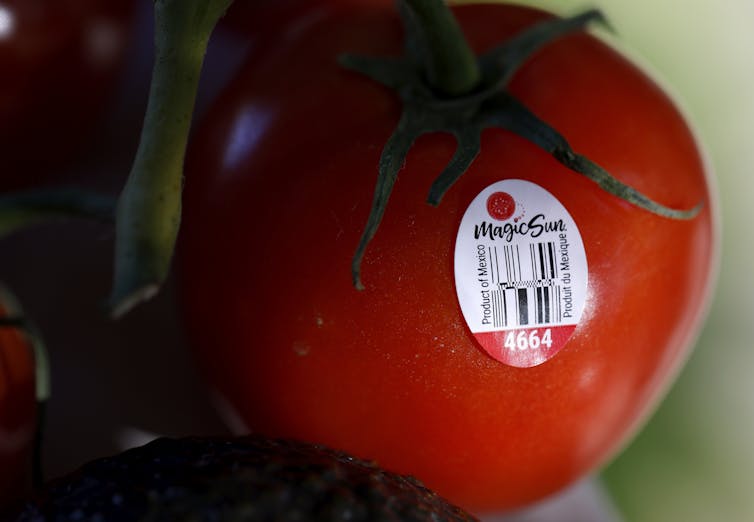
Mexico supplies most of the fresh tomatoes Americans buy in supermarkets.
Justin Sullivan/Getty Images
Influx didn’t clearly affect prices
In 2024, fresh tomato imports totaled US$3.6 billion, with $3.1 billion coming from Mexico. This was a 367% increase since NAFTA took effect, adjusted for inflation.
Given that costs of production are lower in Mexico for many products, especially in the fresh produce sector where labor costs are less than half U.S. levels, you might figure that this arrangement has kept prices for fresh tomatoes in the U.S. low. But there’s little evidence to support that. Instead, the opposite seems true.
In 1995, the price that U.S. importers paid of Mexican tomatoes was 31 cents per pound. Since then, import prices have steadily increased to 74 cents per pound in 2024. They have often exceeded prices paid to American farmers and kept pace with the overall rise in food prices the past three decades.
While restricting imported Mexican tomatoes might benefit U.S. tomato producers by making it easier for them to raise their prices, there are other factors to consider. Imports play a crucial role in boosting economic activity and creating jobs. According to a recent study, these imports generated a total economic impact of more than $8 billion.
The extra $5 billion comes from all the value-added activities associated with getting that produce from the border to consumers. That total economic impact supports approximately 47,000 U.S. jobs tied to tomato storage, distribution, wholesaling and retailing.
We would expect antidumping duties on imported fresh tomatoes to increase prices, and reduce the amount of fresh tomatoes Americans can buy. That would also shrink some of the economic impact and eliminate some of the jobs spurred by the imported tomato boom.

The authors do not work for, consult, own shares in or receive funding from any company or organization that would benefit from this article, and have disclosed no relevant affiliations beyond their academic appointment.
—-
Author : Andrew Muhammad, Professor of Agriculture and Resource Economics, University of Tennessee
Publish date : 2025-05-19 12:43:00
Copyright for syndicated content belongs to the linked Source.