



Cities like Houston get high humidity in addition to the heat, making summer almost unbearable without cooling. Brandon Bell/Getty Images
The U.S. is headed into what forecasters expect to be one of the hottest summers on record, and millions of people across the country will struggle to pay their power bills as temperatures and energy costs rise.
A 2023 national survey found that nearly 1 in 4 Americans were unable to pay their full energy bill for at least one month, and nearly 1 in 4 reported that they kept their homes at unsafe temperatures to save money. By 2025, updated polling indicated nearly 3 in 4 Americans are worried about rising energy costs.
Conservative estimates suggest that utilities shut off power to over 3 million U.S. households each year because the residents cannot pay their bills.
This problem of high energy prices isn’t lost on the Trump administration.
On the first day of his second term in 2025, President Donald Trump declared a national energy emergency by executive order, saying that “high energy prices … devastate Americans, particularly those living on low- and fixed incomes.”
Secretary of Energy Christopher Wright raised concerns about utility disconnections and outlined a mission to “shrink that number, with the target of zero.”
Yet, the administration’s 2026 budget proposal zeros out funding for the Low Income Home Energy Assistance Program, or LIHEAP, the federal program that administers funding to help low-income households pay their utility bills. And on April 1, 2025, the administration laid off the entire staff of the LIHEAP office.
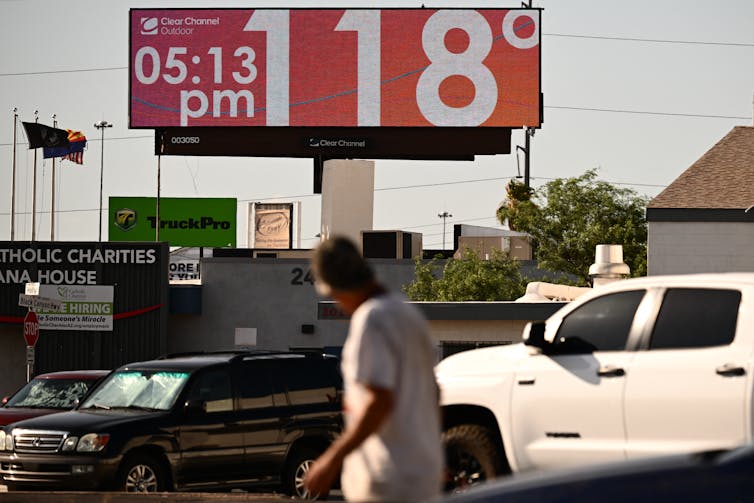
During the hottest periods, even nighttime temperatures might not drop below 90 in Phoenix. Without air conditioning, homes can become dangerously hot.
Patrick T. Fallon/AFP via Getty Images
Many people already struggle to cobble together enough help from various sources to pay their power bills. As researchers who study energy insecurity, we believe gutting the federal office responsible for administering energy bill assistance will make it even harder for Americans to make ends meet.
The high stakes of energy affordability
We work with communities in South Carolina and Tennessee where many residents struggle to heat and cool their homes.
We see how high energy prices force people to make dangerous trade-offs. Low-income households often find themselves choosing whether to buy necessities, pay for child care or pay their utility bills.
One elderly person we spoke with for our research, Sarah, explained that she routinely forgoes buying medications in order to pay her utility bill. Another research participant who connects low-income families to energy bill assistance in Tennessee said: “I’ve gone into these homes, and it’s so hot. Your eyes roll in the back of your head. It’s like you can’t breathe. How do you sit in here? It’s just unreal.”
Unfortunately, these stories are increasingly common, especially in low-income communities and communities of color.
Electricity prices are predicted to rise with worsening climate change: More frequent heat waves and extreme weather events drive up demand and put pressure on the grid. Furthermore, rising energy demand from data centers – supercharged by the increasing energy use by artificial intelligence – is accelerating price increases.
Shrinking resources for assistance
LIHEAP, created in 1981, provides funding to states as block grants to help low-income families pay their utility bills. In fiscal year 2023, the program distributed US$6.1 billion in energy assistance, helping some 5.9 million households avoid losing power connections.
The program’s small staff played critical roles in disbursing this money, providing implementation guidelines, monitoring state-level fund management and tracking and evaluating program effectiveness.
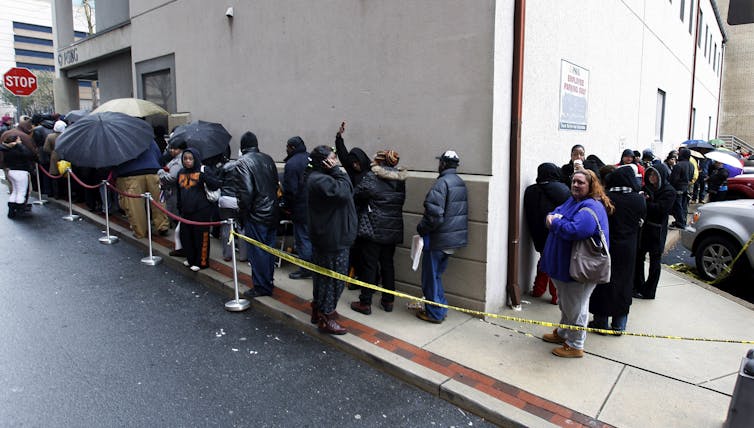
A long line of utility customers wait to apply for help from the Low-Income Energy Assistance Program in Trenton, N.J., in 2011. In 2023, around 6 million households benefited from LIHEAP.
AP Photo/Mel Evans
LIHEAP has historically prioritized heating assistance in cold-weather states over cooling assistance in warmer states. However, recent research shows a need to revisit the allocation formula to address the increasing need for air conditioning. The layoffs removed staff who could direct this work.
It is unlikely that other sources of funding can fill in the gaps if states do not receive LIHEAP funds from the federal government. The program’s funding has never been high enough to meet the need. In 2020, LIHEAP provided assistance to just 16% of eligible households.
Our research has found that, in practice, many households rely on a range of local nonprofits, faith-based organizations and informal networks of family and friends to help them pay their bills and keep the power on.
For example, a research participant named Deborah reported that when faced with a utility shut-off, she “drove from church to church to church” in search of assistance. United Way in South Carolina received over 16,000 calls from people seeking help to pay their utility bills in 2023.
These charitable services are an important lifeline for many, especially in the communities we study in the South. However, research has shown that faith-based programs do not have the reach of public programs.
Without LIHEAP, the limited funds provided by nonprofits and the personal connections that people patch together will be stretched even thinner, especially as other charitable services, such as food banks, also face funding cuts.
What’s ahead
The $4.1 billion that Congress allocated to LIHEAP for the 2025 fiscal year, which ends Sept. 30, has already been disbursed. Going forward, however, cuts to LIHEAP staff affect its ability to respond to growing need. Congress now has to decide if it will kill the program’s future funding as well.
Maricopa County in Arizona, home to Phoenix, illustrates what’s at stake. Annual heat-related deaths have risen 1,000% there in the past decade, from 61 to 602. Hundreds of these deaths occurred indoors.
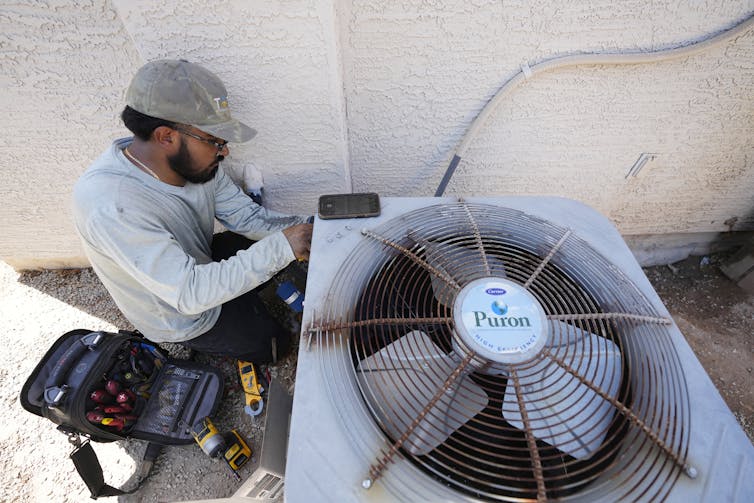
Cooling becomes essential during Arizona’s extreme summers. Maricopa County, home to Phoenix, reported more than 600 heat-related deaths in 2024.
AP Photo/Ross D. Franklin
We believe gutting LIHEAP puts the goal of energy affordability for all Americans – and Americans’ lives – in jeopardy. Until more affordable energy sources, such as solar and wind power, can be scaled up, an expansion of federal assistance programs is needed, not a contraction.
Increasing the reach and funding of LIHEAP is one option. Making home weatherization programs more effective is another.
Governments could also require utilities to forgive past-due bills and end utility shut-offs during the hottest and coldest months. About two dozen states currently have rules to prevent shut-offs during the worst summer heat.
For now, the cuts mean more pressure on nonprofits, faith-based organizations and informal networks. Looking ahead to another exceptionally hot summer, we can only hope that cuts to LIHEAP staff don’t foreshadow a growing yet preventable death toll.
Etienne Toussaint, a law professor at the University of South Carolina, and Ann Eisenberg, a law professor at West Virginia University, contributed to this article.

Conor Harrison receives funding from the National Science Foundation and the Alfred P. Sloan Foundation.
Elena Louder receives funding from the Alfred P. Sloan Foundation.
Nikki Luke receives funding from the Alfred P. Sloan Foundation. She previously worked at the U.S. Department of Energy.
Shelley Welton receives funding from the Alfred P. Sloan Foundation.
—-
Author : Conor Harrison, Associate Professor of Economic Geography, University of South Carolina
Publish date : 2025-05-13 12:25:00
Copyright for syndicated content belongs to the linked Source.