



President Donald Trump's executive order on birthright citizenship resurrects a dissenting argument in an 1898 case that went before the Supreme Court. iStock/Getty Images Plus
For more than 150 years, almost all people who were born within U.S. territory automatically received citizenship – regardless of their parents’ immigration status.
President Donald Trump’s January 2025 executive order on birthright citizenship – stating that children born in the U.S. to parents who are not in the country legally, or who are not permanent residents, cannot receive citizenship – threatens to upend this precedent.
The Supreme Court is set to hear arguments on the case on May 15, 2025.
This comes after federal judges in three cases that took place in Maryland, Massachusetts and Washington banned Trump’s order from going into effect, determining that the president cannot change or limit the Constitution by executive order.
The Trump administration has argued that courts previously did not interpret the 14th Amendment’s citizenship clause correctly. But the administration’s argument in its emergency appeal to the Supreme Court is different. The administration is asking the Supreme Court to narrow the federal judges’ bans on implementing the order so their rulings apply only to the noncitizen plaintiffs named in those specific cases. If the Supreme Court justices agree, that could mean Trump’s executive order could apply to all of the other noncitizens not named in the cases at hand.
The president has broad powers when enforcing immigration laws and has the most discretion to use this authority when immigration is a national security issue.
At the same time, as an immigration law scholar, I understand that the president’s immigration power is limited by federal laws and the Constitution. American citizenship is a right that is spelled out in the Constitution – and the Constitution does not give the president the power to change how someone gets citizenship in the country.
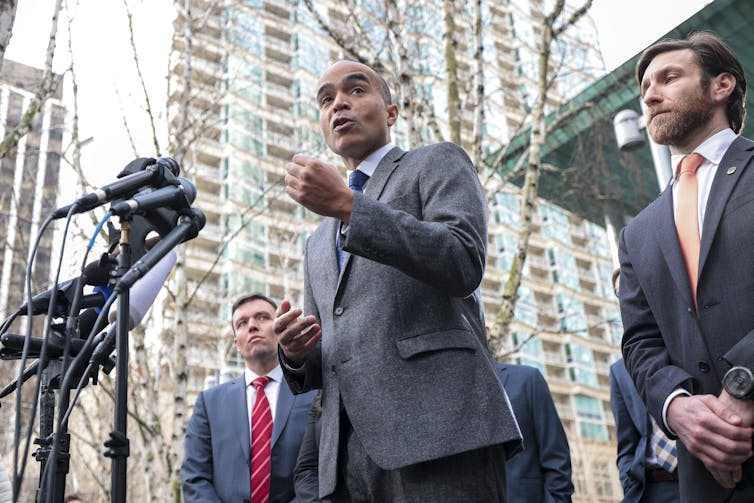
Washington state Attorney General Nick Brown speaks to the media after a federal judge blocked President Donald Trump’s executive order on birthright citizenship on Feb. 6, 2025.
Jason Redmond/AFP via Getty Images
What the Constitution says about birthright citizenship
Ratified in 1868, the 14th Amendment citizenship clause states, “All persons born or naturalized in the United States, and subject to the jurisdiction thereof, are citizens of the United States. …”
There are currently two exceptions to who can receive birthright citizenship: children of war enemies who are occupying the U.S. and children of noncitizens working as foreign diplomats in the U.S.
Trump’s executive order states there is now a third exception – the child of a mother who is living in the country without legal authorization, or has a temporary visa, if the father is also not a lawful permanent resident or U.S. citizen.
Since Trump’s Jan. 20 executive order, multiple states, cities, immigration rights organizations and private individuals, including pregnant mothers, have sued Trump. They have also sued the government agencies he instructed to deny citizenship to children born in the U.S. to noncitizens.
If the president’s executive order were to fully take effect, hundreds of thousands of babies born in the U.S. would be living in the country illegally. They could be deported by the U.S. government and would potentially be stateless, meaning without citizenship in any country.
If these babies stayed in the U.S., they would also be denied basic rights and privileges given to U.S. citizens, such as government-provided health care insurance and legal identification documents.
Once these children became adolescents and then adults, they could not receive federal financial aid for education, may not be eligible to legally work and could not vote.
This would create a vast and indefinitely growing population of noncitizens who are born and raised in the U.S. but do not have the legal right to stay there.
What led to the 14th Amendment
In 1868, the required 28 of the then 37 U.S. states ratified the 14th Amendment. This ensured that certain states did not deny citizenship to freed former slaves, who were of African descent and forcibly sent to the U.S., as well as their children.
About 30 years later, a U.S.-born man of Chinese descent named Wong Kim Ark was returning home to San Francisco after visiting his parents in China. U.S. authorities would not let him leave a steamship docked in the San Francisco harbor and enter the U.S.
Government officials prevented his entry under the Chinese Exclusion Act of 1882, a discriminatory law that barred Chinese nationals from entering the U.S. and becoming naturalized citizens, among other restrictions.
Wong argued that he was a U.S. citizen at birth and not barred by the exclusion laws.
The Supreme Court, albeit not unanimously, decided in 1898 that Wong was a citizen, since he was born in a U.S. territory.
The Supreme Court noted that the framers of the 14th Amendment relied on the British legal principle of “jus soli,” a Latin term meaning right of soil, to give automatic citizenship to anyone born on U.S. soil. Under jus soli, any person born within the kingdom of the British king was a citizen of that kingdom.
U.S. courts and lawmakers have similarly interpreted the 14th Amendment to automatically give citizenship to all children born in the U.S., even if their parents are immigrants.
In 1952, Congress passed the Immigration and Nationality Act, which incorporated language from the 14th Amendment into immigration law. This included the phrase that “any person born in the United States, and subject to the jurisdiction thereof” is a “citizen of the United States at birth.”
The 1952 statute did not exclude children born to immigrants living in the U.S. without legal authorization or immigrants with a temporary visa.
In 1995, the Office of Legal Counsel for the Department of Justice evaluated proposed federal legislation that would deny birthright citizenship to certain children, based on their parents’ immigration status. The Department of Justice determined the legislation would be “unquestionably unconstitutional” and it did not become law.
Less than 10 years later, the Supreme Court recognized in 2004 that accused Taliban fighter Yasser Hamdi had certain rights as a U.S. citizen. Hamdi was born in Louisiana to Saudi Arabian parents who had temporary visas.
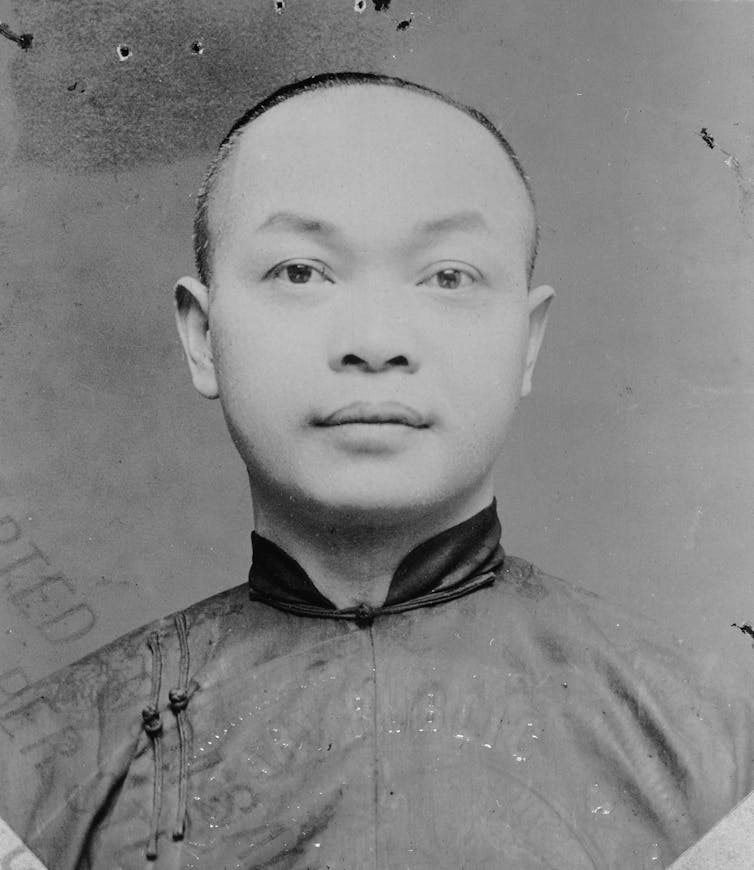
Wong Kim Ark was born in the U.S. but denied reentry in 1895 in a case that went to the Supreme Court.
National Archives/Interim Archives/Getty Images
Trump’s 14th Amendment claims
Whether Trump’s executive order ultimately survives depends on how the Supreme Court interprets the phrase “subject to the jurisdiction thereof” in the 14th Amendment.
The Trump administration argues that this phrase was never meant to include the children of immigrants who were living in the U.S. without legal authorization or with temporary visas. The administration also says the phrase “subject to the jurisdiction thereof” means more than just being born in U.S. territory. It means having undivided sovereign allegiance to the U.S. government.
The Trump administration argues that U.S.-born children of noncitizens owe allegiance to a different country.
This is an old argument, based on the dissenting opinion in the Wong Kim Ark case in 1898. The Supreme Court already rejected this argument in that case.
The courts are following historical precedent
Three federal judges in the cases before the Supreme Court all determined in 2025 that Trump’s executive order is likely unconstitutional.
The Washington judge, for example, said in February that the administration was rehashing a century-old losing argument.
The appellate courts have also denied the government’s requests to change the preliminary injunctions.
For over a century, the federal government has recognized that nearly every child born in the U.S., regardless of who their parents are, automatically becomes a U.S. citizen.
Now, the Supreme Court will decide whether there is merit to the Trump administration’s technical argument that the federal judges’ block on its executive order should apply to plaintiffs in the three cases – an option that could permit the executive order to apply to all other noncitizens, even if it is unconstitutional.
Whether the executive order itself is constitutional would be a question left for a later date. However, that date may come after the executive order causes irreversible damage to U.S. citizens.
This story has been updated to correct the date of the Supreme Court hearing.

Jean Lantz Reisz does not work for, consult, own shares in or receive funding from any company or organization that would benefit from this article, and has disclosed no relevant affiliations beyond their academic appointment.
—-
Author : Jean Lantz Reisz, Clinical Associate Professor of Law, Co-Director, USC Immigration Clinic, University of Southern California
Publish date : 2025-05-12 19:11:00
Copyright for syndicated content belongs to the linked Source.