



Medical gaslighting stems from centuries of gender bias in medicine. SimpleImages/Moment via Getty Images
For people with chronic gynecological pain conditions, pain can be constant, making everyday activities like sitting, riding a bicycle and even wearing underwear extremely uncomfortable. For many of these people – most of whom identify as women – sexual intercourse and routine pelvic exams are unbearable.
Endometriosis and vulvodynia, or chronic genital pain, are common gynecological conditions that can cause severe pain. They each affect about 1 in 10 American women.
Yet many women face skepticism and gaslighting in health care settings when they seek care for this type of pain.
We know this well through our research on social cognition and on how people with misunderstood health conditions manage difficult conversations with their doctors and family, as well as through volunteer work alongside people living with these conditions.
We’ve consistently found that medical gaslighting around chronic gynecological pain is a complex societal problem, fueled by holes in medical research and training.
‘It’s all in your head’
A 2024 study of patients who went to a clinic for vulvovaginal pain – pain experienced in the external female genitals and vagina – found that 45% of these patients had been told that they “just needed to relax more” and 39% were made to feel that they were “crazy”. A staggering 55% had considered giving up on seeking care.
These results echo what one of us – Elizabeth Hintz – found in her 2023 meta-synthesis: Female patients with chronic pain conditions frequently hear this “It’s all in your head” response from doctors.
Another study followed patients in two different major U.S. cities who were seeking care for vulvovaginal pain. The researchers found that most patients saw multiple clinicians but never received a diagnosis. Given the challenges of seeking medical care, many patients turn to social media sources like Reddit for support and information.
These studies, among others, illustrate how people with these conditions often spend years going to clinician after clinician seeking care and being told their pain is psychological or perhaps not even real. Given these experiences, why do patients keep seeking care?
“Let me describe the pain that would drive me to try so many different doctors, tests and treatments,” a patient with vulvovaginal pain said to her doctor. For her, sex “is like taking your most sensitive area and trying to rip it apart.”
“I can now wear any pants or underwear that I want with no pain,” said another patient after successful treatment. “I never realized how much of a toll the pain took on my body every day until it was gone.”
The World Health Organization estimates that at least 1 in 10 women suffers from endometriosis, yet many doctors miss it or dismiss it.
Medical gaslighting
Many patients worldwide experience medical gaslighting – a social phenomenon where a patient’s health concerns are not given appropriate medical evaluation and are instead downplayed, misattributed or dismissed outright.
Medical gaslighting is rooted in centuries of gender bias in medicine.
Women’s reproductive health issues have long been dismissed as psychological or “hysterical.” Genital and pelvic pain especially has been misattributed to psychological rather than biological causes: A century ago, Freudian psychoanalysts incorrectly believed that female sexual pain came from psychological complexes like penis envy.
These historical views help shed light on why these symptoms are still not taken seriously today.
Consequences of medical gaslighting
In addition to the physical toll of untreated pain, medical gaslighting can take a psychological toll. Women may become isolated when other people do not believe their pain. Some internalize this disbelief and can begin to doubt their own perceptions of pain and even their sanity.
This cycle of gaslighting compounds the burden of the pain and might lead to long-term psychological effects like anxiety, depression and post-traumatic stress symptoms. For some, the repeated experience of being dismissed by clinicians erodes their sense of trust in the health care system. They might hesitate to seek medical attention in the future, fearing they will once again be dismissed.
Although some chronic gynecological pain conditions like endometriosis are gaining public attention and becoming better understood, these dynamics persist.
A funding crisis
Part of the reason for the misunderstanding surrounding chronic gynecological pain conditions is the lack of research on them. A January 2025 report from the National Academies found that research on diseases disproportionately affecting women were underfunded compared with diseases disproportionately affecting men.
This problem has gotten worse over time. The proportion of funding from the National Institutes of Health spent on women’s health has actually declined over the past decade. Despite these known disparities, in April 2025 the Trump administration threatened to end funding for the Women’s Health Initiative, a long-running women’s health research program, further worsening the problem.
Without sustained federal funding for women’s health research, conditions like endometriosis and vulvodynia will remain poorly understood, leaving clinicians in the dark and patients stranded.
Disparities in care
As hard as it is for any female patient to have their pain believed and treated, gaining recognition for chronic pain is even harder for those who face discrimination based on class or race.
One 2016 study found that half of the white medical students surveyed endorsed at least one false belief about biological differences between Black and white patients, such as that Black people have physically thicker skin or less sensitive nerve endings than white people. The medical students and residents who endorsed these false beliefs also underestimated Black patients’ pain and offered them less accurate treatment recommendations.
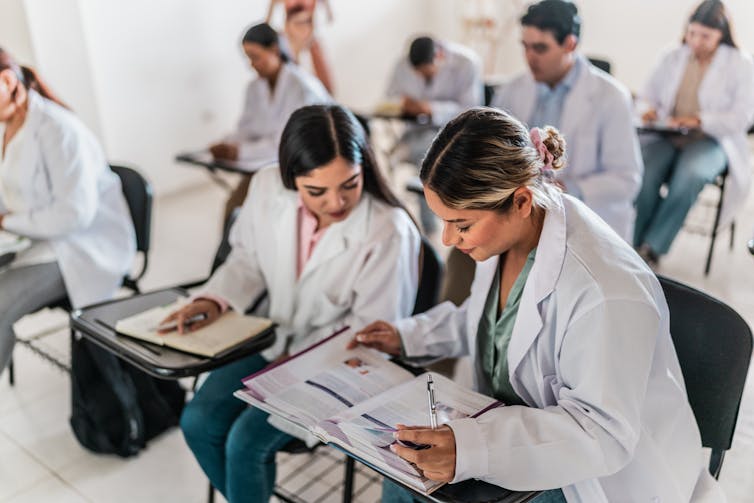
Research shows that medical students and residents often hold false beliefs about biological differences between Black and white patients.
FG Trade Latin/E+ via Getty Images
Studies show that women are more likely to develop chronic pain conditions and report more frequent and severe pain than men. But women are perceived as more emotional and thus less reliable in describing their pain than men. Consequently, female patients who describe the same symptoms as male patients are judged to be in less pain and are less likely to be offered pain relief, even in emergency settings and with female clinicians. Compared to male patients, female patients are more likely to be prescribed psychological care instead of pain medicine.
These lingering erroneous beliefs about gender and race are key reasons patients’ pain is dismissed, misunderstood and ignored. The very real-life consequences for patients include delayed diagnosis, treatment and even death.
Practical steps to disrupt medical gaslighting
Correcting these problems will require a shift in clinical training, so as to challenge biased views about pain in women and racial minorities and to educate clinicians about common pain conditions like vulvodynia. Research suggests that medical training needs to teach students to better listen to patients’ lived experiences and admit when an answer isn’t known.
In the meantime, people navigating the health care system can take practical steps when encountering dismissive care.
They can educate themselves about chronic gynecological pain conditions by reading books like “When Sex Hurts: Understanding and Healing Pelvic Pain” or educational information from trusted sources like the International Society for the Study of Women’s Sexual Health, the International Pelvic Pain Society and the International Society for the Study of Vulvovaginal Disease.
Although these steps do not address the roots of medical gaslighting, they can empower patients to better understand the medical conditions that could cause their symptoms, helping to counteract the effects of gaslighting.
If someone you know has experienced medical gaslighting and would like support, there are resources available.
Organizations like The Endometriosis Association and the National Vulvodynia Association offer support networks and information – like how to find knowledgeable providers. Additionally, connecting with patient advocacy groups like Tight Lipped can provide opportunities for patients to engage in changing the health care system.

Elizabeth Hintz volunteers with Tight Lipped, a non-profit patient advocacy organization by and for people with chronic vulvovaginal and pelvic pain.
Marlene Berke volunteers with Tight Lipped, a non-profit patient advocacy organization by and for people with chronic vulvovaginal and pelvic pain.
—-
Author : Elizabeth Hintz, Assistant Professor of Health Communication, University of Connecticut
Publish date : 2025-05-08 12:34:00
Copyright for syndicated content belongs to the linked Source.