



The OSIRIS-REx sample return capsule contained rock from the asteroid Bennu. NASA/Keegan Barber
China’s Tianwen-2 asteroid sample return mission is set to launch this month, May 2025, en route to the asteroid Kamoʻoalewa (2016 HO3). The country could join the United States and Japan, whose space agencies have both successfully retrieved a sample from an asteroid to study back on Earth.
Several space missions have flown by asteroids before and gotten a peek at their compositions, but bringing a sample back to Earth is even more helpful for scientists. The most informative analyses require having physical samples to poke and prod, shine light at, run through CT scanners and examine under electron microscopes.
These missions require detailed planning and specialized spacecraft, so to shed light on why agencies go through the trouble, we compiled four stories from The Conversation U.S.’s archive. These articles describe the ways asteroid sample return missions generate new scientific insights at every stage – from the collection process, to the container’s return to Earth, to laboratory analyses.
1. Ryugu’s colorful history
The asteroid Ryugu is made of carbon-rich rock. Japan targeted Ryugu for its sample return mission Hayabusa2 in 2020.
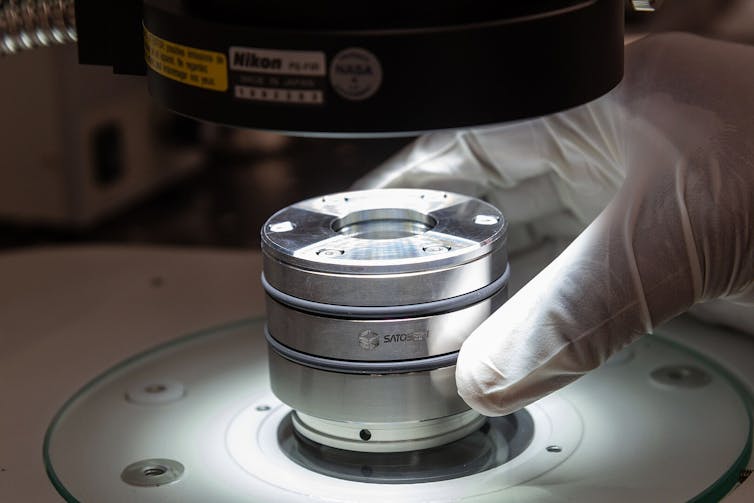
A sealed container that holds a piece of the Ryugu sample from Japan’s Hayabusa2 mission.
NASA/Robert Markowitz
As planetary scientist Paul K. Byrne from Washington University in St. Louis described in his article, the Hayabusa2 team shot the asteroid with a metal projectile and collected the dusty debris that floated into space. This process allowed the Hayabusa2 craft to gather a sample to bring home and also get a close-up look at the asteroid’s surface.
One thing the collection team noticed: The material that flew off the asteroid was redder than the surface they shot at, which had a bluer tinge.
Some parts of Ryugu appear almost striped – the middle latitudes are redder, while the poles look more blue. The sample collection process gave researchers some hints about why that is.
“At some point the asteroid must have been closer to the Sun that it is now,” Byrne wrote. “That would explain the amount of reddening of the surface.”
Read more:
Touching the asteroid Ryugu revealed secrets of its surface and changing orbit
2. Return capsules make shock waves
Similar to how researchers gained valuable data just from the Hayabusa2 collection process, atmospheric scientists didn’t even need to open the OSIRIS-REx sample return capsule to learn something new.
NASA’s OSIRIS-REx mission traveled to the carbon-rich asteroid Bennu and sent home a small capsule containing a sample in September 2023.
Released from the OSIRIS-REx craft, the sample return capsule hurtled down to Earth in a heavy box about the size of a microwave. Aside from the fact that it had been released from a spacecraft about 63,000 miles (102,000 kilometers) away, the return looked strikingly similar to that of a meteorite hitting Earth.
Scientists don’t often have the advance notice needed to study how real meteoroids – the term given to meteorites before they hit the ground – behave when they enter the atmosphere, so they jumped on the opportunity to study the capsule as it returned to Earth.
As physicists Brian Elbing from Oklahoma State University and Elizabeth A. Silber from Sandia National Laboratories discussed in their article, OSIRIS-REx’s reentry was the perfect opportunity to study what happens in the atmosphere when meteoroid-size objects fly through.
The teams set up networks of sensitive microphones and other instruments – both on the ground and attached to balloons – to log the sound wave frequencies that the capsule generated in the atmosphere. Understanding how waves travel through the atmosphere can help scientists figure out how to detect hazards such as natural disasters.
Read more:
NASA’s asteroid sample mission gave scientists around the world the rare opportunity to study an artificial meteor
3. Building blocks of life on Bennu
Once the OSIRIS-REx return capsule was safely back on Earth, researchers across the world – including geologist Timothy J. McCoy from the Smithsonian Institution and planetary scientist Sara Russell from the Natural History Museum in the U.K. – got to work running tests on its contents, while handling the sample carefully to avoid contaminating it.
As they described in their article, McCoy and Russell found the sample was mostly water-rich clay, which they expected from a carbon-rich asteroid. But they also found a surprising amount of salty and brine-related minerals. These minerals form when water evaporates off a rock’s surface.
Because these minerals – aptly called evaporites – dissolve when they come into contact with moisture, scientists had never seen them in the meteorites that fly through Earth’s atmosphere, even ones with similar compositions to Bennu. The spacecraft’s sample container kept the Bennu sample airtight, so these evaporites stayed intact.
These results suggest that the asteroid used to be wet and muddy. And a salty, water-rich environment like Bennu may have once been a great place for organic molecules to form. Some scientists predict that Earth got its ingredients for life from a collision with an asteroid like Bennu.
Read more:
Bennu asteroid reveals its contents to scientists − and clues to how the building blocks of life on Earth may have been seeded
4. Looking ahead: Asteroid mining
Asteroid sample return missions generate lots of scientific insights. They can also help space agencies and companies understand what exactly is out there, available to bring home from asteroids. While carbon-rich asteroids like Bennu and Ryugu aren’t flush with precious metals, other asteroids have more valuable contents.
Launched in 2023 and currently traveling through space, NASA’s Psyche mission will explore a metallic asteroid. The Psyche asteroid likely contains platinum, nickel, iron and possibly gold – all materials of commercial interest.
Scientists can learn about the formation and composition of Earth’s core from metallic asteroids like Psyche, which is the mission’s main goal. But as planetary scientist Valerie Payré from the University of Iowa wrote in her article, “The Psyche mission is a huge step in figuring out what sort of metals are out there.”
For now, commercial asteroid mining operations are science fiction – not to mention legally fraught. But some companies have started considering early-stage plans for how they one day might do it. Asteroid sample missions can lay some early groundwork.
Read more:
NASA’s robotic prospectors are helping scientists understand what asteroids are made of – setting the stage for miners to follow someday
This story is a roundup of articles from The Conversation’s archives.

—-
Author : Mary Magnuson, Associate Science Editor
Publish date : 2025-05-13 12:24:00
Copyright for syndicated content belongs to the linked Source.