



A panorama created from images taken by the rover Curiosity while it was working at a site called 'Rocknest' in 2012. NASA/JPL-Caltech/Malin Space Science Systems
Mars, one of our closest planetary neighbors, has fascinated people for hundreds of years, partly because it is so similar to Earth. It is about the same size, contains similar rocks and minerals, and is not too much farther out from the Sun.
Because Mars and Earth share so many features, scientists have long wondered whether Mars could have once harbored life. Today, Mars is very cold and dry, with little atmosphere and no liquid water on the surface − traits that make it a hostile environment for life. But some observations suggest that ancient Mars may have been warmer, wetter and more favorable for life.
Even though scientists observing the surface of Mars conclude that it was once warmer than it is today, they haven’t been able to find much concrete evidence for what caused it to be warmer. But a study my colleagues and I published in April 2025 indicates the presence of carbonate minerals on the planet, which could help solve this puzzle.
Carbonate minerals contain carbon dioxide, which, when present in the atmosphere, warms a planet. These minerals suggest that carbon dioxide could have previously existed in the atmosphere in larger quantities and provide exciting new clues about ancient Mars’ environment.
As a geochemist and astrobiologist who has studied Mars for more than 15 years, I am fascinated by Mars’ past and the idea that it could have been habitable.
Ancient carbon cycle on past Mars
Observations of Mars from orbiting satellites and rovers show river channels and dry lakes that suggest the Martian surface once had liquid water. And these instruments have spotted minerals on its surface that scientists can analyze to get an idea of what Mars may have been like in the past.
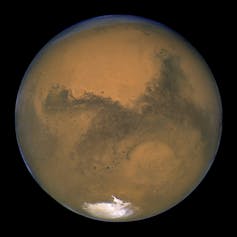
Today, Mars is very cold, with a thin atmosphere and dry climate. But in the ancient past, it may have been warmer and wetter, with a thicker heat-trapping atmosphere.
NASA/J. Bell – Cornell U./M. Wolff – SSI via AP, File
If ancient Mars had liquid water, it would have needed a much warmer climate than it has today. Warmer planets usually have thick atmospheres that trap heat. So, perhaps the Martian atmosphere used to be thicker and composed of heat-trapping carbon dioxide. If Mars did once have a thicker carbon dioxide-containing atmosphere, scientists predict that they’d be able to see traces of that atmospheric carbon dioxide on the surface of Mars today.
Gaseous carbon dioxide dissolves in water, a chemical process that can ultimately contribute to formation of solid minerals at and below the surface of a planet − essentially removing the carbon dioxide from the atmosphere. Lots of scientists have previously tried to find carbonate minerals on the surface of Mars, and part of the excitement about a warmer, wetter early Mars is that it could have been a suitable environment for ancient microbial life.
Finding carbonates on Mars
Previous searches for carbonates on Mars have turned up observations of carbonates in meteorites and at two craters on Mars: Gusev crater and Jezero crater. But there wasn’t enough to explain a warmer past climate on Mars.
For the past few years, the Mars Science Laboratory Curiosity rover has been traversing a region called Gale crater. Here, the rover’s chemistry and mineralogy instrument has discovered lots of the iron-rich carbonate mineral siderite.
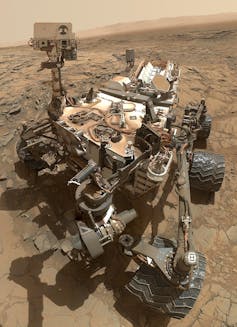
The Curiosity rover has detected carbonates on Mars’ surface.
NASA
As my colleagues and I detail in our new study about these results, this carbonate mineral could contain some of the missing atmospheric carbon dioxide needed for a warmer, wetter early Mars.
The rover also found iron oxyhydroxide minerals that suggest some of these rocks later dissolved when they encountered water, releasing a portion of their carbon dioxide back into the atmosphere. Although it is very thin, the modern Martian atmosphere is still composed mainly of carbon dioxide.
In other words, these new results provide evidence for an ancient carbon cycle on Mars. Carbon cycles are the processes that transfer carbon dioxide between different reservoirs − such as rocks on the surface and gas in the atmosphere.
Potential habitats for past microbial life on Mars
Scientists generally consider an environment habitable for microbial life if it contains liquid water; nutrients such as carbon, hydrogen, nitrogen, oxygen, phosphorus, sulfur and necessary trace elements; an energy source; and conditions that were not too harsh − not too acidic, too salty or too hot, for example.
Since observations from Gale crater and other locations on Mars show that Mars likely had habitable conditions, could Mars then have hosted life? And if it did, how would researchers be able to tell?
Although microorganisms are too small for the human eye to detect, they can leave evidence of themselves preserved in rocks, sediments and soils. Organic molecules from within these microorganisms are sometimes preserved in rocks and sediments. And some microbes can form minerals or have cells that can form certain shapes. This type of evidence for past life is called a biosignature.
Collecting Mars samples
If Mars has biosignatures on or near the surface, researchers want to know that they have the right tools to detect them.
So far, the rovers on Mars have found some organic molecules and chemical signatures that could have come from either abiotic − nonliving − sources or past life.
The Curiosity rover travels across Mars searching for signs that the planet could have once been habitable.
However, determining whether the planet used to host life isn’t easy. Analyses run in Earth’s laboratories could provide more clarity around where these signatures came from.
To that end, the Mars 2020 Perseverance rover has been collecting and sealing samples on Mars, with one cache placed on the surface of Mars and another cache remaining on the rover.
These caches include samples of rock, soil and atmosphere. Their contents can tell researchers about many aspects of the history of Mars, including past volcanic activity, meteorite impacts, streams and lakes, wind and dust storms, and potential past Martian life. If these samples are brought to Earth, scientists could examine them here for signs of ancient life on another planet.

Elisabeth M. Hausrath receives funding from NASA, including from the MSL Curiosity rover Participating Scientist Program and the Mars 2020 Perseverance rover.
—-
Author : Elisabeth M. Hausrath, Professor of Geoscience, University of Nevada, Las Vegas
Publish date : 2025-05-06 12:34:00
Copyright for syndicated content belongs to the linked Source.