



Only a few hundred red wolves still exist, most in captivity. JeffGoulden/E+ via Getty Images
Have you been hearing about the dire wolf lately? Maybe you saw a massive white wolf on the cover of Time magazine or a photo of “Game of Thrones” author George R.R. Martin holding a puppy named after a character from his books.
The dire wolf, a large, wolflike species that went extinct about 12,000 years ago, has been in the news after biotech company Colossal claimed to have resurrected it using cloning and gene-editing technologies. Colossal calls itself a “de-extinction” company. The very concept of de-extinction is a lightning rod for criticism. There are broad accusations of playing God or messing with nature, as well as more focused objections that contemporary de-extinction tools create poor imitations rather than truly resurrected species.
While the biological and philosophical debates are interesting, the legal ramifications for endangered species conservation are of paramount importance. As a legal scholar with a Ph.D. in wildlife genetics, my work focuses on how we legally define the term “endangered species.” The use of biotechnology for conservation, whether for de-extinction or genetic augmentation of existing species, promises solutions to otherwise intractable problems. But it needs to work in harmony with both the letter and purpose of the laws governing biodiversity conservation.
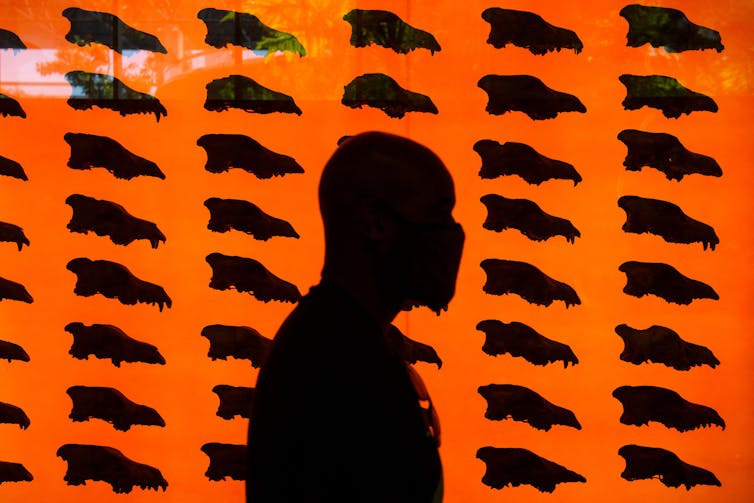
All that’s left of dire wolves today are bones, like these skulls on display in a museum.
Patrick T. Fallon/AFP via Getty Images
Of dire wolves and de-extinction
What did Colossal actually do? Scientists extracted and sequenced DNA from Ice Age-era bones to understand the genetic makeup of the dire wolf. They were able to piece together around 90% of a complete dire wolf genome. While the gray wolf and the dire wolf are separated by a few million years of evolution, they share over 99.5% of their genomes.
The scientists scanned the recovered dire wolf sequences for specific genes that they believed were responsible for the physical and ecological differences between dire wolves and other species of canids, including genes related to body size and coat color. CRISPR gene-editing technology allows scientists to make specific changes in the DNA of an organism. The Colossal team used CRISPR to make 20 changes in 14 different genes in a modern gray wolf cell before implanting the embryo into a surrogate mother.
While the technology on display is marvelous, what should we call the resulting animals? Some commentators argue that the animals are just modified gray wolves. They point out that it would take far more than 20 edits to bridge the gap left by millions of years of evolution. For instance, that 0.5% of the genome that doesn’t match in the two species represents over 12 million base pair differences.
More philosophically, perhaps, other skeptics argue that a species is more than a collection of genes devoid of environmental, ecological or evolutionary context.
Colossal, on the other hand, maintains that it is in the “functional de-extinction” game. The company acknowledges it isn’t making a perfect dire wolf copy. Instead it wants to recreate something that looks and acts like the dire wolf of old. It prefers the “if it looks like a duck, and quacks like a duck, it’s a duck” school of speciation.
Disagreements about taxonomy – the science of naming and categorizing living organisms – are as old as the field itself. Biologists are notorious for failing to adopt a single clear definition of “species,” and there are dozens of competing definitions in the biological literature.
Biologists can afford to be flexible and imprecise when the stakes are merely a conversational misunderstanding. Lawyers and policymakers, on the other hand, do not have that luxury.

President Richard Nixon signed the Endangered Species Act in December 1973.
Associated Press
Deciding what counts as an endangered ‘species’
In the United States, the Endangered Species Act is the main tool for protecting biodiversity.
To be protected by the act, an organism must be a member of an endangered or threatened species. Some of the most contentious ESA issues are definitional, such as whether the listed species is a valid “species” and whether individual organisms, especially hybrids, are members of the listed species.
Colossal’s functional species concept is anathema to the Endangered Species Act. It shrinks the value of a species down to the way it looks or the way it functions. When passing the act, however, Congress made clear that species were to be valued for their “aesthetic, ecological, educational, historical, recreational, and scientific value to the Nation and its people.” In my view, the myopic focus on function seems to miss the point.
Despite its insistence otherwise, Colossal’s definitional sleight of hand has opened the door to arguments that people should reduce conservation funding or protections for currently imperiled species. Why spend the money to protect a critter and its habitat when, according to Interior Secretary Doug Burgum, you can just “pick your favorite species and call up Colossal”?
Putting biotechnology to work for conservation
Biotechnology can provide real conservation benefits for today’s endangered species. I suggest gene editing’s real value is not in recreating facsimiles of long-extinct species like dire wolves, but instead using it to recover ones in trouble now.
Projects, by both Colossal and other groups, are underway around the world to help endangered species develop disease resistance or evolve to tolerate a warmer world. Other projects use gene editing to reintroduce genetic variation into populations where genetic diversity has been lost.
For example, Colossal has also announced that it has cloned a red wolf. Unlike the dire wolf, the red wolf is not extinct, though it came extremely close. After decades of conservation efforts, there are about a dozen red wolves in the wild in the reintroduced population in eastern North Carolina, as well as a few hundred red wolves in captivity.
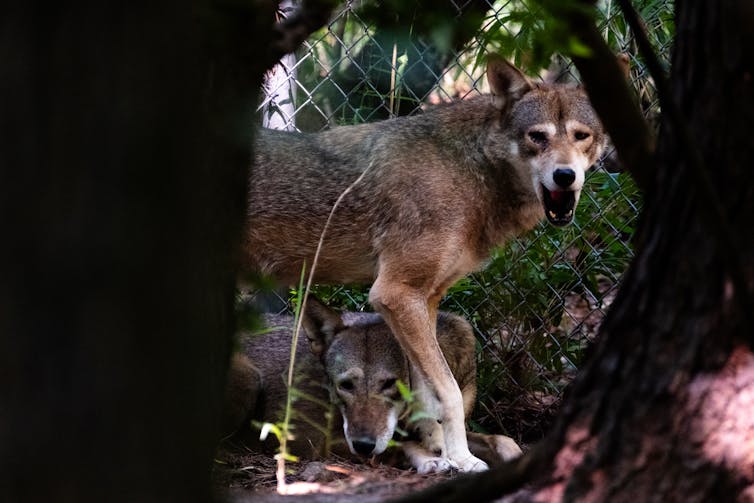
Most of the tiny population of red wolves live in captivity.
Cornell Watson for The Washington Post via Getty Images
The entire population of red wolves, both wild and captive, descends from merely 14 founders of the captive breeding program. This limited heritage means the species has lost a significant amount of the genetic diversity that would help it continue to evolve and adapt.
In order to reintroduce some of that missing genetic diversity, you’d need to find genetic material from red wolves outside the managed population. Right now that would require stored tissue samples from animals that lived before the captive breeding program was established or rediscovering a “lost” population in the wild.
Recently, researchers discovered that coyotes along the Texas Gulf Coast possess a sizable percentage of red wolf-derived DNA in their genomes. Hybridization between coyotes and red wolves is both a threat to red wolves and a natural part of their evolutionary history, complicating management. The red wolf genes found within these coyotes do present a possible source of genetic material that biotechnology could harness to help the captive breeding population if the legal hurdles can be managed.
This coyote population was Colossal’s source for its cloned “ghost” red wolf. Even this announcement is marred by definitional confusion. Due to its hybrid nature, the animal Colossal cloned is likely not legally considered a red wolf at all.
Under the Endangered Species Act, hybrid organisms are typically not protected. So by cloning one of these animals, Colossal likely sidestepped the need for ESA permits. It will almost certainly run into resistance if it attempts to breed these “ghost wolves” into the current red wolf captive breeding program that has spent decades trying to minimize hybridization. How much to value genetic “purity” versus genetic diversity in managed species still proves an extraordinarily difficult question, even without the legal uncertainty.
Biotechnology could never solve every conservation problem – especially habitat destruction. The ability to make “functional” copies of a species certainly does not lessen the urgency to respond to biodiversity loss, nor does it reduce human beings’ moral culpability. But to adequately respond to the ever-worsening biodiversity crisis, conservationists will need all available tools.

Alex Erwin does not work for, consult, own shares in or receive funding from any company or organization that would benefit from this article, and has disclosed no relevant affiliations beyond their academic appointment.
—-
Author : Alex Erwin, Assistant Professor of Law, Florida International University
Publish date : 2025-06-06 12:53:00
Copyright for syndicated content belongs to the linked Source.