


There's a conflict brewing over the rights of the arrested and detained; it's not a new conflict. busra İspir, iStock/Getty Images Plus
The principle of habeas corpus, a legal phrase, is a simple one: Translated from the Latin as “produce the body,” it provides that a judge may compel prosecutors to supply evidence to determine whether someone has been legally detained or arrested.
In the U.S., a detained or arrested individual, or their legal representative, may ask a judge to decide based on the evidence presented whether the detainee has been legally confined. That process is termed “seeking a writ.”
Suspending the privilege of the writ, also known as “suspending the writ,” denies that individual or their representation from making that request or a judge from honoring it. The “privilege” in that phrase is a right of the accused.
In the past few months, members of the Trump administration have raised the issue of the president’s power to suspend the privilege of habeas corpus.
White House Deputy Chief of Staff Stephen Miller in May 2025 shared with the media the news that administration officials were exploring the possibility of suspending the privilege of the writ to help the administration deport immigrants quickly.
Eleven days later, Secretary of Homeland Security Kristi Noem declared at a congressional hearing that habeas corpus “is a constitutional right that the president has to be able to remove people from this country,” a misunderstanding of this foundational legal right immediately challenged by New Hampshire Senator Maggie Hassan.
Article I of the U.S. Constitution declares that “the Privilege of the Writ of Habeas Corpus shall not be suspended, unless when in Cases of Rebellion or Invasion the public Safety may require it.” Suspension is thus a grave and serious matter.
This is not the first time that Americans have debated which branch of government – the executive branch or Congress – has the power to suspend the privilege of the writ and under what circumstances it may do so.
Sen. Maggie Hassan asks Homeland Security Secretary Kristi Noem to define habeas corpus; Noem can’t.
Lincoln and the Great Writ
Habeas corpus became a major point of controversy during the Civil War, when President Abraham Lincoln suspended the privilege of the writ, first in parts of Maryland and later throughout the nation, without seeking prior congressional approval.
While the Constitution provides for the suspension of the writ, the document is silent as to who has the power to exercise this authority. Although most of this section of the Constitution concerns the powers of Congress, it also addresses the power and authority of other branches in specific instances. And the use of the passive voice – “shall not be suspended” – in this section leaves the question of who can suspend the writ open to interpretation.
The questions of who may suspend the privilege of the writ and under what circumstances emerged in the spring of 1861.
On April 12, Confederate forces fired on U.S.-controlled Fort Sumter in Charleston Harbor, South Carolina, an act that is considered the formal start of the war. A week later, Marylanders supporting secession clashed with militia from Massachusetts and Pennsylvania who were making their way through Baltimore to defend Washington.
Lincoln refused to honor requests from Maryland Governor Thomas Hicks and Baltimore Mayor George Brown to avoid transporting reinforcements through Baltimore. The president initially tried to skirt any conflict by routing the reinforcements through Annapolis.
This proved a stopgap measure. On April 27, Lincoln authorized General Winfield Scott, commanding general of the U.S. Army, to suspend the privilege of the writ between Philadelphia and Washington, if necessary. This would permit arbitrary arrests and detaining of people determined to be acting in support of the insurrection.
Taney challenges Lincoln
To protect national security, U.S. military authorities arrested John Merryman on May 25, 1861. Merryman, who was from Baltimore, was suspected of involvement in destroying railroad bridges to obstruct Union troop movements.
Chief Justice Roger B. Taney honored a request from Merryman’s lawyers to issue a writ of habeas corpus, only to have federal military authorities refuse to produce Merryman, who remained at his cell in Fort McHenry.
Taney then ruled that neither Lincoln nor military personnel under his command could suspend the privilege of the writ when it came to civilians such as Merryman.
“If at any time the public safety should require the suspension of the powers vested by this act in the courts of the United States, it is for the Legislature to say so,” wrote Taney, quoting an 1807 opinion by Chief Justice John Marshall.
Days later, on June 1, Taney offered a more extended decision reflecting his reasoning that Congress, not the president, could suspend the privilege of the writ.
Taney was challenging the president’s authority to act unilaterally.
Lincoln ignored Taney’s ruling. He reasoned that in time of emergency, especially with Congress not in session, he – as president – was compelled to act in the interests of national security. He did so to protect the movement of troops through Maryland to defend the national capital.
Not only did Lincoln’s order remain in place, but the president later expanded its geographic scope in several instances, most notably in September 1862. On the heels of issuing the preliminary Emancipation Proclamation, Lincoln authorized the detention of individuals accused of obstructing efforts to raise troops or who sought to support the rebellion.
Unwilling to concede that Lincoln’s actions need not seek congressional approval, Congress, first in 1861, then through the Habeas Corpus Act of 1863 offered retroactive sanction of the actions of the executive branch and, in 1863, empowered Lincoln to suspend the privilege of the writ in the future in the interests of national security for the duration of the rebellion.
Democrats, however, criticized Lincoln’s actions as arbitrary, unconstitutional and smacking of tyranny.
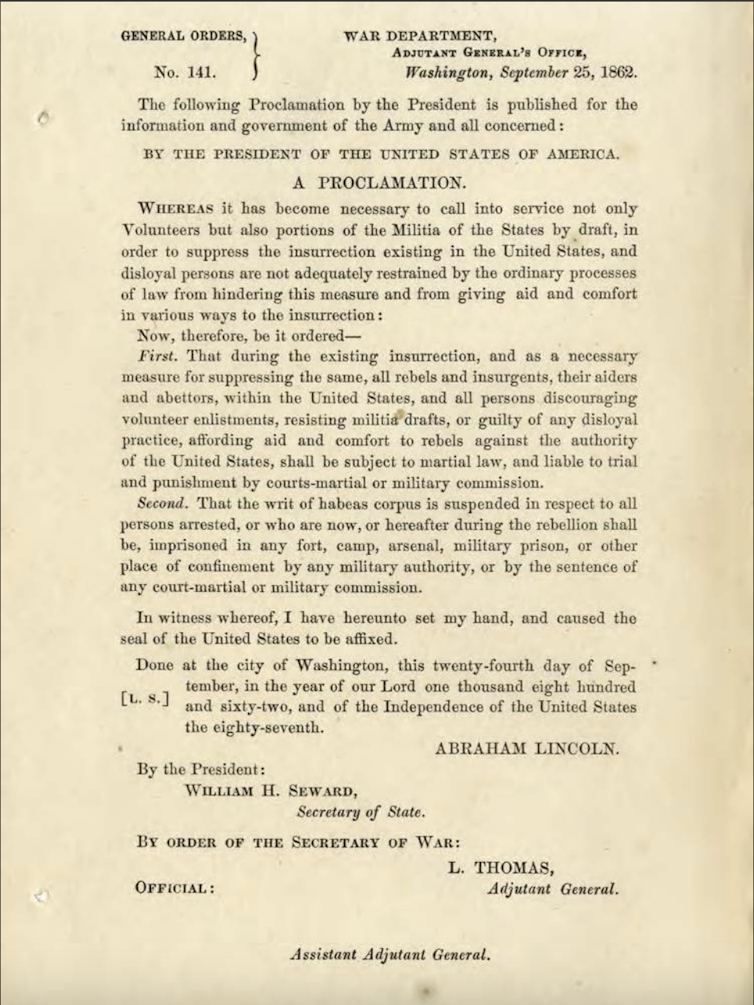
President Abraham Lincoln’s 1862 proclamation suspending the use of habeas corpus.
Mississippi State University
Executive overreach?
Almost a decade later, in 1871, President Ulysses S. Grant declined to act on his own to suspend the privilege of the writ to prosecute white supremacist terrorists in the Reconstruction South, requiring that Congress first pass legislation authorizing him to do so.
Since the Civil War, only once has a president unilaterally suspended the privilege of the writ without prior congressional authorization. That’s what President Franklin D. Roosevelt did in Hawaii after the attack on Pearl Harbor in 1941, in order to combat any suspicious activity that might be construed as espionage.
With Congress currently in session, lawmakers could authorize the president to suspend the privilege of the writ to set aside debates over executive overreach. Otherwise, presidents might define as emergencies situations that do not meet the extreme circumstances envisioned by the Constitution while sidestepping congressional approval.

Brooks D. Simpson does not work for, consult, own shares in or receive funding from any company or organization that would benefit from this article, and has disclosed no relevant affiliations beyond their academic appointment.
—-
Author : Brooks D. Simpson, Foundation Professor of History, Arizona State University
Publish date : 2025-06-06 12:53:00
Copyright for syndicated content belongs to the linked Source.