



The NASA challenge NEOWISE, which has given astronomers an in depth view of near-Earth items – a few of which might strike the Earth – ended its project and burned on reentering the ambience after over a decade.
On a transparent evening, the sky is filled with brilliant items – from stars, massive planets and galaxies to tiny asteroids flying close to Earth. Those asteroids are often referred to as near-Earth items, they usually are available all kinds of sizes. Some are tens of kilometers throughout or greater, whilst others are best tens of meters or smaller.
From time to time, near-Earth items spoil into Earth at a top velocity – more or less 10 miles according to 2nd (16 kilometers according to 2nd) or sooner. That’s about 15 occasions as rapid as a rifle’s muzzle velocity. An have an effect on at that velocity can simply harm the planet’s floor and anything else on it.
Affects from massive near-Earth items are usually uncommon over a normal human lifetime. However they’re extra widespread on a geological timescale of thousands and thousands to billions of years. The most efficient instance could also be a 6-mile-wide (10-kilometer-wide) asteroid that crashed into Earth, killed the dinosaurs and created Chicxulub crater about 65 million years in the past.
Smaller affects are quite common on Earth, as there are extra small near-Earth items. A global group effort known as planetary protection protects people from those house intruders by means of cataloging and tracking as many near-Earth items as conceivable, together with the ones carefully coming near Earth. Researchers name the near-Earth items that might collide with the outside doubtlessly hazardous items.
NASA started its NEOWISE project in December 2013. This project’s number one center of attention was once to make use of the distance telescope from the Vast-field Infrared Survey Explorer to carefully stumble on and signify near-Earth items equivalent to asteroids and comets.
NEOWISE contributed to planetary protection efforts with its analysis to catalog near-Earth items. During the last decade, it helped planetary defenders like us and our colleagues learn about near-Earth items.
NASA’s NEOWISE project, the spacecraft for which is proven right here, surveyed for near-Earth items.
NASA/JPL-Caltech
Detecting near-Earth items
NEOWISE was once a game-changing project, because it revolutionized the right way to survey near-Earth items.
The NEOWISE project endured to make use of the spacecraft from NASA’s WISE project, which ran from overdue 2009 to 2011 and carried out an all-sky infrared survey to stumble on no longer best near-Earth items but in addition far-off items equivalent to galaxies.
The spacecraft orbited Earth from north to south, passing over the poles, and it was once in a Solar-synchronous orbit, the place it will see the Solar in the similar course over the years. This place allowed it to scan all the sky successfully.
The spacecraft may just survey astronomical and planetary items by means of detecting the signatures they emitted within the mid-infrared vary.
People’ eyes can sense visual mild, which is electromagnetic radiation between 400 and 700 nanometers. After we have a look at stars within the sky with the bare eye, we see their visual mild elements.
Then again, mid-infrared mild incorporates waves between 3 and 30 micrometers and is invisible to human eyes.
When heated, an object shops that warmth as thermal power. Except the thing is thermally insulated, it releases that power ceaselessly as electromagnetic power, within the mid-infrared vary.
This procedure, referred to as thermal emission, occurs to near-Earth items after the Solar heats them up. The smaller an asteroid, the fainter its thermal emission. The NEOWISE spacecraft may just sense thermal emissions from near-Earth items at a top degree of sensitivity – that means it will stumble on small asteroids.
However asteroids aren’t the one items that emit warmth. The spacecraft’s sensors may just pick out up warmth emissions from different resources too – together with the spacecraft itself.
To ensure warmth from the spacecraft wasn’t hindering the hunt, the WISE/NEOWISE spacecraft was once designed in order that it will actively cool itself the use of then-state-of-the-art forged hydrogen cryogenic cooling techniques.
Operation levels
Because the spacecraft’s apparatus had to be very delicate to stumble on far off items for WISE, it used forged hydrogen, which is very chilly, to chill itself down and keep away from any noise that might mess with the tools’ sensitivity. In the end the coolant ran out, however no longer till WISE had effectively finished its science objectives.
All the way through the cryogenic section when it was once actively cooling itself, the spacecraft operated at a temperature of about -447 levels Fahrenheit (-266 levels Celsius), moderately upper than the universe’s temperature, which is set -454 levels Fahrenheit (-270 levels Celsius).
The cryogenic section lasted from 2009 to 2011, till the spacecraft went into hibernation in 2011.
All the way through this reactivation section, the detectors didn’t wish to be reasonably as delicate, nor the spacecraft saved as chilly because it was once right through the cryogenic cooling section, since near-Earth items are nearer than WISE’s far off objectives.
The outcome of dropping the energetic cooling was once that two long-wave detectors out of the 4 on board was so sizzling that they may now not serve as, restricting the craft’s capacity.
However, NEOWISE used its two operational detectors to ceaselessly observe each up to now and newly detected near-Earth items intimately.
NEOWISE’s legacy
As of February 2024, NEOWISE had taken greater than 1.5 million infrared measurements of about 44,000 other items within the sun gadget. Those integrated about 1,600 discoveries of near-Earth items. NEOWISE additionally supplied detailed measurement estimates for greater than 1,800 near-Earth items.
In spite of the project’s contributions to science and planetary protection, it was once decommissioned in August 2024. The spacecraft in the end began to fall towards Earth’s floor, till it reentered Earth’s surroundings and burned up on Nov. 1, 2024.
NEOWISE’s contributions to looking near-Earth items gave scientists a lot deeper insights into the asteroids round Earth. It additionally gave scientists a greater concept of what demanding situations they’ll wish to conquer to stumble on faint items.
So, did NEOWISE to find all of the near-Earth items? The solution is not any. Maximum scientists nonetheless imagine that there are way more near-Earth items in the market that also wish to be recognized, in particular smaller ones.
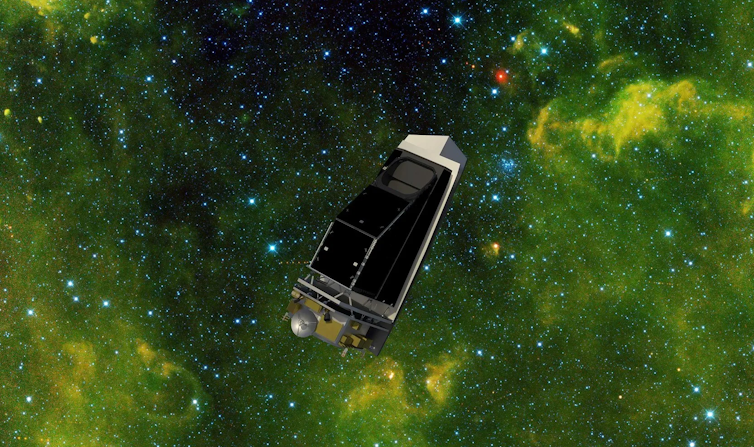
An indication of NEO Surveyor, which is able to proceed to stumble on and catalog near-Earth items as soon as it’s introduced into house.
NASA/JPL-Caltech/College of Arizona
To hold on NEOWISE’s legacy, NASA is making plans a project known as NEO Surveyor. NEO Surveyor shall be a next-generation house telescope that may learn about small near-Earth asteroids in additional element, principally to give a contribution to NASA’s planetary protection efforts. It’ll determine masses of hundreds of near-Earth items which are as small as about 33 toes (10 meters) throughout. The spacecraft’s release is scheduled for 2027.